Households that use milk throughout the week
If you also use milk in coffees, at breakfast and in recipes, a multipack of cartons can be a handy way to stock up for regular use.


A 6–8 L pack of UHT milk is a good choice if you’ll also use it in drinks and recipes over the following days, rather than just for a date night. If you only need milk occasionally for two, 50 cl cartons mean you can open a smaller amount at a time. In either case, check the storage instructions after opening on the product you choose.
If you also use milk in coffees, at breakfast and in recipes, a multipack of cartons can be a handy way to stock up for regular use.
For a sauce, dessert or biscuits when you don’t use much milk day to day, 50 cl cartons let you open an amount that’s closer to what you need straight away.
As well as the pack size, they check the ingredients, the milk allergen and any claims specific to the product, such as its declared origin or production method.
For a date night, start with how much milk you’ll need for the meal, then factor in how you’ll use it over the following days. The size of each carton matters just as much as the total amount in the pack.
| What to consider | What to check | Who is it for? |
|---|---|---|
| Amount you’re stocking up on | Compare the number of cartons and their size: pack sizes available include 6 × 1 L, 8 × 1 L and 4 × 1.5 L. | If I’m also planning to use milk in drinks and cooking throughout the week, having several litres matters more than keeping each portion small. Around 40% of consumers would make stocking up their priority. |
| Amount opened at a time | Consider 50 cl cartons for smaller needs, and check the storage life after opening on the packaging. | For the occasional recipe for two, I’d rather not open a large carton that might be left in the fridge. Around 40% of consumers would put portion control first. |
| Product information | Check the ingredients and milk allergen, then look for origin, organic or supply-chain information if these matter to you. | If I need to check the ingredients or want milk with a declared origin, the pack size alone isn’t enough to make a decision. Around 20% of consumers would put this information first. |
A large pack won’t reduce the amount left in an opened carton. It’s best suited to situations where you’ll use several cartons after the meal.
Allow for the drinks and recipes you have planned over the following days. If you only need milk once, compare this with a 50 cl or 1 L carton.
Instructions vary by product: Lactel says its Bio UHT milk keeps for 3 days, Candia says 4 days for GrandLait, and Auchan says 5 days for its 8 × 1 L UHT pack, provided you follow their refrigeration instructions.
Follow the storage time and temperature on the product you buy. Writing the opening date on the carton can help you keep track.
These claims don’t change the fact that semi-skimmed milk contains milk.
If someone at the table needs to avoid this ingredient, check the label on the exact product rather than relying on its other claims.
Lactel offers Bio UHT semi-skimmed milk in 1 L cartons; Carrefour also sells a Filière Lactel version in a pack of 6 × 1 L.
Candia sells GrandLait semi-skimmed milk in several pack sizes, including 6 × 1 L, 4 × 1.5 L and 6 × 50 cl.
Carrefour sells French UHT-sterilised semi-skimmed milk in a pack of 6 × 1 L cartons.
Auchan sells UHT semi-skimmed milk in packs of 6 × 1 L and 8 × 1 L.
E.Leclerc sells Eco+ semi-skimmed milk in 6 × 1 L packs, as well as a Delisse version in 6 × 50 cl cartons.
This 50 cl per-carton option is suited to meals and recipes that only need a little milk at a time, rather than stocking up on 1 L cartons.
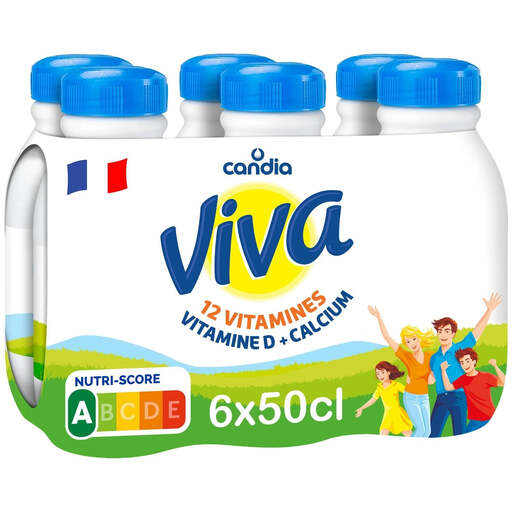 Image unavailable
If your recipe only needs a little milk at a time, this pack lets you open a 50 cl carton. The six cartons add up to 3 L in total, so consider what else you’ll use it for before choosing this pack size.
Not if the label says it can be stored at room temperature before opening, as is the case with Lactel Bio UHT milk and Auchan’s 8 × 1 L UHT pack. After opening, follow the instructions for the product you’ve bought.
Follow the time stated on the carton: Lactel says 3 days for its Bio UHT milk, Candia says 4 days for GrandLait, and Auchan says 5 days for its 8 × 1 L UHT product. These instructions apply to those specific products and assume you follow their refrigeration guidance.
It’s best suited to situations where you’ll also use the milk after dinner. For a one-off recipe, compare the amount you need with a 50 cl or 1 L carton before buying several litres.
Check the ingredients and allergen information on the exact packaging: semi-skimmed milk contains milk, whatever claims are made about its origin, organic status or supply chain. If milk needs to be left out of the meal, don’t treat these claims as an indication that it’s suitable for someone avoiding milk.