
Livraison le jour même ou le lendemain

Qualité garantie

Débloquez vos offres de bienvenue: Livraison GRATUITE | Jusqu'à -80 % | 30 jours d'essai gratuits à JoyPlus
Téléchargez l'application
Shooting a stable video, taking a group photo where no one gets cut off, or filming a vlog without your arm taking over the screen—who hasn't faced these everyday challenges? The selfie stick tripod has become the essential accessory to solve them. But with a crowded market full of options with varying features, it can be tough to know where to start.
This guide is here to help you make an informed decision by breaking down the key criteria and showcasing our selection of the best models, whether you're an on-the-go vlogger or a demanding content creator.
Before you dive in, take a moment to define your needs by considering a few key technical criteria.
Far from being just a simple stick, a good accessory today combines several functions:
A good portable travel tripod should be lightweight and compact. However, be careful not to sacrifice stability for the sake of lightness. Check the materials (ABS, fibreglass, aluminium) and the total weight. A heavier tripod will generally be more stable, especially when fully extended, but less convenient to carry. It's all about finding the right balance.
Most models include a detachable selfie stick with a Bluetooth remote. Check its range (usually around ten metres) and battery life. For recent iPhone owners, a MagSafe tripod for iPhone offers unparalleled convenience: the magnetic attachment is fast, secure, and requires no clamp, thus avoiding accidental presses on the phone's side buttons.
Here is our selection of models that stand out from the crowd, each catering to specific needs.
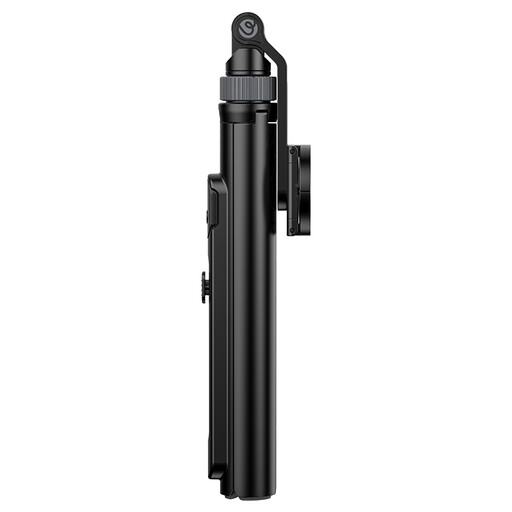
Its Key Feature
The Ulanzi TT88 is all about versatility. Its secret weapon? An articulating arm that flips horizontally for overhead mode, perfect for top-down shots. Its dual MagSafe and clamp compatibility makes it universally adaptable.
Pros
Who is it for?
Content creators, vloggers, and tutorial enthusiasts looking for a versatile tool that can handle any shot, including top-down views. iPhone owners will love the simplicity of MagSafe.
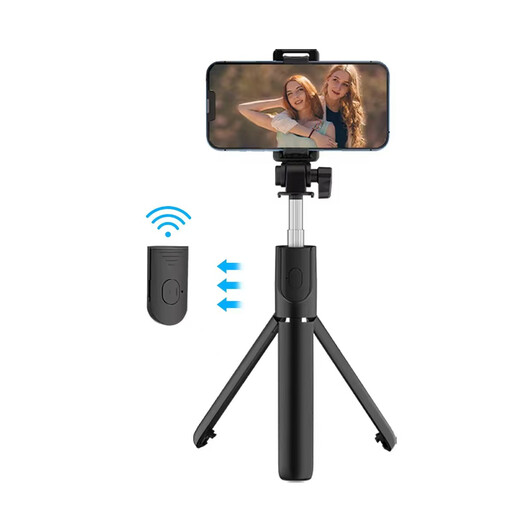
Its Main Asset
The Verbex K50 plays in the big leagues with its impressive extension height. Capable of reaching nearly 2 m, it transforms into a true floor-standing tripod, offering shooting angles that are out of reach for more compact models.
Pros
Who is it for?
Those who need maximum height for their projects: event organisers, real estate agents for interior shots, or streamers looking for a versatile floor stand without investing in a heavy-duty photo tripod.
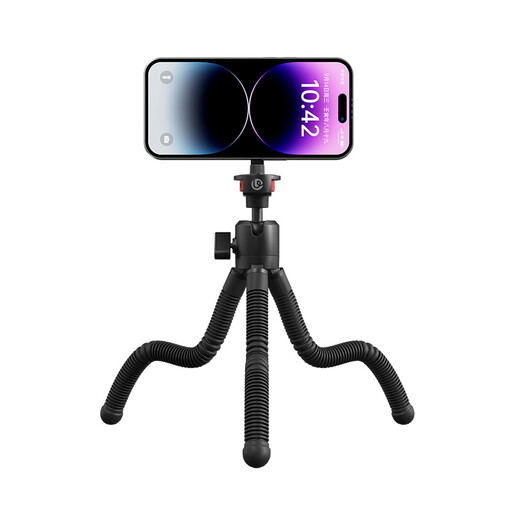
What Makes It Special
Forget the classic selfie stick tripod: the Ulanzi MT-30 is an "octopus" mini-tripod that makes adaptability its superpower. Its flexible legs can wrap around anything, while its magnetic feet stick it to metal surfaces.
Pros
Who is it for?
Travellers, hikers, and creators who love to experiment with original camera angles. It's the ideal tool for those who need to mount their phone quickly and securely in changing environments.
Our selection highlights models with distinct strengths. If you don't find what you're looking for here or simply want to explore other options, feel free to browse our full catalogue.
Discover our full range of Cameras & Equipment
1. Is a selfie stick tripod compatible with all smartphones?
Yes, the vast majority of models are equipped with an adjustable clamp that fits almost every smartphone on the market. However, you should always check the maximum supported width. Models like the Ulanzi TT88 or MT-30 go a step further by offering MagSafe compatibility, a real treat for owners of recent iPhones (12 series and later), which greatly simplifies mounting.
2. Does the Bluetooth remote work with apps like Instagram or TikTok?
Absolutely. The Bluetooth remote is recognised by your smartphone as a simple volume button. Most photo/video apps, including the native cameras in Instagram and TikTok, use the volume button to snap a photo or start a recording. So, compatibility is virtually guaranteed.
3. What's the difference between a selfie stick tripod and a stabiliser (gimbal)?
The difference is fundamental. A selfie stick tripod provides static stability: it keeps the phone perfectly still once set up. It's ideal for fixed shots, group photos, or time-lapses. In contrast, a vlogging stabiliser, also known as a gimbal, is a motorised device that actively compensates for your movements (walking, shaking) to produce perfectly smooth videos. The first is for stillness, the second is for motion.