
Livraison le jour même ou le lendemain

Qualité garantie

Débloquez vos offres de bienvenue: Livraison GRATUITE | Jusqu'à -80 % | 30 jours d'essai gratuits à JoyPlus
Téléchargez l'application
A self-cleaning cat litter tray can save you from daily scooping, but not all models are created equal. Between promises of reduced maintenance, connected apps and odour-control systems, certain details make all the difference after a few weeks of use.
Before buying an automatic cat litter tray, check that it is suitable for your cat, the actual capacity of the waste drawer and the cleaning requirements. Here are the main criteria to examine to avoid any unpleasant surprises.
A spacious drum does not guarantee that the waste drawer will stay empty for a long time. How long it lasts depends on the number of cats, their weight, how often they use it and the volume of clumps.
In a multi-cat household, choose a large-capacity cat litter tray with a drawer of at least 7 to 13 litres. Manufacturers’ figures are generally calculated for a single cat under very specific conditions.
Most machines work with clumping litter made from bentonite, tofu or certain blends. Crystal and non-clumping litters, on the other hand, can block the mechanism or prevent waste from being separated correctly.
The PETKIT PUROBOT CRYSTAL DUO is an exception: it works exclusively with disposable trays and PETKIT Crystal litter. This restriction should be factored into the running costs, as well as your usual shopping habits.
Weight, infrared, radar and anti-pinch sensors play an essential role, but they do not remove the need for correct installation. An uneven floor, an overly soft mat or a poorly assembled machine can distort the readings.
The same applies to an odour-control cat litter tray: you need to empty the drawer regularly, replace filters or deodorisers and clean the machine. Manufacturers’ stated performance should be viewed as an indication based on their testing protocol, not as a guarantee that applies to every home.
For a large cat, measure the available space inside the drum, as well as the width and height of the entrance. A compact machine will be easier to install in a flat, while a model with a capacity of 70 to 106 litres will provide more interior space.
A low entrance can make access easier for older cats, short-legged cats or those that are not comfortable with steps. However, check the minimum weight supported by the sensors: some models are not suitable for kittens under 6 months old or weighing less than 1.5 to 2 kg.
A safe cat litter tray should stop or prevent the cycle as soon as a cat is detected. Systems may combine infrared sensors, weight sensors, radar, motor overload protection and anti-pinch devices.
When installing the machine for the first time, leave it in manual mode or temporarily disable automatic cleaning for two or three days. This will give your cat time to get used to the tray’s shape, noise and movements.
A connected automatic cat litter tray may offer remote control, alerts when the drawer is full, a usage history and weight monitoring. Check Wi-Fi compatibility before buying: several devices work only on the 2.4 GHz band, rather than the 5 GHz network.
Health monitoring should be viewed as a record of frequency, duration, weight or observed behaviour. It is not a substitute for a medical diagnosis. If your cat’s habits change unusually, seek advice from a vet.
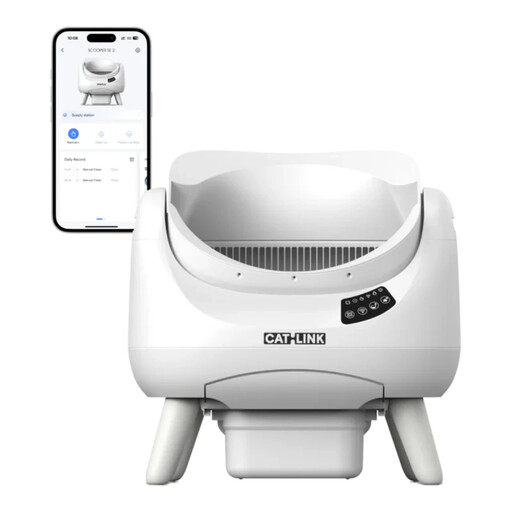
Why this choice suits this profile: Its open design makes it easier for cats to get used to, while its 12 L waste container reduces the need for frequent emptying. It is ideal for anyone looking to try a self-cleaning litter tray without unnecessary extra features.
The product details specify use with clumping litter and a cat weighing between 1.5 and 10 kg : limits that must be checked carefully before ordering.
Sealed 12 L container, individual identification and usage tracking for multiple cats.
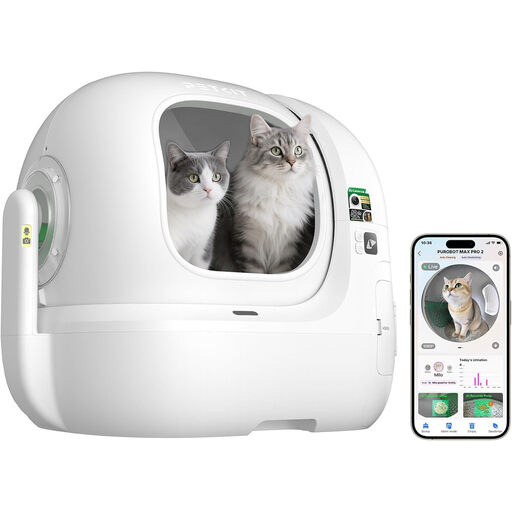
Why this choice suits this profile: This model is designed for users who want to manage cleaning, notifications and usage tracking from a single app.
The 267 mm entrance and 76 L interior are suitable for large cats, while the connection is specified as 2.4 GHz.
Adjustable camera, safety sensors, 8 L waste tray and stated operating noise of 35 dB.
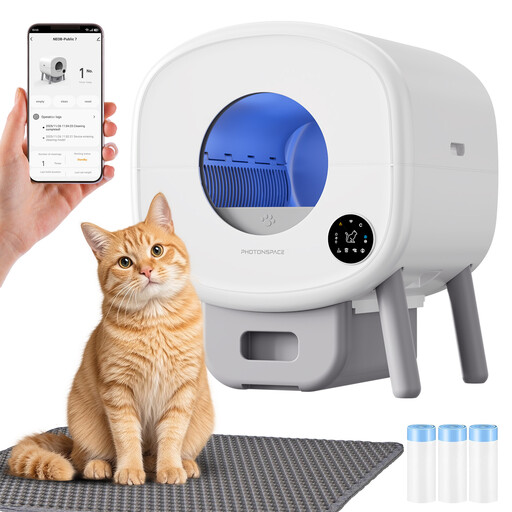
Why this choice suits this profile: Its 95 L interior and 15 L drawer are designed for multi-cat households or anyone who wants to empty the tray less frequently.
The product details specify that the machine must be installed on a hard, level floor and used only with clumping litter : these conditions are essential for the sensors to work correctly.
95 L capacity, 15 L waste drawer, 2.4 GHz Wi-Fi app and weight and proximity sensors.
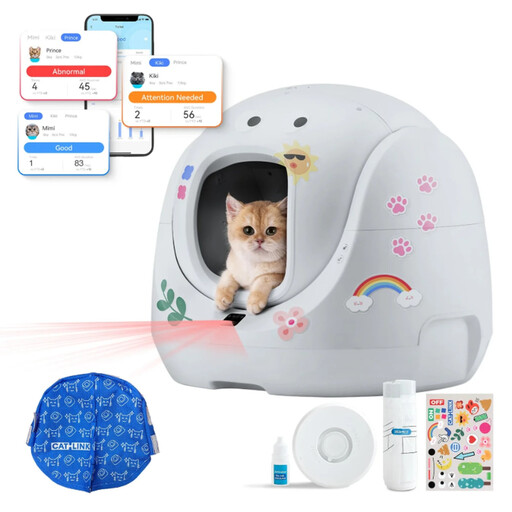
Why this choice suits this profile: Its 70 L capacity, four cleaning modes and multi-cat recognition are designed for intensive everyday use.
The product details set out the weight limits, 2.4 GHz Wi-Fi compatibility and litter replacement intervals according to the number of cats.
Eight-level protection system, low entrance, compatibility with bentonite, tofu and clumping blend litters.
We have put together a comprehensive, real-time updated list of products that meet these strict selection criteria and European safety regulations.
Install it on a stable, level, non-slip floor near a power socket. Add only the recommended litter, connect the app if necessary, then let your cat explore the machine without running an automatic cycle for a few days. Clean the sensors and regularly check that nothing is blocking the mechanism.
This depends on how often it is used, the quality of maintenance and the condition of the moving parts. Empty the drawer before it overflows, clean removable components with a mild product and never immerse the electronic base in water. Filters or deodorisers may also need to be replaced periodically.
The budget includes clumping litter, bags, filters or deodorisers and, for some models, proprietary consumables. Before choosing, compare the drawer capacity, compatibility with your usual litter and the price of refills. An advertised capacity for one cat cannot be applied directly to a household with several cats.