
Livraison le jour même ou le lendemain

Qualité garantie

Débloquez vos offres de bienvenue: Livraison GRATUITE | Jusqu'à -80 % | 30 jours d'essai gratuits à JoyPlus
Téléchargez l'application
A visible gap between two floor coverings can quickly make a room look unfinished. It can also trap dust, catch on socks or create a slight difference in level between laminate flooring, tiles, carpet or vinyl flooring. A self-adhesive floor threshold strip offers a simple way to conceal this join without taking on major building work.
However, not every model is suitable for every layout. Before buying, check the width of the join, the type of surface and the level of durability required. Here are the main criteria to consider to avoid choosing an unsuitable product.
A self-adhesive joining strip that is too narrow may leave the edges of the floor coverings visible. Measure the distance to be covered at several points: a join is not always perfectly even. A width of 4 cm is suitable for many domestic applications, but it will not replace a wider profile if the gap to be concealed is substantial.
The words ‘strong adhesive’ do not guarantee a secure hold on every surface. Dust, grease, moisture, an uneven floor or old wax residue can reduce adhesion. A self-adhesive transition strip will hold best on a clean, dry, smooth and stable surface.
On a porous, crumbly or heavily textured surface, test it on a small area first. In a bathroom or near a shower, also check that the intended use stated in the product specifications matches the actual level of exposure to moisture.
A wood-effect floor moulding can create a harmonious transition. However, a shade that is too different from the flooring or furniture may draw attention to the join. Compare the colour with samples of the floor, skirting boards and doors. A cherry, brown, grey or black finish will not create the same visual effect.
PVC is commonly used for a floor joint cover thanks to its flexibility, easy maintenance and everyday resistance to scratches, stains and abrasion. A degree of flexibility makes it easier to accommodate minor irregularities, but it cannot compensate for a significant difference in level.
For a join between parquet and tiles, check that the profile properly covers both edges without being positioned on an area that may move. For a transition between tiles and carpet, also make sure that the fibres will not lift the adhesive strip.
The models featured here are available in particular in the following sizes:
A profile for laminate flooring should be long enough to minimise visible joins. Allow a few extra centimetres for cutting and measure the total length before placing your order.
These models can be fitted without additional glue or screws, thanks to their integrated self-adhesive backing. The method is very simple:
If the strip is slightly bent after transportation, applying a moderate amount of heat with a hairdryer may help it return to its original shape. Take care not to overheat the PVC or the flooring.
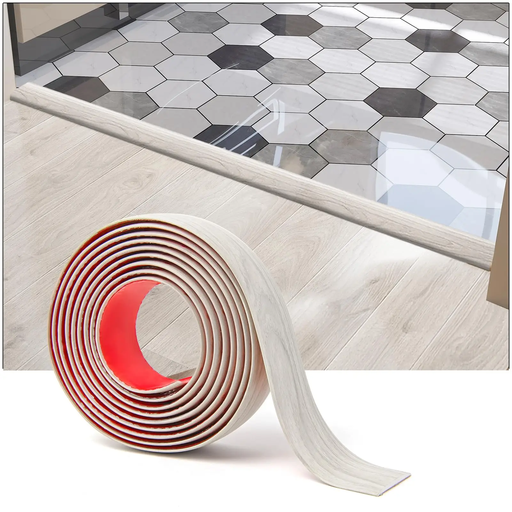
Why this product suits this profile : At 300 cm long, this model is suitable for hallways, living rooms or areas where a single strip needs to cover a long distance. Fitting it simply involves peeling off the backing and sticking it down, making it accessible to DIY beginners.
Its long format limits the number of visible joins. Its 4 cm width covers a typical join, provided you have measured the gap beforehand.
Flexible PVC, whitewashed finish, can be cut to size and easy to clean with a simple wipe.
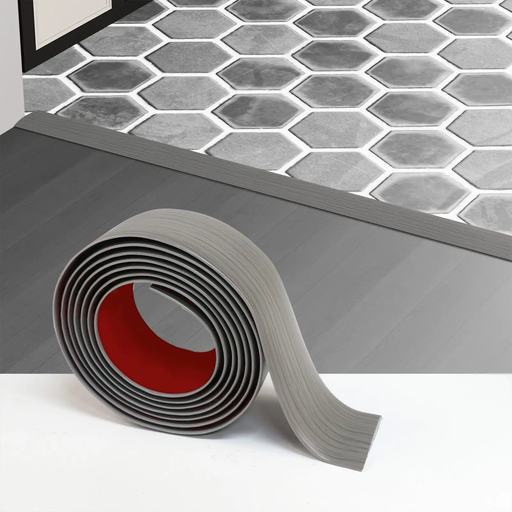
Why this product suits this profile : Its short format makes it easier to achieve a precise fit in an entrance hall, bedroom or in front of a door. Its grey wood-effect pattern can complement light parquet, a mineral-effect floor or contemporary décor.
Its one-metre length means you do not need to buy a large quantity when the join is limited. Checking the shade also helps avoid an overly strong decorative contrast.
PVC advertised as resistant to scratches and stains, grey wood-effect finish, can be cut with scissors and easy self-adhesive fitting.
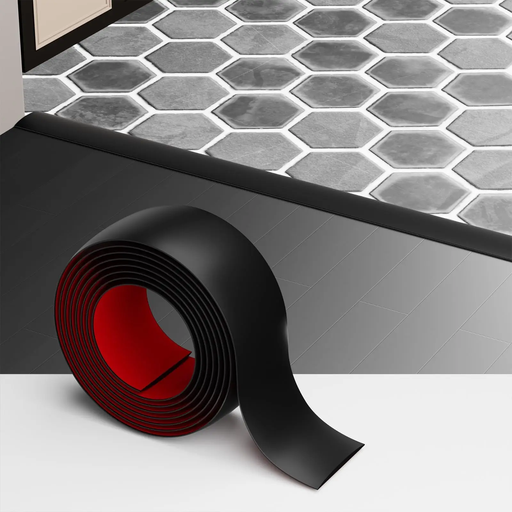
Why this product suits this profile : At 300 cm long, this model is suitable for busy areas such as a hallway, kitchen or a join between several rooms. Its black colour can also create a clear visual separation.
Its continuous coverage reduces the number of joins that could start to lift. It is still essential to check its suitability for humid conditions and to fit the strip on a perfectly degreased surface.
PVC measuring 0,3 cm thick, advertised resistance to scratches, stains and moisture, pressure fitting after cutting to size.
We have put together a comprehensive, real-time updated list of products that meet these strict selection criteria and European safety regulations.
Long-term performance depends above all on the environment and how well the surface has been prepared. In a dry residential room, clean the profile regularly with a slightly damp cloth and avoid abrasive products. Do not pour water directly over it.
On underfloor heating, in an area exposed to strong sunlight or in a place subject to heavy foot traffic, inspect the ends regularly. If an edge starts to come away, deal with it promptly rather than allowing dust to work its way underneath the strip.
A self-adhesive floor threshold strip is designed to conceal a join or a small difference in level. It should not be used to compensate for a significant step, an unstable floor or a poorly secured covering. In this type of situation, a mechanical profile or remedial work on the surface will often be more suitable.
The tiles must be perfectly clean and dry, with no traces of grease or cleaning-product residue. Position the profile without removing the protective film, check that it is centred, then stick it down gradually while applying even pressure. Deep grout lines or heavily textured tiles may reduce the available adhesive surface.
Measure the actual gap, then add enough allowance for each side to rest on a stable surface. The 4 cm models are suitable for many common joins, but a wider gap cover will be needed if the joint exceeds this measurement.
Some models are designed for rooms such as bathrooms, but their performance depends on exposure to water, ventilation and the condition of the surface. For an area that gets wet directly, check the manufacturer’s instructions and avoid immersion or standing water. The surface must remain clean and dry when the strip is fitted.