
Livraison le jour même ou le lendemain

Qualité garantie

Débloquez vos offres de bienvenue: Livraison GRATUITE | Jusqu'à -80 % | 30 jours d'essai gratuits à JoyPlus
Téléchargez l'application
A gap forms between laminate flooring and tiles, carpet stops a few millimetres too soon, or two floor coverings are not at the same height. A self-adhesive floor threshold strip conceals this join without the need for major work. However, you need to choose a model suited to the width of the gap, how often the area is used and the conditions in the room.
A wood finish blends easily into a living room or bedroom, but appearance is not everything. A shade that is too different from your existing floor coverings may actually draw attention to the join. Compare the colour with the flooring, skirting boards and furniture, and do not forget to consider the effect of natural light.
A strip that is too narrow will leave the gap visible. Conversely, a profile that is too wide will overlap both floor coverings and may look bulky. Measure the width to be covered in several places: a gap is not necessarily perfectly even along its entire length.
The difference in levels must also be taken into account. A flat self-adhesive floor joiner is mainly suitable when both surfaces are almost at the same height. If there is a more significant difference, opt for a transition profile with a compensating shape.
A self-adhesive threshold strip adheres properly to a clean, dry, grease-free and sufficiently smooth surface. Dust, moisture, residual wax or a very porous floor can quickly compromise its hold. In a bathroom or near a water source, make sure the area will be completely dry when you install it and that the product is suitable for this environment.
Flexible PVC is a practical solution for a floor transition profile. It can follow minor irregularities, cleans with a damp cloth and can generally be cut with scissors. Good resistance to scratches, stains and abrasion is useful in high-traffic areas, but it does not eliminate the need to clean the profile with non-abrasive products.
A PVC floor joint cover is suitable for residential spaces and some moderate professional uses. For an area exposed to heavy loads, repeated impacts or the movement of heavy furniture, carefully check the usage limitations specified by the manufacturer.
The models featured here measure approximately 122 × 4 × 0,3 cm, while another variant is available in a 1 m length. A width of 4 cm covers many joins between flooring, tiles and carpet, but always measure the gap before placing your order.
Plan for a clean cut at both ends. A floor finishing strip that is slightly longer than the area to be covered allows you to adjust the length precisely, without risking leaving an edge of the gap visible.
Self-adhesive installation follows a simple process:
Easy, tool-free installation is particularly useful for tenants or small renovation projects. Art3d models can be cut with scissors. If the profile has become slightly misshapen during transport, briefly and carefully warm it with a hairdryer to restore its shape before installation. Avoid excessive heat, which could deform the PVC.
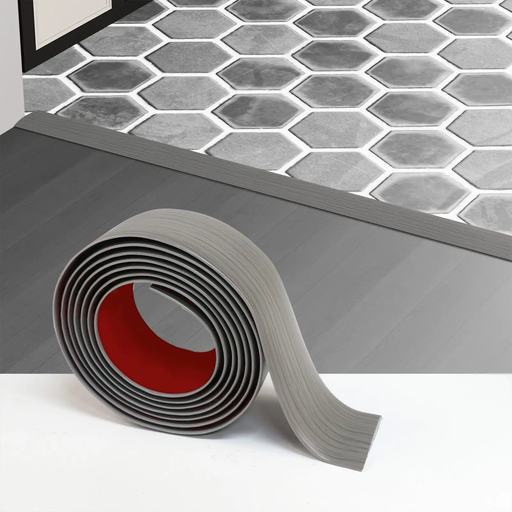
Why this choice suits this profile : With its 1 m length and self-adhesive installation, this model is suitable for small joins between two floor coverings and can be fitted without nails or additional glue.
Its flexible PVC construction and scissor-cut design make it easy to adjust when the gap does not match a standard length.
PVC advertised as resistant to scratches, stains and rubbing, with a grey wood-effect finish.
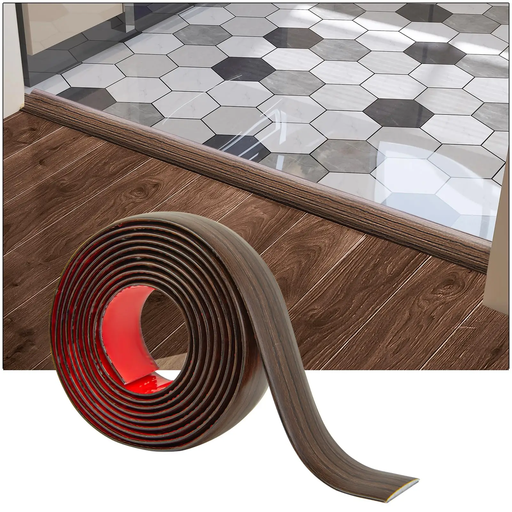
Why this choice suits this profile : Its brown wood-effect finish complements warm-toned flooring and helps finish a clearly visible join in a living room or bedroom.
The detailed dimensions make it possible to check compatibility before ordering, rather than relying solely on the photograph.
122 cm length, 4 cm width, 0,3 cm thickness and an easy-to-clean PVC surface.
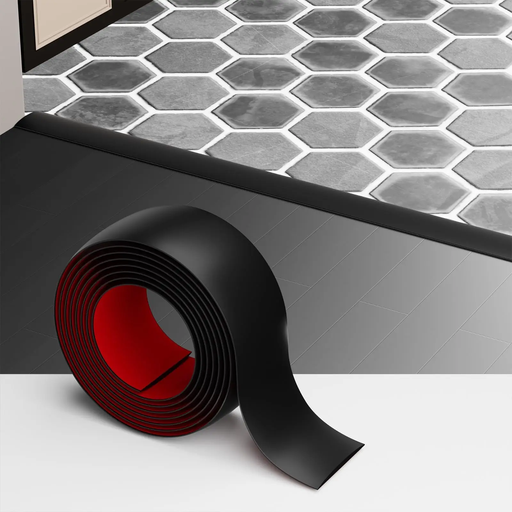
Why this choice suits this profile : The black colour creates a clear division between light tiles, dark flooring or carpet, particularly in a hallway or a professional space with moderate use.
Its 4 cm width covers a standard gap, but measuring beforehand is still essential to avoid a poor fit and premature replacement.
Flexible PVC advertised as abrasion-resistant, with self-adhesive installation and the option to cut it for a made-to-measure fit.
This type of join between flooring and tiles can be used in a living room, kitchen, bedroom or hallway. It is also suitable for a transition between tiles and carpet, provided the edges of the floor coverings are properly secured and the surface is sufficiently even.
In a bathroom, steam and splashes put the adhesive under greater strain. Installation on a perfectly dry surface is therefore essential. To discover other solutions suitable for this room, explore our selection of bathroom flooring.
We have brought together a complete, real-time updated selection of products that meet these demanding criteria while complying with European safety regulations.
Clean, degrease and dry the surfaces thoroughly. Measure the length to be covered, cut the profile, then gradually remove the protective film while pressing down firmly. Avoid walking on the join immediately afterwards and follow the instructions supplied with the product.
Its lifespan depends on how well the surface was prepared, how often the area is used, humidity and maintenance. Installing it on a dusty or damp floor can cause it to come away quickly. Check the ends regularly and avoid dragging heavy furniture over the profile.
The models featured are advertised as suitable for cutting with scissors. For a clean cut, measure twice, mark the back of the profile, then cut gradually. If the piece is particularly wide or thick, a suitable tool will make the job easier without changing the principle of self-adhesive fixing.