
Same-day & Next-day Delivery

Quality Guaranteed

Unlock Your Welcome Offers: FREE Delivery | Up to 80% OFF | Free 30-day JoyPlus trial
Download the APP
Designing your patio, balcony, or garden is a real pleasure. To define spaces and add greenery with style, the self-watering wall planter is often the ideal solution. But be warned: the market is so vast that it's easy to fall into common traps, turning a promising purchase into a real disappointment. Let's review the mistakes to avoid.
The first pitfall is the infamous "frost-proof" promise that doesn't survive the first winter. Many models, despite appearing sturdy, crack or shatter from the frost, forcing you to replace everything come spring. The second trap concerns the water reservoir system. A poorly designed mechanism can either drown the roots or, conversely, fail to provide the promised moisture, rendering the feature completely useless. Finally, be extremely wary of materials that fade at lightning speed. Your stunning anthracite grey planter turning a washed-out grey after just one summer? A classic scenario that ruins the aesthetic of your outdoor space.
To avoid these disappointments, it's best to rely on objective technical specifications. These are the true guarantee of your future planter's quality and longevity.
This is the most important factor. Models made from high-quality, injection-moulded polypropylene are an excellent starting point. For maximum durability, two points are essential to check:
An effective water reservoir works through capillary action. Water stored at the bottom of the planter is drawn up to the soil via a grid or wicks, ensuring continuous hydration for the plants. A well-designed system includes an "overflow" to drain excess water (during heavy rain, for example), thus preventing the roots from suffocating. This feature is simply essential for outdoor use.
The shape and volume must be suited to your project. A tall, rectangular planter is perfect for structuring a space. To create a true divider on a patio, aim for models that are at least 80 cm long and of a substantial height (over 50 cm). If you plan to plant shrubs, a large container of over 100 litres is essential to ensure healthy root development. Also, consider the total weight once the planter is filled with soil and plants—a crucial detail if you're placing it on a balcony.
To illustrate these criteria in practice, here are a few models that meet specific needs.
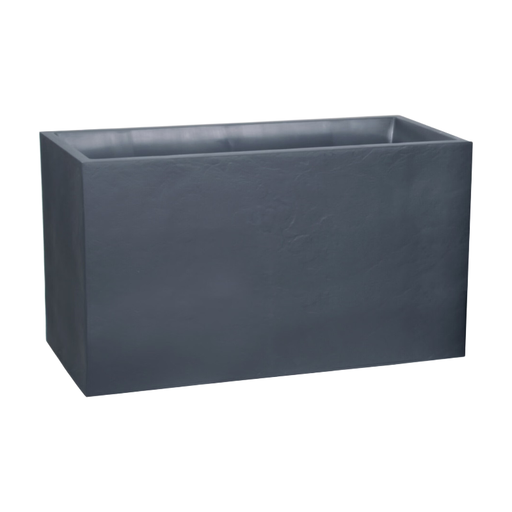
The Editor's Verdict: Perfect for creating a true green divider on a patio or in a garden. Its large volume and height can accommodate shrubs or dense arrangements for an effective visual screen and immediate aesthetic impact.
Its double-walled structure provides superior thermal insulation, protecting the roots from both frost and heat while ensuring the planter's longevity. This is the direct solution to the problem of planters cracking due to temperature fluctuations.
Its very large capacity (116 litres) and robust design make it the ideal candidate to serve as a patio divider. The Origine France Garantie certification is a real bonus.
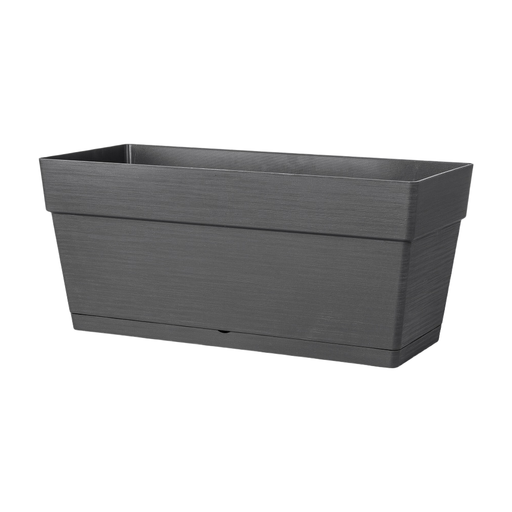
The Editor's Verdict: For those seeking a designer planter with clean lines and a timeless colour. This model fits elegantly into modern decor, on a balcony or a patio, without sacrificing functionality.
Made from recycled and recyclable materials, it is UV-stabilised throughout the material, which prevents the notorious fading trap. Its anthracite colour will remain stable season after season, an essential point for a lasting aesthetic.
Its frost-proof design and UV resistance ensure excellent durability over time. Its minimalist design and integrated water reservoir make it a reliable and practical choice.
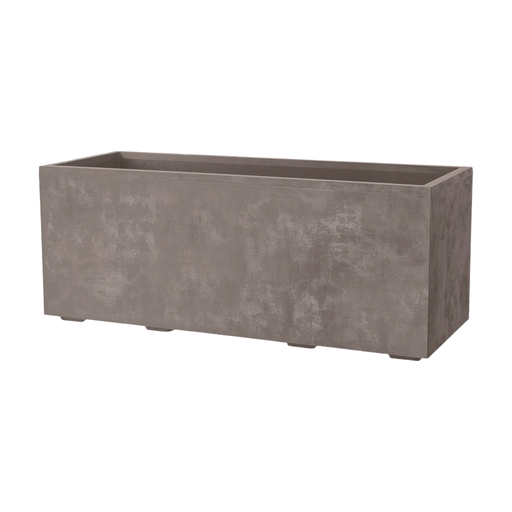
The Editor's Verdict: The perfect solution for those designing large spaces who want to maintain flexibility. Its 99 cm length allows for creating impressive arrangements, while its integrated wheels are a game-changer for cleaning or rearranging the patio.
It solves the puzzle of large, immobile containers. Once filled, a planter of this size is impossible to move. The integrated wheels allow you to move it effortlessly: a practical detail, often overlooked at the time of purchase, that makes all the difference.
The winning trio: long length (99 cm), a water reservoir, and wheels. A combination that makes it an ultra-versatile product for large outdoor spaces.
We have curated a complete selection of outdoor planters and pots that meet our strictest quality criteria.
The principle is simple: the water reservoir at the bottom of the planter continuously hydrates the soil through capillary action. This allows you to water much less frequently. Simply refill the reservoir when it's empty (rely on the water level indicator if there is one). However, be aware: right after planting, water from the top for a few weeks to encourage the roots to grow downwards. And of course, during a heatwave, keep a close eye on your plants!
Yes, provided you choose a quality model. Planters made of treated polypropylene, and ideally double-walled ones, are designed to withstand the sub-zero temperatures found in most regions. Pro tip: ensure the overflow drainage hole is always clear. This prevents water from stagnating, freezing, and causing the container to shatter.
For a successful dividing effect, aim for a height of at least 50-60 cm and a length of 80 cm or more. This will create a true plant barrier. As for width, plan for around 40 cm: this ensures good stability and a sufficient volume of soil for your plants, especially if you opt for evergreen shrubs.