
Livraison le jour même ou le lendemain

Qualité garantie

Débloquez vos offres de bienvenue: Livraison GRATUITE | Jusqu'à -80 % | 30 jours d'essai gratuits à JoyPlus
Téléchargez l'application
A self-cleaning cat litter tray can save you from daily scooping, but not all models are created equal. Between promises of hands-free operation, mobile apps and odour-control systems, certain details can quickly turn an appealing purchase into a demanding appliance to live with every day.
Before comparing automatic litter trays, focus on three common pitfalls: the capacity that is genuinely available, the cleaning requirements and compatibility with your cat. Here are the criteria to consider when looking for a solution suited to a flat, a large cat or a multi-pet household.
A large internal volume does not necessarily mean that the waste drawer can hold several weeks’ worth of clumping litter. Runtime depends on the number of cats, their weight, the amount of litter used and how often the cleaning cycles run.
For one cat, a self-cleaning litter tray with a 7 to 12 litre waste drawer may be suitable if you want to reduce how often you need to intervene. With several cats, it is better to choose a larger capacity and an app that can alert you when the compartment is full.
Many automatic appliances work only with clumping litter. Silica crystals, non-clumping litter and certain plant-based pellets can interfere with the waste-separation mechanism.
The technical specifications should state which types of litter are accepted, such as bentonite, tofu or clumping blends. Using a non-recommended material may result in clumps being removed incorrectly, residue building up or cycles stopping before completion.
An odour-control litter tray depends on several factors: a closed drawer, a correctly fitted bag, room ventilation, how often it is emptied and how frequently the surfaces are cleaned. A filter or deodoriser does not remove the need for regular maintenance.
Also check for an anti-leak system, easily accessible seals and washable parts. Liquids can collect beneath the drum if the tray is not placed on a level surface or if its edges are too low.
The entrance size and internal space are crucial for a larger cat. A cat litter enclosure that is too narrow may be rejected by your pet, even if the external volume looks generous.
Measure the space available in your home, leaving enough clearance to open the drawer and remove the bags. For several cats, look for a large-capacity litter tray, while bearing in mind that some appliances are designed to support a specific individual weight.
A litter tray with safety sensors should stop its cycle as soon as a cat is detected nearby. Weight, infrared or proximity sensors can also be used to record visits.
However, check the minimum weight limit. Some kittens are too light to activate the systems correctly. In this case, it is best to leave the appliance switched off or use it manually until your cat reaches the stated threshold.
For a litter tray with app control, check Wi-Fi compatibility. Several models work only on a 2.4 GHz network and do not connect directly to a 5 GHz network. The app may let you schedule cycles, receive a notification when the drawer is full or monitor usage habits. Naturally, this data is not a veterinary diagnosis.
Choose smooth surfaces, removable parts and trays that can be rinsed separately. The base containing the electrical components should generally not be submerged.
When buying in the European Union, check the details of the manufacturer, importer or EU-established responsible person, as well as the safety warnings and the availability of instructions in French. An electrical appliance must be installed on a hard, stable, dry floor, with a cable in good condition.
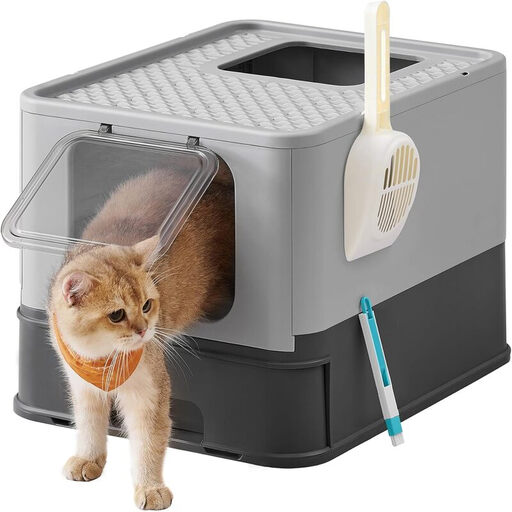
Why this choice suits this profile : This non-automated tray is ideal for anyone who wants to start with an enclosed litter tray that is easy to handle and requires no app to set up.
There are no unrealistic autonomy claims here: the sliding drawer, scoop and brush make manual maintenance perfectly straightforward.
Internal dimensions of 50 × 40,5 × 34,5 cm, suitable for cats up to 15 kg, a base described as waterproof and an adjustable entrance.
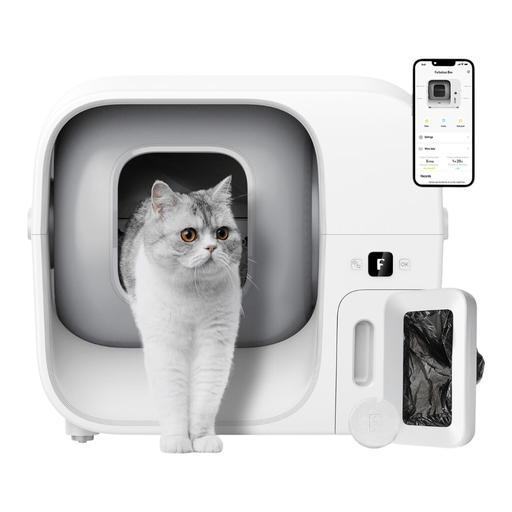
Why this choice suits this profile : Its automated operation and app are designed for households that value remote monitoring and more organised waste management.
The self-sealing bag system reduces direct contact with waste, while the proximity and weight sensors help control the cycles.
Advertised 60 litre capacity, self-filling bags, operation advertised at 37 dB and app-based monitoring.
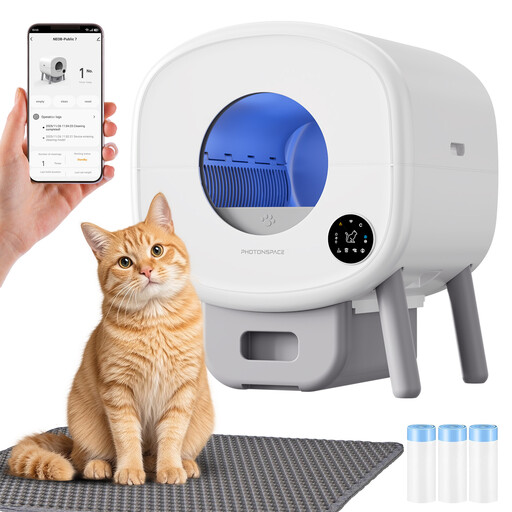
Why this choice suits this profile : Designed for multi-cat households, this tray is aimed at users looking for generous capacity and remote control of cleaning cycles.
The specifications state the weight limits, the requirement to use clumping litter and the need for a hard floor to maintain sensor accuracy.
Advertised internal volume of 95 litres, 15 litre waste drawer, app with 2.4 GHz Wi-Fi and infrared detection.
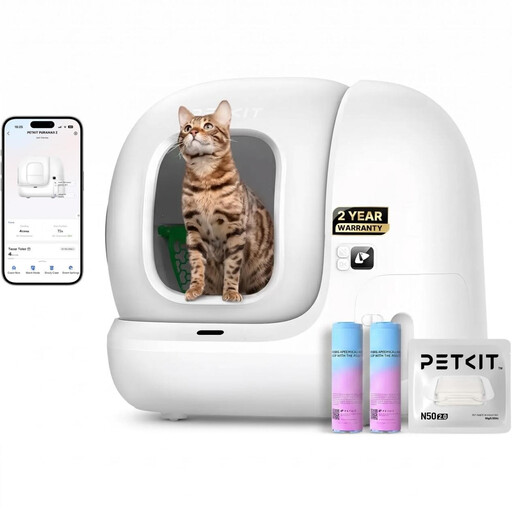
Why this choice suits this profile : This model is designed for users who want to schedule cycles, receive notifications and monitor several cat profiles from an app.
The specifications state a weight range of 2 to 8 kg, a 2.4 GHz Wi-Fi connection and a mat with an elastic edge designed to help prevent leaks.
Advertised litter capacity of 76 litres, 7 litre drawer, weight, infrared and anti-pinch sensors.
We have put together a complete, real-time updated list of products that fully meet these demanding selection criteria and European safety regulations.
To minimise measurement errors and incomplete cycles:
Running costs include bags, any filters or deodorisers, compatible litter and electricity. A model advertised as offering fifteen days of autonomy may need to be emptied much more frequently in a multi-cat household.
No. Check the minimum and maximum supported weight, the entrance height and the internal space. Kittens that are too light may not be detected correctly. A gradual adjustment period is recommended.
The budget depends on the price of the bags, odour-control consumables, clumping litter and replacement frequency. Check compatible references before buying so that you can estimate the actual monthly cost.
No. Automation reduces scooping, but the drum, seals, drawer and sensors still need to be cleaned. The app makes it easier to monitor cycles and visits, but does not replace daily monitoring of your cat.