
Livraison le jour même ou le lendemain

Qualité garantie

Débloquez vos offres de bienvenue: Livraison GRATUITE | Jusqu'à -80 % | 30 jours d'essai gratuits à JoyPlus
Téléchargez l'application
A self-cleaning cat litter tray can lighten the daily scooping, contain odours and simplify life in a multi-pet household. However, manufacturers’ promises alone aren’t enough to guarantee the right choice. The actual usable capacity, litter compatibility, safety features and cost of consumables can all change the experience considerably after just a few weeks.
Here are the criteria to consider before buying an automatic litter tray, along with a selection of models suited to different needs.
A large internal volume doesn’t guarantee the waste drawer will stay usable for several weeks. You need to distinguish between:
A model boasting long autonomy may therefore need emptying far more often in a multi-cat household. The claimed durations should be taken as rough estimates, which can vary depending on your cats’ weight, their habits and the type of litter used.
Some devices accept clumping litters made from bentonite, tofu or blends. Others work only with disposable trays and a specific litter.
This distinction has a direct impact on your running costs. An automatic litter tray that works with common products generally gives you more freedom. Conversely, a closed system may force you to buy proprietary refills on a regular basis. Always check the manual before using a mineral, plant-based, silica or non-clumping litter.
A safe litter tray must incorporate features that match your cat’s weight and size. Weight sensors, presence sensors, infrared sensors or anti-pinch mechanisms can stop the cycle when an animal approaches, but their effectiveness also depends on installation.
The tray must be placed on a hard, flat, stable floor. A thick mat could throw off the weight measurement. Very light kittens may also not be detected properly. Supervision is essential during the first few uses.
For a large cat or multiple animals, choose an internal drum that’s spacious enough and has a suitable opening. The minimum and maximum accepted weight is a key reference: some models are designed for cats weighing 2 to 8 kg, while others claim a range of up to 9.5 or 10 kg.
Also remember to measure the space you have at home. A large-capacity unit can exceed 60 cm in height and needs a clear area for access, maintenance and opening the drawer.
An effective self-cleaning litter tray must separate clumps without needlessly carrying away clean litter. The shape of the drum, the quality of the grid and the delay you set before the cycle starts all directly affect the result.
For an anti-odour litter function, look at the drawer’s sealing system, whether there’s a filter or deodoriser, and the price of refills. When the manufacturer claims a neutralisation rate, such as the 98% ammonia reduction stated for the PETKIT PuraMax 2’s N50 2.0 deodoriser, this should be understood as a claim on its product page, not a guarantee that applies in every home setup.
A connected automatic litter tray can offer remote start, alerts when the drawer is full, a usage history or even weight tracking. These features can be handy in a multi-cat household, but first check the Wi-Fi compatibility.
Some devices only support 2.4 GHz networks. The PETKIT PuraMax 2 and the Photonspace XXL state this restriction, while the PETKIT PUROBOT CRYSTAL DUO supports both 2.4 and 5 GHz networks. An app obviously doesn’t replace manual cleaning, checking the sensors or observing your pet’s behaviour.
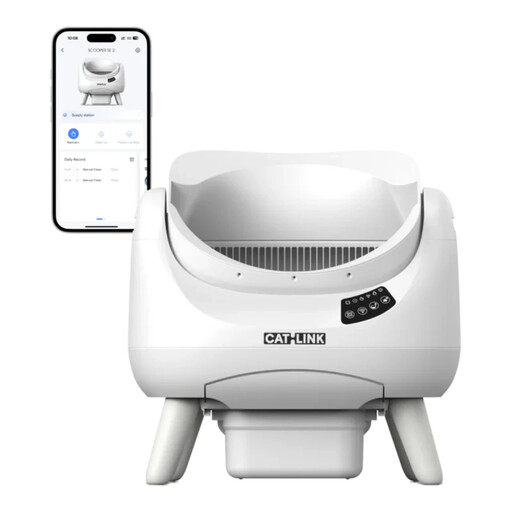
Why this choice suits this profile: Its sealed 12 L drawer and claimed 15-day autonomy make it an accessible entry point into automation. The model also offers a mobile app and multi-cat identification.
The stated weight range of 1.5 to 10 kg and compatibility with clumping litter make it easy to check suitability before buying.
12 L sealed waste container, non-slip mat and individual tracking claimed for up to 20 cats.
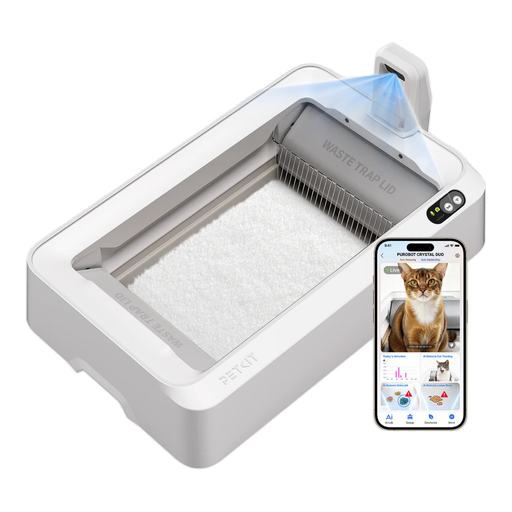
Why this choice suits this profile: This model is aimed at users who want to track their pet’s habits via an app, enjoy a built-in camera and use disposable trays.
Compatibility is clearly limited to PETKIT Crystal litter and single-use trays. This constraint must be factored into the ongoing cost calculation.
Camera monitoring, claimed safety sensors and support for 2.4 GHz and 5 GHz Wi-Fi networks.
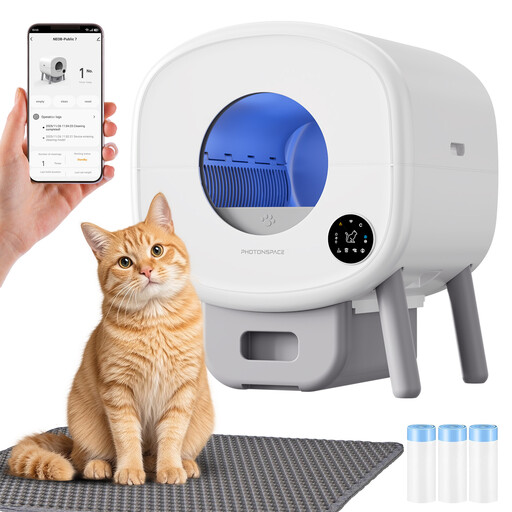
Why this choice suits this profile: Its 95 L drum and 15 L waste drawer are designed for multi-cat households or homes with large pets.
The product page specifies a weight range of 1.5 to 9.5 kg and excludes non-clumping or crystal litters, making compatibility checks straightforward.
15 L drawer, app operating on 2.4 GHz Wi-Fi and weight and proximity sensors listed on the product page.
We’ve put together a comprehensive, real-time selection of products that meet these strict criteria and European safety regulations.
Even a robot cat litter tray needs a minimum routine:
The total cost isn’t limited to the purchase price: you also need to factor in bags, filters, deodorisers, disposable trays and litter refills. Compare the price of these consumables with that of the device to assess the long-term value.
Yes, some models have a drum and drawer designed for a multi-cat litter tray. However, you need to check the accepted weight, waste volume and actual emptying frequency. In a very busy household, two trays can sometimes spread the load better than a single large-capacity unit.
Allow for a gradual adjustment period. Place the device in a familiar spot, keep a small amount of their usual litter and temporarily disable the automatic cycles. Watch your cat’s reaction before activating the scheduled cleaning.
No. Depending on the model, the app can send alerts, log visits or display your pet’s weight. It doesn’t replace emptying, washing the removable parts or directly observing your cat. These data points remain handy indicators, not medical advice.