
Livraison le jour même ou le lendemain

Qualité garantie

Débloquez vos offres de bienvenue: Livraison GRATUITE | Jusqu'à -80 % | 30 jours d'essai gratuits à JoyPlus
Téléchargez l'application
An automatic self-cleaning cat litter box can lighten the daily scooping routine and help keep the room cleaner. But you still need to choose a model that suits your pet. An entrance that’s too high, a narrow tray, sensors that struggle to detect your cat’s weight, or an app that won’t work with your home network – these details can quickly turn a practical purchase into an abandoned appliance.
Here are the criteria to check before choosing an automatic litter tray, along with a selection of models suited to different households in the UK.
A claimed volume of 70 or 95 litres doesn’t guarantee the interior space will suit a large cat. The shape of the drum, the width of the opening and the height of the entrance all play a part. A Maine Coon, a Ragdoll or an older cat may need more room to get in, turn around and get back out without feeling cramped.
So check the internal dimensions, the width of the opening and the access height. In a multi-cat household, an XXL tray can reduce how often you need to empty it, but it doesn’t necessarily replace the need for several separate toilet areas.
The effectiveness of an anti-odour litter box depends on several factors: cleaning frequency, the type of clumping litter, how well the waste drawer seals, and how often you replace the filter or deodoriser. Even when closed, the waste compartment needs regular emptying.
The figures manufacturers quote should be taken as claimed performance. PETKIT, for example, states its N50 2.0 deodoriser can neutralise up to 98% of ammonia. That doesn’t mean the device will eliminate all odours, regardless of the room or conditions of use.
Weight sensors can struggle to detect a lightweight kitten. Several models are only suitable for cats over 6 months old or weighing at least 1.5 to 2 kg. You also need to give your cat time to get used to this new piece of equipment.
During the first two or three days, place the machine near the old litter tray and disable the automatic cycle if the manual recommends it. Watch your cat’s reactions before activating the scheduled cleaning.
For a multi-cat household, compare these separately:
The models shown here generally work with clumping litter made from bentonite, tofu or a blend. Non-clumping litters and crystals can block certain mechanisms or even damage them. Always refer to the manual for the model you choose.
A litter box with safety sensors should stop a cycle or prevent it from starting when a cat is detected. Depending on the model, the system combines infrared sensors, weight sensors, proximity detection and anti-pinch protection.
These features reduce risks, but they don’t replace the need to supervise the device during the first few uses. Place the tray on a hard, flat, stable and non-slip floor – a carpet or uneven surface can throw off the weight measurement.
A connected automatic litter box can let you start a cycle remotely, receive an alert when the drawer is full, or check the visit history. Before ordering, check the Wi-Fi compatibility: many models only work on the 2.4 GHz band, not on a 5 GHz network.
For a litter tray with an app or camera, also look at the privacy settings, account management and data retention policies. Cat health tracking features are useful for spotting trends, but they don’t replace a vet’s opinion.
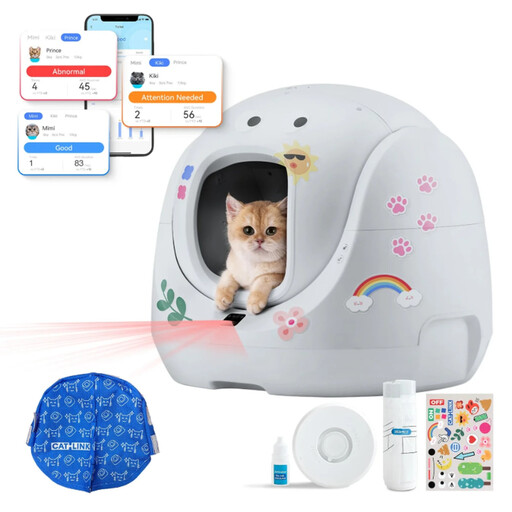
Why this model suits this profile: its four cleaning modes and 70-litre interior volume let you get used to this type of device gradually, whether you have one cat or several.
The manual details the weight limits, the need for clumping litter and the importance of a stable floor – all useful information to avoid an unsuitable setup.
70 L volume, 7 L drawer, CATLINK app on 2.4 GHz Wi-Fi and eight claimed safety features.
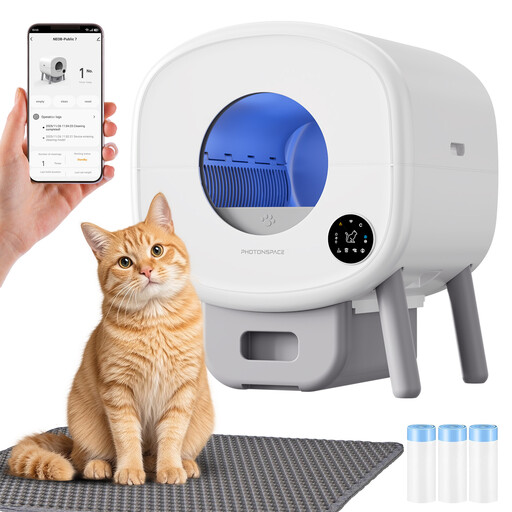
Why this model suits this profile: its 95 L interior space and 15 L waste drawer are designed for heavy use and cats weighing from 1.5 to 9.5 kg according to the product sheet.
The drawer capacity is stated separately from the drum volume – so you can estimate emptying frequency more accurately based on the number of cats.
XXL 95 L capacity, 15 L drawer, app on 2.4 GHz Wi-Fi and claimed weight and proximity sensors.
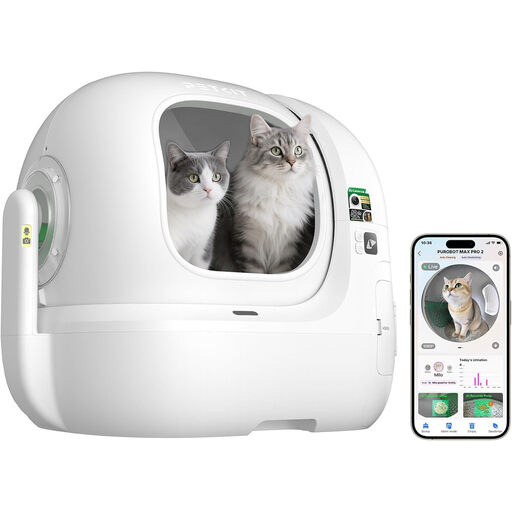
Why this model suits this profile: its camera, multi-cat recognition and app are aimed at owners who want to keep an eye on their pet’s habits remotely.
The camera shouldn’t be mistaken for a medical tool. The alerts and history are there to help you spot changes, which you can then discuss with a vet.
Entrance claimed to be 43% wider than the previous generation, 76 L drum, 8 L drawer and claimed operation at 35 dB.
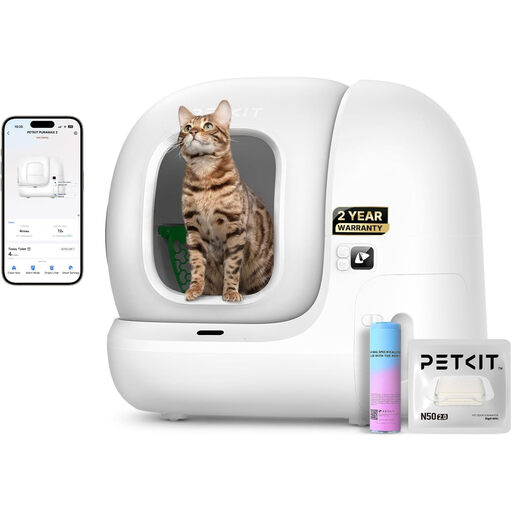
Why this model suits this profile: its low 20 cm entrance and 76 L volume can make access easier, provided your cat weighs between 2 and 8 kg.
The compatible weight range and the exclusion of kittens under 6 months are clearly stated. 5 GHz Wi-Fi is not supported.
XSecure system with heat, infrared, weight and anti-pinch sensors, 7 L drawer and automatic, scheduled or manual modes.
We’ve put together an up-to-date selection of products that meet these capacity, connectivity and safety criteria for UK households.
To keep the mechanism working properly:
The running costs include bags, deodorisers, any filters, litter and electricity. A large drawer can space out emptying, but consumption varies depending on the number of cats and how often they use it.
Yes, some models have an interior volume and drawer designed for several cats. Individual recognition and in-app tracking can be handy. However, it’s still advisable to provide enough trays in the home, especially if your cats don’t share resources easily.
Its lifespan depends on how often cycles run, how well it’s maintained, the quality of the installation and how often consumables are replaced. Regularly inspect the sensors, cable and moving parts, and follow the manufacturer’s recommendations. If it breaks down, makes an unusual noise or becomes blocked, stop the device immediately and unplug it.
No. The sealed drawer, deodoriser and quick waste removal can reduce smells, but they won’t get rid of them in every situation. The choice of litter, room ventilation and regular cleaning of the tray are still key factors.