
Livraison le jour même ou le lendemain

Qualité garantie

Débloquez vos offres de bienvenue: Livraison GRATUITE | Jusqu'à -80 % | 30 jours d'essai gratuits à JoyPlus
Téléchargez l'application
An automatic self-cleaning cat litter box can save you from daily scooping, help contain odours more effectively, and allow you to keep track of your pet’s habits. But you still need to choose a device that suits your cat and your home. A model that’s too narrow, incompatible with your litter, or a pain to clean can quickly turn into a disappointing purchase.
Before choosing an automatic litter tray, take the time to check three points that are often glossed over in product descriptions.
A large volume in litres doesn’t guarantee your cat can turn around comfortably. Large breeds, such as some Maine Coons or Ragdolls, need a wide enough opening and an interior space that suits their size.
So look at the external dimensions, the width of the entrance, and the maximum weight accepted. In a multi-cat household, a litter box for several cats also needs a waste drawer large enough to avoid emptying it too often.
Charcoal filters, sealed compartments, and deodorisers can help limit the spread of smells. However, they don’t replace emptying the drawer or cleaning the sensors. How often you need to maintain it depends on the number of cats, the type of litter used, and the number of daily cycles.
Also be wary of the efficiency percentages that manufacturers push. A claim like “98%” comes from the brand’s test conditions – it’s not a guarantee that holds true in every home.
Many models work with clumping litter. Some accept bentonite, tofu, or mixed litters, while others require a specific mineral litter or disposable trays.
The connection can also throw up nasty surprises. Several devices are limited to 2.4 GHz Wi-Fi and don’t support 5 GHz. Check this before you buy, especially if your router clearly separates the two networks.
For a large adult cat, go for a sufficiently wide opening, a low entrance if needed, and a drum where it can move without feeling cramped. The spec sheets sometimes list a weight range, for example 1.5 to 10 kg or 2 to 8 kg.
Kittens under six months old are often excluded from usage recommendations, because their weight may not be detected correctly by the sensors. In that case, don’t let an automatic device run without proper supervision.
A genuinely serious anti-pinch system usually combines several protections: infrared sensors, weight sensors, radar, proximity detection, or automatic motor shut-off. The whole setup should stop the cycle as soon as a cat enters the rotation area.
Always place the device on a flat, hard, and stable floor. A thick mat can throw off the weighing and disrupt detection. Never disable the safety features, and always unplug the tray before any thorough cleaning.
A drawer of 7 to 15 litres can space out emptying, but the real autonomy varies depending on the number of cats. The app can tell you when the bin is full, log visits, or offer app-based control.
Cat health tracking should be taken for what it is: a record of habits – weight, frequency of use, duration, or times – not a diagnosis. A camera can provide extra information, but it doesn’t replace a vet’s opinion if your pet’s behaviour changes.
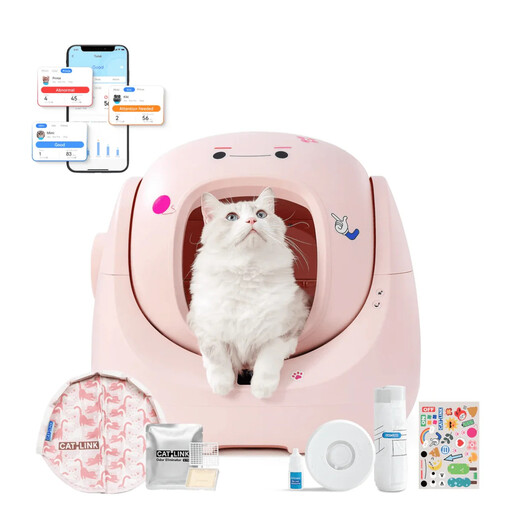
Why this choice suits this profile: Its app, automatic, scheduled and manual modes, plus its removable ramp, make this first robot tray fairly simple to get to grips with.
The weight and infrared sensors, combined with the motor, are designed to stop the cycle when a cat is detected. Supervision during the first few uses is still essential.
Multi-cat identification, weight tracking, and compatibility with clumping litter as per the manufacturer’s instructions.
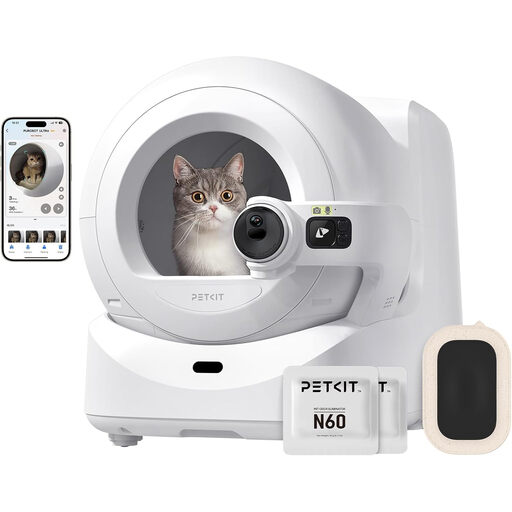
Why this choice suits this profile: Its 180° rotating camera and 2.4 GHz or 5 GHz Wi-Fi connection are aimed at households that want to observe the habits of several cats.
The camera and individual identification let you check litter box usage, without presenting this data as a medical conclusion.
Sealed 10-litre waste drawer, smooth surface, and habit tracking via the app.
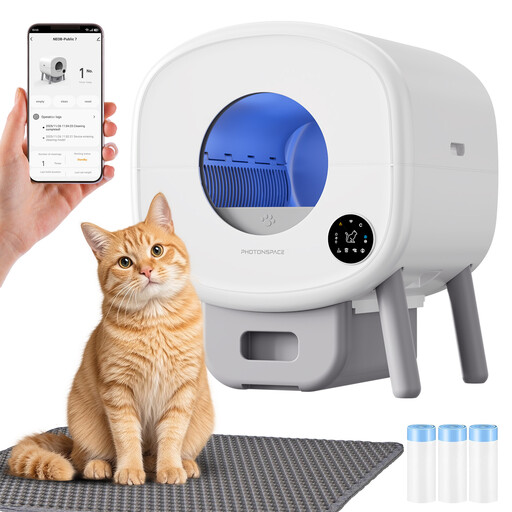
Why this choice suits this profile: With its 95-litre drum and 15-litre waste drawer, this model is aimed at households with several cats or one large adult cat.
The drum and drawer show separate capacities, making the volumes easier to understand. You still need to respect the weight limit and use a compatible clumping litter.
Weight and proximity sensors, 2.4 GHz Wi-Fi app, and sealed waste compartment.
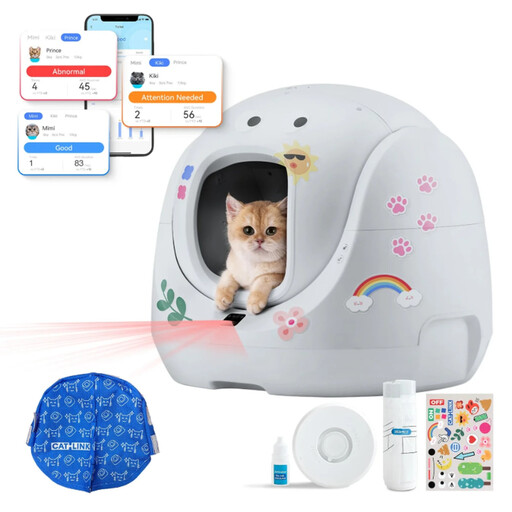
Why this choice suits this profile: Its low entrance and 70-litre drum can suit adult cats that need easier access.
The spec sheet mentions four gravity sensors, two anti-pinch devices, and an infrared sensor. This model is still intended for adult cats whose weight falls within the stated range.
Four cleaning modes, multi-cat recognition, and stated compatibility with bentonite, tofu, and mixed litters.
We’ve put together a full selection, updated in real time, of products that meet these demanding criteria and European safety requirements.
Yes, some models have a more spacious drum and waste drawer, plus an individual identification feature in the app. Still, check the weight range, the actual available volume, and the emptying frequency that suits the number of cats.
Most of the models shown work with compatible clumping litter. Bentonite, tofu, and mixed litters may be accepted depending on the device. Disposable crystal trays are the exception: they usually require the consumables supplied by the manufacturer.
The purchase price is only part of the budget. You also need to factor in bags, filters, deodorisers, specific consumables, and the litter itself. A tray with a large drawer can reduce how often you need to handle it, but it won’t eliminate the running costs. Before you order, check the availability of accessories and their price.