
Same-day & Next-day Delivery

Quality Guaranteed

Unlock Your Welcome Offers: FREE Delivery | Up to 80% OFF | Free 30-day JoyPlus trial
Download the APP
A gap between two floor coverings quickly attracts dust, catches on socks and can even create an uncomfortable difference in height. Between parquet and tiles, laminate flooring and carpet, or vinyl and tiles, a self-adhesive floor transition strip can often refresh the finish without removing the existing flooring.
However, not all strips are suitable for every configuration. Choosing the wrong width, applying it to a dusty surface or using unsuitable adhesive can cause it to come away after just a few weeks. Here are the key points to check before buying, along with a selection of models available from Joybuy.
A strip advertised as having a width of 4 cm will not necessarily cover a 4 cm gap effectively. You need to allow for an overlap on each side, especially when the two floors are not perfectly level.
So measure:
A strip that is too narrow will leave the edges of the joint visible. Conversely, a strip that is too wide may extend too far and be overly noticeable, particularly in a small room.
A wood-effect transition profile may complement parquet flooring, but its shade must also work with the tiles, skirting boards and furniture. Cherry, brown, grey or black finishes will create very different looks.
The finish should not distract from the practical considerations: thickness, flexibility, stain resistance and ease of maintenance. Even a convincing wood effect cannot make up for a strip that lifts at the edges.
Even adhesive marketed as powerful will lose its effectiveness on a damp, greasy, dusty or uneven floor. Wax residue and certain cleaning products can also reduce adhesion.
A self-adhesive PVC floor strip is best suited to smooth, clean and dry surfaces. On a crumbly, highly textured surface or one exposed to water ingress, an adhesive floor joint cover may not provide sufficient hold.
Flexible PVC is very common for adhesive finishing strips. It can be easily cut with scissors and moulded around minor irregularities. The models featured here are 0.3 cm thick, giving them a relatively discreet profile.
This slim profile is suitable for a mainly visual transition or a small gap. It will not replace a levelling system designed to compensate for a significant difference in height. In that situation, check the profile shape and overlap area carefully before ordering.
The 122 × 4 × 0.3 cm, 1 metre and 300 × 4 × 0.3 cm formats meet different needs:
Scissors allow you to install the strip without specialist tools. For a straight cut, mark the measurement on the back of the strip and use a ruler as a guide.
A self-adhesive threshold strip is easy to install once the protective film has been removed. However, the result depends above all on preparing the surface properly:
If the strip is slightly curved after transport, a hairdryer can help restore its shape. Heat it briefly from a reasonable distance and avoid excessive temperatures that could deform the PVC or damage the adjacent flooring.
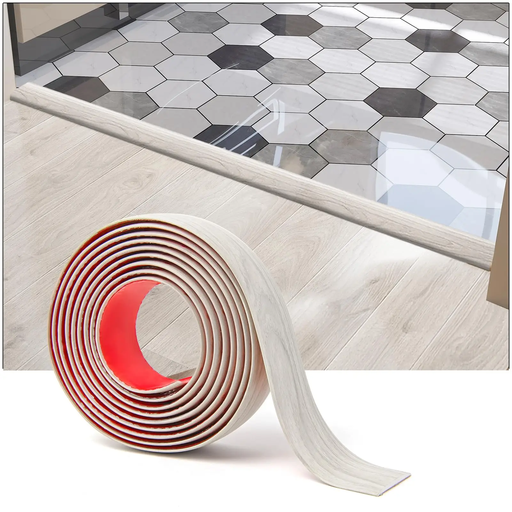
Why this choice suits this profile : its 300 cm length makes it possible to cover a long joint while minimising the number of joins. Installation simply involves cutting and sticking it in place.
The available length reduces the risk of using multiple small sections that are poorly aligned. Properly preparing the floor is still essential to maintain good adhesion.
Flexible PVC, 4 cm width, 0.3 cm thickness and easy cutting with scissors.
Why this choice suits this profile : its light wood-effect finish can blend into a carefully styled interior when the transition needs to remain discreet.
At 0.3 cm thick, the strip remains visually discreet. Nevertheless, check that its colour works well with both floors before installation.
Wood-effect appearance, PVC advertised as scratch- and stain-resistant, cleans with a damp cloth.
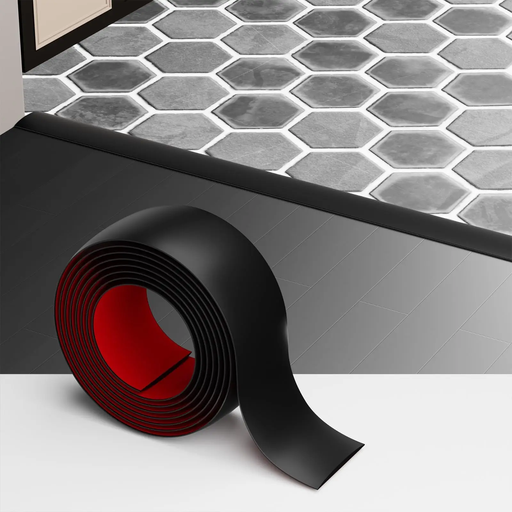
Why this choice suits this profile : its black colour creates a strong visual marker in a hallway, entrance or high-traffic area.
Its 3 m length limits the number of joins across a large area. However, the product information states that it is intended for residential indoor use and advises against unsuitable, very damp spaces.
Flexible PVC, surface advertised as resistant to scratches, stains and moisture, installs without nails or additional adhesive.
Before sticking it down, allow the strip and the floor to reach room temperature. Position it in place first to check that both edges rest securely on stable surfaces. For a transition between parquet and tiles, avoid placing the adhesive over a hollow tile joint or a parquet board that is coming loose.
After installation, press from the centre towards the ends to push out any air bubbles. Avoid washing the area thoroughly immediately after fitting. A damp cloth is sufficient for routine cleaning; abrasive products may dull the finish.
In a bathroom or near a shower, check the manufacturer's instructions and the condition of the surface carefully. An adhesive finishing strip is not waterproofing and should not be used to conceal water ingress or an unstable floor.
We have put together a complete, real-time updated list of products that fully meet these strict selection criteria and European safety regulations.
Its lifespan depends on foot traffic, surface preparation, humidity and cleaning quality. There is no universal lifespan. Check the ends regularly and re-stick or replace the strip as soon as it starts to lift.
Yes. A strip designed to cover joins between laminate flooring, tiles, carpet or vinyl may be suitable if the surfaces are clean, dry and sufficiently level. However, very thick or frayed carpet may provide uneven support.
For the self-adhesive models featured here, installation mainly requires a tape measure, a pencil and scissors. A hairdryer may be useful if the strip has become curved during transport. Installation without specialist tools does not remove the need for accurate measuring and thorough cleaning.