
Livraison le jour même ou le lendemain

Qualité garantie

Débloquez vos offres de bienvenue: Livraison GRATUITE | Jusqu'à -80 % | 30 jours d'essai gratuits à JoyPlus
Téléchargez l'application
A visible joint between laminate flooring and tiles, a difference in height between two rooms or a gap along a carpet can quickly disrupt the harmony of an interior. A self-adhesive floor threshold strip can conceal this separation without nails or additional glue, provided you choose a model suited to the actual floor configuration.
Tenants, homeowners and DIY enthusiasts can still encounter several pitfalls when making a purchase. Here are the criteria to consider before ordering an adhesive transition profile, along with a selection of models suited to different needs.
A strip that is too narrow may leave part of the gap between the two floor coverings visible. Measure the width of the joint in several places: a wall or floor cut is not always perfectly straight. A width of 4 cm, like the models featured here, is suitable for many domestic transitions, but it should be compared with the actual situation.
Even a self-adhesive floor joint cover can come loose if the surface is dusty, greasy, damp or covered with cleaning-product residue. After cleaning, allow the surface to dry completely. On a porous, crumbly or very uneven floor, adhesion may nevertheless remain limited.
A wood-effect finish may look perfectly matched to a wooden floor on screen, then create a much stronger contrast once installed. Compare the shade with both floor coverings involved: brown, grey, black and washed white will not produce the same result. Also remember to check the direction of the grain and the effect of natural light in the room.
The dimensions directly determine whether the product is compatible. The Art3d references featured here are available in 1 metre or 122 cm, as well as in the 300 cm × 4 cm × 0.3 cm format.
A genuine difference in height may require an angled threshold strip or a levelling transition profile rather than a simple gap cover for laminate flooring, carpet and vinyl.
A PVC threshold strip is lightweight, easy to cut and flexible enough to follow minor irregularities. The Art3d models featured are made from PVC and advertised as resistant to scratches, stains and abrasion. This does not mean that their surface is indestructible: repeated friction, heavy furniture or harsh cleaning products may eventually damage the finish.
PVC is suitable for many transitions between indoor floors. However, check the usage conditions specified by the manufacturer before installing it in a very damp area. The 300 cm black reference is specifically indicated for indoor residential use and is not intended for heavily damp areas, unless otherwise stated.
Easy, tool-free installation is one of the main advantages of this type of product. In most cases, you simply need to measure, cut, remove the protective film and press firmly. A pair of scissors is all you need to adjust the length.
Before installation:
If the strip or roll is slightly curved when received, the product information recommends gently warming it with a hairdryer to restore its shape. On a delicate floor or in rented accommodation, first test it on a small, inconspicuous area: removing the adhesive may leave marks or pull away a finish.
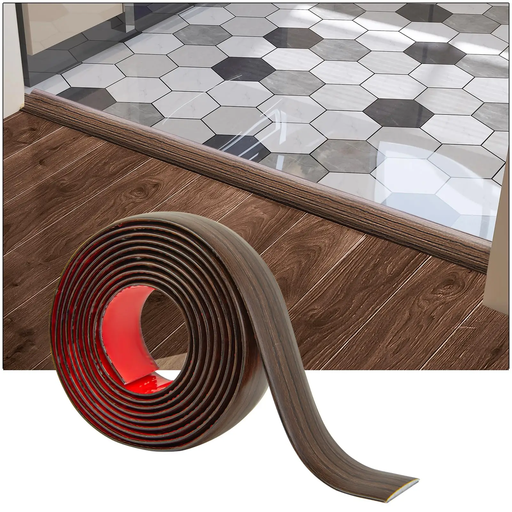
Why this choice suits this user profile : Measuring 122 × 4 × 0.3 cm, this strip is suitable for a small transition between wooden flooring, tiles or carpet. The peel-and-stick installation is accessible to anyone looking to make a quick repair at home.
Its dimensions are clearly stated and the strip can be cut with scissors. However, you should check the actual width of the joint before buying.
Flexible PVC, brown wood-effect finish and self-adhesive backing. The product information states that it is resistant to scratches, stains and abrasion.
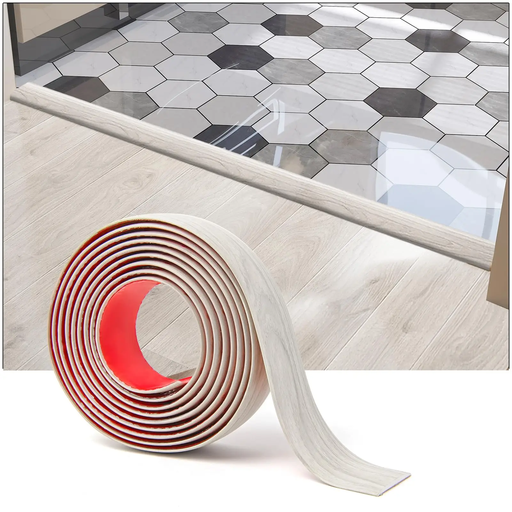
Why this choice suits this user profile : At 300 cm long, this strip reduces the number of joins in a spacious room. Its washed-white shade works well with a bright interior or contemporary décor.
Its long format helps minimise visible joins. However, the shade should still be compared with the actual colour of the wooden flooring or tiles.
300 × 4 × 0.3 cm format, PVC construction and tool-free self-adhesive installation. The surface is advertised as easy to clean.
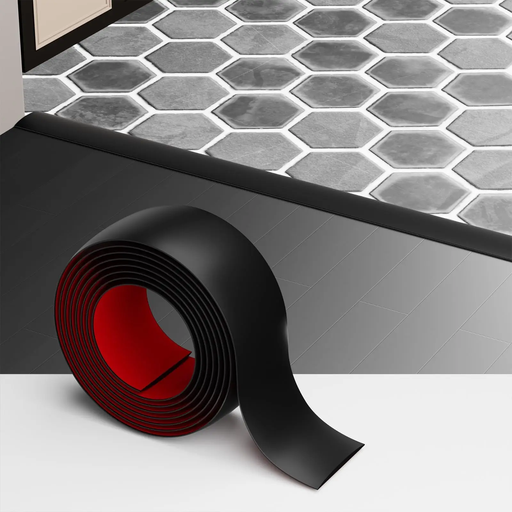
Why this choice suits this user profile : This 300 cm strip is suitable for hallways, large rooms and busy areas where a continuous transition is preferred. Black creates a bold contrast between two floor coverings.
Its length reduces the number of intermediate joins. To protect the adhesive, install it on a clean, completely dry indoor surface.
0.3 cm-thick PVC, black finish, advertised resistance to scratches, abrasion and stains, and can be cut with scissors.
After installation, avoid vigorously scrubbing the edges with a stiff brush. For routine care, a slightly damp cloth is generally sufficient. For a transition between tiles and vinyl, regularly check that water is not seeping beneath the strip.
Do not install the profile on an unstable or lifting surface, or one with a significant difference in height. A self-adhesive threshold strip conceals a gap and makes it easier to move from one floor covering to another, but it cannot replace levelling the subfloor. In a busy area, chair wheels, rigid footwear and moving furniture can also accelerate lifting.
Measure the length and width of the joint, then clean and dry the surfaces thoroughly. Cut the strip if necessary, gradually remove the protective film and press firmly along its entire length. Installing it on a clean, dry and degreased surface helps ensure good adhesion.
Its lifespan depends on foot traffic, the quality of the surface, humidity and maintenance. Installation indoors, on an even and properly prepared surface, will generally last longer than fitting it to a dusty, damp or heavily used floor. The manufacturer's recommendations should be used as a guide.
This is not guaranteed, particularly on a delicate finish, varnished wooden flooring or a recently installed floor covering. Warm the adhesive slightly, then remove the strip slowly, without using an aggressive metal tool. In rented accommodation, always test the method in an inconspicuous area and check the conditions set out in your tenancy agreement.