
Livraison le jour même ou le lendemain

Qualité garantie

Débloquez vos offres de bienvenue: Livraison GRATUITE | Jusqu'à -80 % | 30 jours d'essai gratuits à JoyPlus
Téléchargez l'application
Protecting your most precious belongings, whether they're official documents, family heirlooms, or digital media, is a top priority. Faced with a crowded market, choosing the right security safe can quickly become a headache. Certain details, often glossed over in marketing descriptions, can be the difference between a wise investment and a purchase you'll regret.
As a Product Specialist at Joybuy, my mission is to help you navigate your options. Let's break down the common pitfalls and essential criteria to make an informed choice.
The market is full of products with tempting promises. Here are three red flags to watch for so you don't get fooled by purely marketing-driven claims:
To select a reliable storage solution, focus on objective features rather than advertising slogans.
The true value of a fireproof and waterproof safe lies in its certifications.
The type of lock should match your needs for accessibility and security.
Physical security is just as important. Features like live-locking bolts (which engage with the safe's body), a pry-resistant hinge, and robust steel construction are quality indicators that should not be overlooked.
First, list what you want to protect: important documents, jewellery, a laptop, backup drives? Measure your largest items and compare them to the safe's interior dimensions. A good layout (adjustable shelves, door compartments, interior lighting) makes organising and accessing your belongings much easier.
To help you see how these criteria apply in practice, here are a few options suited for different user profiles.
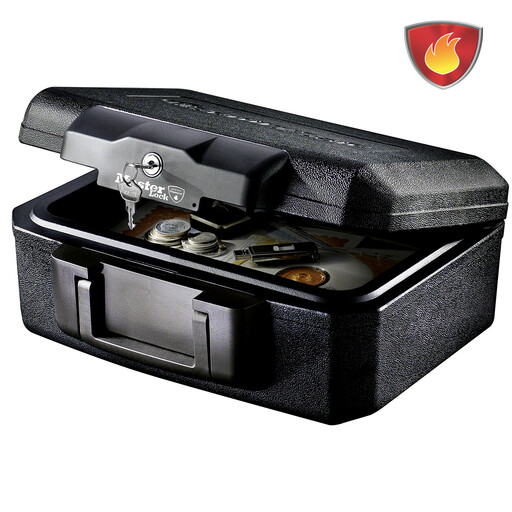
Why it stands out: Ideal for securing essential documents (passports, property deeds, birth certificates) and small digital media. Its carrying handle makes it a convenient portable solution to store in a cupboard or take with you if needed.
This safe doesn't just make promises: it has UL and ETL certifications for 30 minutes of fire protection at 843°C, valid for both paper and digital media. That's a verifiable guarantee.
Its compact size and certification for digital media make it a targeted and effective solution for essential fire protection needs.
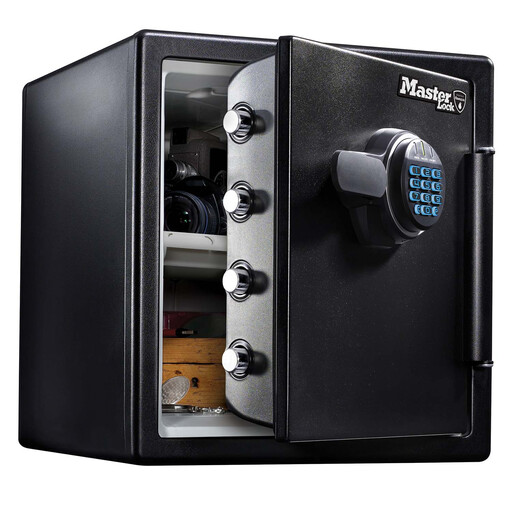
Why it stands out: With its 33.6-litre capacity and interior layout (shelf, door storage), it offers an excellent balance for family or professional use (small businesses/SMEs). It can hold documents, electronic devices, and other valuables.
It avoids all three pitfalls: it's UL/ETL certified for 1 hour at 927°C and is water-resistant (24 hours in 12 cm of water). Most importantly, its product sheet specifies that the waterproofing is only guaranteed before it's bolted down—a level of transparency we appreciate.
Comprehensive protection (fire, water, impact) and enhanced physical security with four live-locking bolts and a pry-resistant hinge. The digital safe with a backlit keypad is a real bonus.
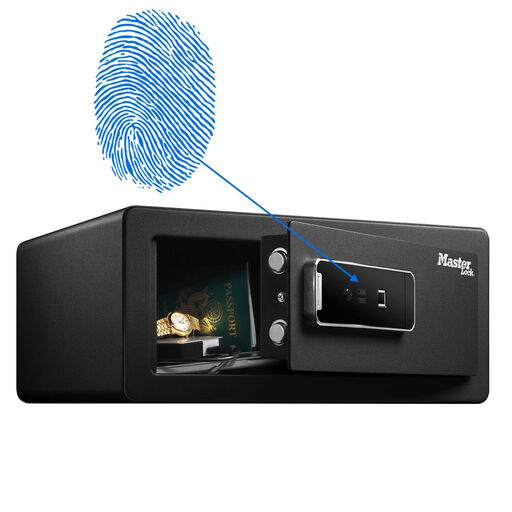
Why it stands out: Perfect for those who prioritise quick access to everyday valuables (jewellery, cash, electronic devices). The fingerprint scanner allows for keyless and codeless entry, ideal for secure and repeated use.
This safe focuses on anti-burglary security rather than protection from the elements (fire, water). It doesn't claim to be fireproof or waterproof, thus avoiding any misleading promises. Its strength lies in its steel construction, motorised bolts, and concealed hinge.
The biometric safe can store up to 30 fingerprints, offering personalised and rapid access. The included bolt-down kit allows you to secure it firmly for optimal theft protection.
From lockable office cabinets to high-security padlocks, discover our selection of products that all meet rigorous security and reliability standards.
For anti-theft protection, bolting the safe to the floor or a wall is essential. An unbolted safe can simply be carried away by burglars. However, be aware of two crucial points:
Digital media (USB drives, hard drives, CDs) are much more sensitive to heat than paper. A safe certified to protect documents may therefore be insufficient. For adequate protection of your data, look for a specific ETL certification for digital media, which guarantees the internal temperature will not exceed 120°C.
Most electronic safes are designed for this eventuality. They have a low-battery indicator that alerts you well in advance. If you ignore this warning, the majority of models include an override key (or emergency key) that allows you to open the safe manually. Golden rule: never store this key inside the safe itself.