
Livraison le jour même ou le lendemain

Qualité garantie

Débloquez vos offres de bienvenue: Livraison GRATUITE | Jusqu'à -80 % | 30 jours d'essai gratuits à JoyPlus
Téléchargez l'application
Sharing a key with a family member, a tradesperson, a carer or a tenant can save you a lot of running around. But not all models are suited to every need. An undersized, poorly fixed or weather-exposed secure key safe can quickly become difficult to use, or even unusable.
So before buying a combination key box, it’s worth looking beyond the marketing claims and checking a few practical features.
An outdoor key box may have a lid or flap that protects the dials from rain and dust. That doesn’t mean it’s completely waterproof. Direct exposure to running water, frost or salty air can speed up dirt build-up and wear on the mechanism.
For outdoor installation, choose a model with dial protection, a metal body and a relatively sheltered location. Make sure the lid is properly closed after every use.
A standard flat key takes up a different amount of space to a key with a remote fob, an access badge or several keyrings. A small key box might be fine for a single key, but it quickly becomes impractical in a rental property, an office or a shared home.
Check the internal dimensions, not just the external ones. Some models can hold several keys or cards, while others are designed for more limited storage.
A wall-mounted key box needs a solid surface and suitable fixings. In contrast, a portable key box with a shackle can be attached to a handle, a gate or a railing without drilling. This flexibility is handy for a rental, but the attachment point must be fixed, sturdy and difficult to remove.
Fixing it to a fragile or easily removable element reduces overall security, no matter how good the combination key safe is.
A resettable 4-digit combination makes it easy to manage access without having to hand out an extra key. It’s particularly suitable for homeowners, concierge services and professionals who work across multiple properties. The code should be changed on first use and only shared with the relevant people.
Connected models sometimes add phone-based opening, access history or alerts. These features can be useful when several users are sharing access, but they do require battery power and an app to manage.
For a single key, a medium capacity may be enough. For a key box intended for a holiday rental, a family home or a business premises, allow more space so you don’t squash keys and cards.
For practical reference, the stated internal dimensions help you compare models:
Compare these measurements against your actual keyring, especially if it includes a remote fob or a thick badge.
A wall-mounted key box is ideal for permanent installation on a wall, fence or fixed structure. The fixing kits supplied make installation easier, but you still need to choose screws and wall plugs suited to the surface.
A portable key box, or a key safe with a shackle, is easier to move. Models with a rigid shackle attach to compatible handles and gates. A flexible cable shackle, on the other hand, can adapt to posts, pipes or railings of various shapes.
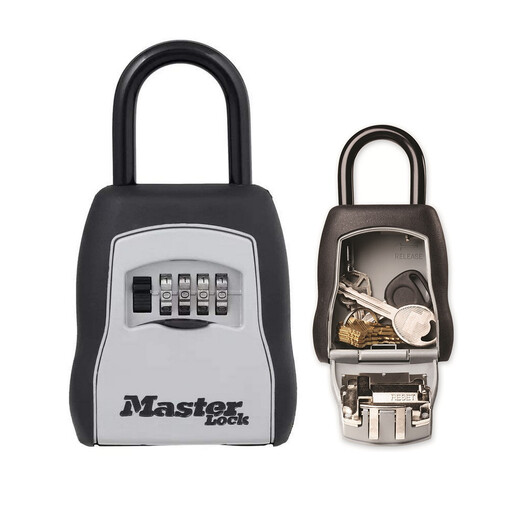
Why this choice suits this profile: This model is ideal for a first installation, a second home or a rental where drilling into the wall isn’t possible. Its built-in shackle attaches to a suitable handle, gate or railing.
It avoids the need for drilling and states an internal cavity of 74 × 68 × 30 mm, so you can check compatibility with your keyring before buying.
Metal body, resettable 4-digit combination and a protective dial cover for indoor and outdoor use.
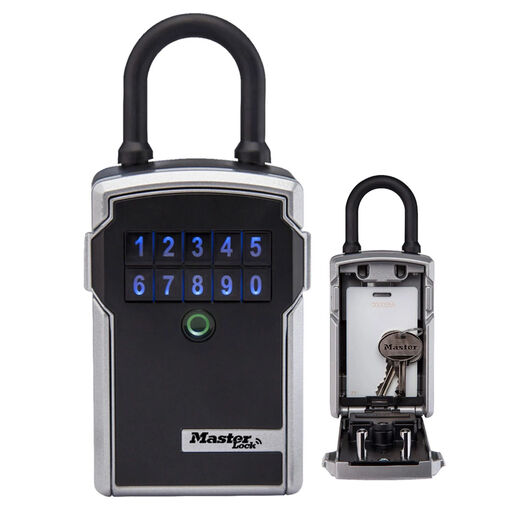
Why this choice suits this profile: Bluetooth or keypad opening is ideal for homeowners and managers who want to share temporary or permanent access without installing a wall-mounted box.
The keypad acts as a backup if your phone isn’t available. However, the CR123A battery needs to be monitored and replaced when necessary.
Master Lock Vault Home app, access history, tamper alerts and a coated shackle to minimise scratches on surfaces.
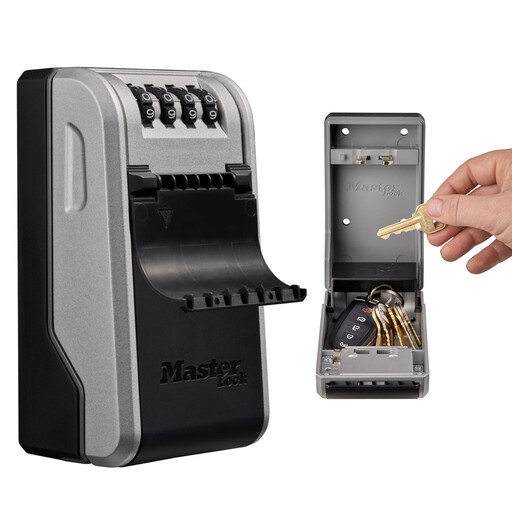
Why this choice suits this profile: Its wall mounting and stated space for up to 10 keys make it suitable for rental properties, home care services, offices and sites with multiple users.
Its cavity of 87 × 61 × 43 mm and internal tray help keep different keyrings organised. The front cover protects the dials from water and dust.
Aluminium body, spaced dials, side handles for one-handed opening and fixing kit supplied.
We’ve put together a comprehensive, real-time list of products that fully meet these strict selection criteria and European safety regulations.
The lifespan depends on how often it’s opened, exposure to the weather and how well it’s maintained. Even a waterproof key box or one with a protective cover should be installed in a sheltered spot to limit water splashes.
It avoids hiding a key under a doormat or in an easily spotted place. The combination can be changed when someone no longer needs access to the property. Keeping the code confidential and ensuring the fixing point is strong remain essential.
Choose a spot that’s visible to authorised users but not directly exposed to running water. A solid wall, a sturdy fence or a fixed handle can work, depending on the model. Also check that the dials are still accessible when wearing gloves in winter.
The capacity varies depending on the internal dimensions. Medium-sized models are generally fine for a small keyring, while some large-capacity models claim to hold up to 10 keys, cards or key fobs. Measure the items you need to store before making your choice.