
Livraison le jour même ou le lendemain

Qualité garantie

Débloquez vos offres de bienvenue: Livraison GRATUITE | Jusqu'à -80 % | 30 jours d'essai gratuits à JoyPlus
Téléchargez l'application
Managing property access, whether for a holiday rental, a home care provider, or a contractor, raises a critical question: how can you share keys simply and securely? A secure key safe is a practical solution, but the market is flooded with models making claims of varying reliability. A poor choice is, at best, money down the drain and, at worst, a gaping security flaw.
To avoid buyer's remorse, here are the common pitfalls that can render a product useless, or even dangerous:
There's no secret to making the right choice: you need to focus on objective technical criteria. These are the true guarantors of your future key safe's quality and longevity.
The body of the safe must be made from a material capable of withstanding brute-force attacks like drilling or sawing. Opt for zinc alloys or reinforced steel. For a wall-mounted key safe, security depends just as much on its mounting. Ensure the model comes with screws and anchors suitable for a solid installation on a solid wall (concrete, brick). The mounting points must be located inside the safe so they are inaccessible once it is closed.
There are two main types of mechanisms for a code lock box:
If you plan to install your key safe outdoors, weather protection is non-negotiable. A good indicator? The presence of a protective cover that shields the keypad or dials. This not only protects against rain and frost but also against dust and sand—the sworn enemies of precision mechanisms. Some models even display an IP (Ingress Protection) rating, which certifies their level of resistance to water and dust.
Every need has its solution. Here is our selection of reliable products, designed for specific uses and validated against our criteria.
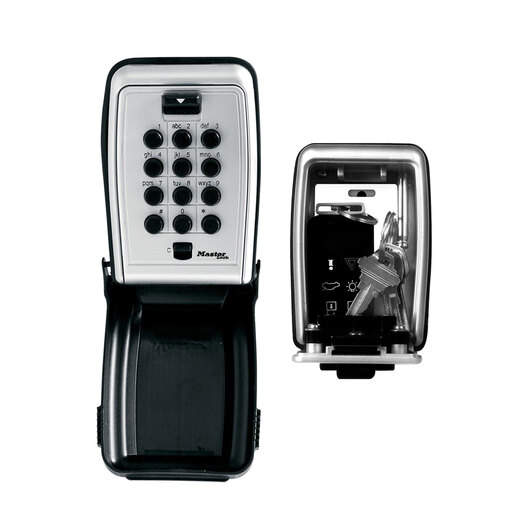
Why we recommend it: Perfect for use as an Airbnb key box, this model lets you change the code in a flash between guests. Its robust design and secure wall mounting are a guarantee of peace of mind for managing self-check-ins.
Its metal body is designed to resist break-in attempts, while its protective cover shields the keypad from the elements. Goodbye rust and malfunctions!
Its push-button system offers thousands of possible combinations and is ultra-simple for travellers, who don't have to worry about carrying a key.
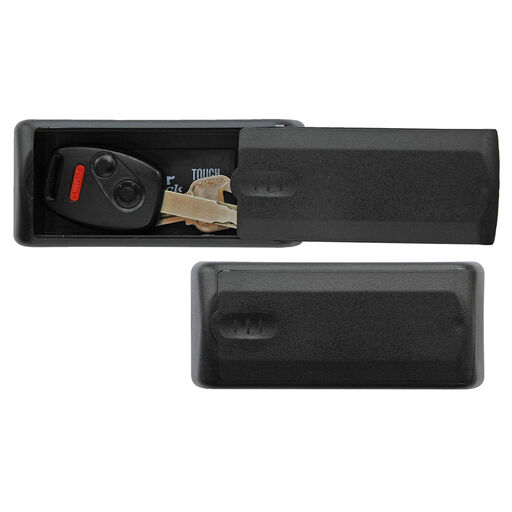
Why we recommend it: This magnetic key hider is the simplest solution for keeping a spare car key handy. It attaches directly to the vehicle's undercarriage and saves the day in an emergency (lost keys or keys locked inside—a classic scenario).
Its robust plastic shell is rust-proof, an essential feature for an accessory exposed underneath a car. Its sliding cover is designed not to detach when opened.
Its super-strong magnet ensures a perfect hold on any metal surface, with no drilling required. Its compact size makes it virtually invisible.
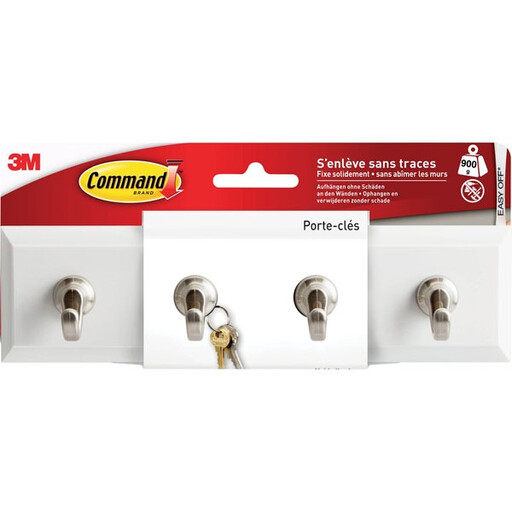
Why we recommend it: For anyone who simply wants a place to put their keys in the entryway or kitchen, without the need for a secure solution. Note: this is not a safe, but an ultra-practical storage solution that leaves no trace.
This product meets a simple need: organisation. It saves you from investing in an expensive secure box when a simple wall-mounted key rack is all you need.
Its Command adhesive mounting system is like magic: it goes up in seconds and removes without leaving a single trace on most surfaces (painted walls, tile, wood...).
Discover our complete selection of products to organise and secure your keys, all chosen for their reliability and value for money.
For maximum security, the safe must be mounted on a solid, sturdy surface, like a concrete or brick wall. You must use the provided screws and anchors, which are specifically designed for this type of material. Choose a discreet but easily accessible location, preferably out of plain sight. Ensure the box is perfectly flush against the wall to prevent a crowbar or other tool from being inserted behind it.
Absolutely not. Not all surfaces are created equal. Avoid plasterboard (drywall), thin wood, or any crumbly surface that could be easily torn away. If you have no other choice, consult a professional to use special fasteners (like Molly bolts for drywall) to ensure maximum hold.
The golden rule: avoid obvious combinations like "1234," your date of birth, or part of your address. For push-button models, choose a combination of at least 5 to 7 digits. For dial models, change the default code immediately upon first use. Finally, get into the habit of changing the code regularly, and always after each guest departs if you are using it for a holiday rental.