
Livraison le jour même ou le lendemain

Qualité garantie

Débloquez vos offres de bienvenue: Livraison GRATUITE | Jusqu'à -80 % | 30 jours d'essai gratuits à JoyPlus
Téléchargez l'application
A highly absorbent sponge is not necessarily the best ally against burnt-on residue. Conversely, a surface that is too abrasive can scratch a ceramic hob, a non-stick frying pan or a painted surface. To avoid unpleasant surprises, it is therefore best to look beyond claims such as “effective”, “durable” or “multi-purpose”.
A scouring side can quickly tackle baked-on grease, but it is not suitable for every surface. Products designed for stubborn dirt often advise against using them on non-stick coatings and delicate materials.
The right approach: choose a double-sided sponge and reserve the abrasive side for saucepans, dishes and hard-wearing surfaces. For a delicate hob or a non-stick frying pan, use the soft side and test it first on an inconspicuous area.
A sponge’s lifespan depends on how often it is used, the type of dirt it encounters and how well it dries between washes. A long-lasting model will generally retain its structure for longer, but it still needs to be rinsed after every use and replaced as soon as it starts to fray, flatten or retain odours.
Machine-washable models can reduce how often you need to replace them. However, check the recommended temperature: some can be washed at 40 °C, while others can withstand washing at up to 70 °C.
A damp sponge left at the bottom of the sink dries poorly and can retain food particles. The term “antibacterial” does not remove the need for proper care. For models treated with a specific agent, such as zinc pyrithione, always check the labelling and the manufacturer’s instructions.
After every use:
An absorbent cellulose sponge is suitable for soaking up a spilt liquid, washing up every day or wiping a surface. A scouring side provides extra friction for tackling greasy deposits and cooked-on food. Combining the two is particularly practical for everyday use, provided you respect the surfaces they are suitable for.
Three-layer sponges generally combine foam, a cellulose section and a scouring pad. This design makes the sponge easy to hold and clearly separates the absorption and scrubbing functions.
The term “scratch-resistant” does not guarantee that there is no risk whatsoever on every material. The sponge’s texture, dirt trapped between the sponge and the surface, and the pressure applied can all affect the result. Even a sponge marketed as non-scratch should therefore be tested on a small area before being used everywhere.
For delicate surfaces, choose:
A product that is machine- or dishwasher-washable must be cared for in accordance with the instructions provided. With microfibre models, avoid fabric softener where it is not recommended, as it can affect their wiping performance. Even after washing, replace the sponge if it gives off a persistent odour, shows signs of wear or becomes less effective.
A pack of sponges can also make it easier to organise your home: one for washing up, another for the sink and a third for the bathroom. When comparing offers, the price per sponge is often more informative than the price of the pack.
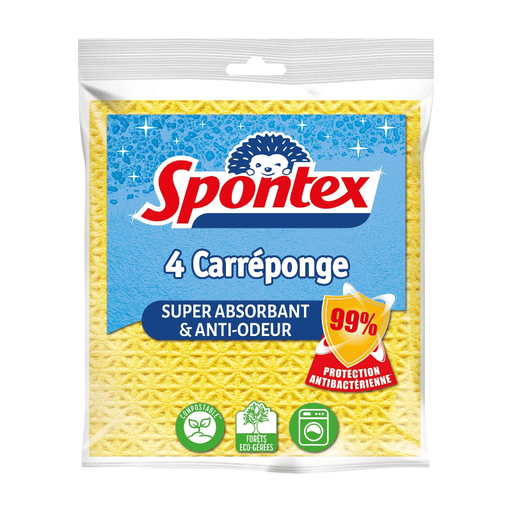
Why this choice suits this profile : this pack of four sponges covers everyday needs in the kitchen, bathroom and other rooms around the home. Their square shape makes them easy to hold and allows you to allocate them according to how they are used.
The description recommends rinsing the sponge after use, allowing it to air-dry and replacing it when worn, rather than promising an unlimited lifespan.
A pack of four, an absorbent material and an antibacterial treatment indicated by the manufacturer to limit the growth of bacteria and unpleasant odours on the product.
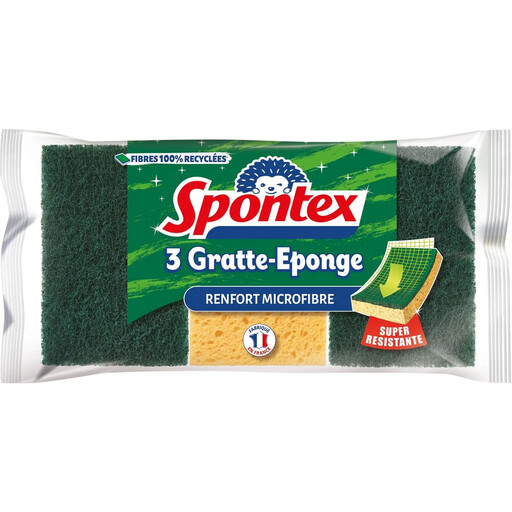
Why this choice suits this profile : combining a microfibre side with a scouring surface lets you move from wiping surfaces to removing dirt, particularly in the kitchen and bathroom.
The side intended for more delicate surfaces means you do not always have to resort to scrubbing. However, the manufacturer recommends testing the product and advises against using it on non-stick coatings.
A pack of three sponges, an absorbent plant-based side, a reinforced scouring texture and machine washing at 40 °C according to the information provided.
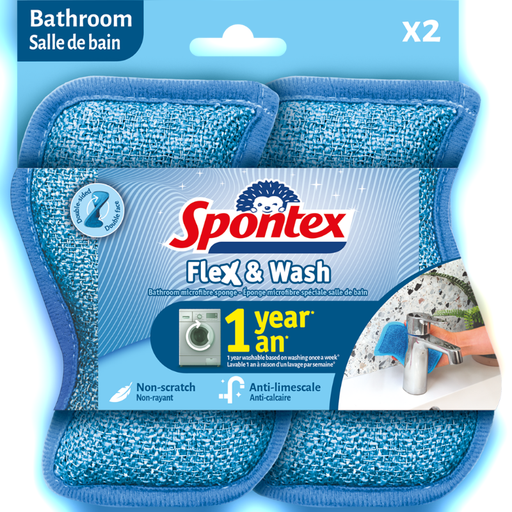
Why this choice suits this profile : this model is designed for the bathroom, with a scouring side for limescale and a microfibre side for windows and mirrors.
Its intended use is clearly defined: wash it at 40 °C, avoid fabric softener and test the material on an inconspicuous area before use.
Up to 52 washes claimed, recycled fibres according to the product information and a double-sided design suitable for limescale, mirrors and wiping.
We have put together a complete, real-time updated selection of products that meet these strict criteria and European safety requirements.
To make a kitchen sponge last longer, a few simple habits are all you need:
Choose a sponge explicitly described as non-scratch and use only its soft side. Even then, test it first on a small area. Avoid traditional abrasive pads and mineral particles if the instructions advise against using them on non-stick coatings.
There is no universal lifespan. Replace it as soon as it becomes misshapen, starts to fray, develops an unpleasant odour or no longer rinses properly. Some manufacturers state around two months for several models, while machine-washable sponges specify a maximum number of washes. These figures should always be considered alongside the product’s actual condition.
It can reduce the number of purchases if it genuinely withstands several cycles and is cared for properly. Compare the pack price, washing temperature, stated number of cycles and replacement frequency. A standard sponge sold in a pack can also be a sensible choice for a household that wants to keep different uses separate easily.