
Livraison le jour même ou le lendemain

Qualité garantie

Débloquez vos offres de bienvenue: Livraison GRATUITE | Jusqu'à -80 % | 30 jours d'essai gratuits à JoyPlus
Téléchargez l'application
Scotch tape can repair an item, protect a surface, join two materials or define a clean paint line. However, choosing a roll based solely on its colour, width or price can quickly lead to insufficient adhesion, glue residue or a damaged finish.
The right approach is to start with the intended use, then check the type of surface, the level of adhesion and the application time. Here are the main pitfalls to avoid, along with the references best suited to DIY users, tradespeople, painters, decorators and building professionals in France.
Cloth-backed or repair tape is designed to hold, bundle, protect or temporarily repair various items. It adheres to many surfaces, but it does not always remove cleanly.
Paint masking tape, on the other hand, is primarily designed to create precise edges and remove in a controlled manner. Using a multi-purpose adhesive on a freshly painted wall can pull away the finishing coat or leave glue marks.
The same adhesive will not necessarily work well on a painted wall, unfinished wood, glass or a rough surface. Tapes intended for delicate surfaces generally offer gentler adhesion. Those designed for rough surfaces, by contrast, need to conform more effectively to the irregularities of concrete, brick or untreated wood.
Before application, the surface must be clean, dry and dust-free. If it is delicate or has recently been renovated, always test the tape in an inconspicuous area.
The stated duration often depends on whether the tape is used indoors or outdoors, exposure to ultraviolet rays, temperature and the type of paint. For example, some Scotch masking tapes claim clean removal for up to 8 days indoors and 24 hours outdoors. Models for delicate surfaces may be removed for up to 60 days, under the conditions specified on the product sheet.
These indications do not replace the manufacturer’s instructions. Prolonged application, paint that is not yet fully dry or a porous surface can affect the result.
Width affects coverage and the stability of the bond. Formats measuring 24 or 36 mm are suitable for masking and painting lines. Widths of 48 mm are better suited to repairs, reinforcement and protection. For flooring, the 50 mm format makes it easier to apply continuous strips beneath carpet or vinyl.
The required length depends on how frequently the tape will be used. A 3 m roll may be sufficient for a small, occasional repair. For regular work or several rooms, it is better to choose a 25 to 50 m format.
When using paint masking tape, apply the strip to a dry surface and press the edges down carefully. When recommended on the product sheet, generally wait 30 to 60 minutes before painting. Then remove the tape slowly, often at approximately 45°, once the paint is dry to the touch.
For mounting applications, avoid greasy, damp or dusty surfaces. The stated strength of double-sided tape also depends on the object’s weight and size, as well as the holding time. Never exceed the load specified on the product sheet.
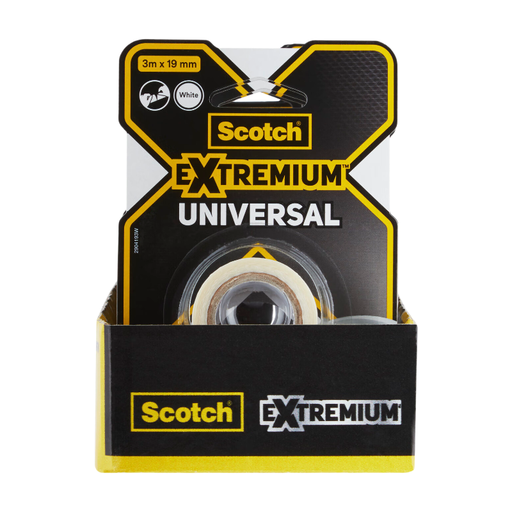
Why it is a smart choice: its compact format is ideal for small household repairs, bundling items and occasional marking.
At 19 mm wide, it minimises waste during small jobs instead of requiring an oversized roll.
3 m long, 19 mm wide, white and tearable by hand, according to the product sheet.
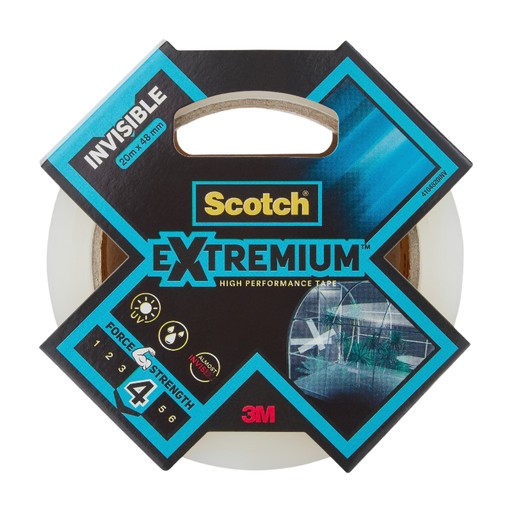
Why it is a smart choice: it is designed for repairs on glass and transparent plastic where the final appearance matters just as much as durability.
Its transparent, grid-free PET backing makes repairs less noticeable than those made with opaque cloth-backed tape.
20 m long, 48 mm wide, tearable by hand and advertised as UV-resistant.
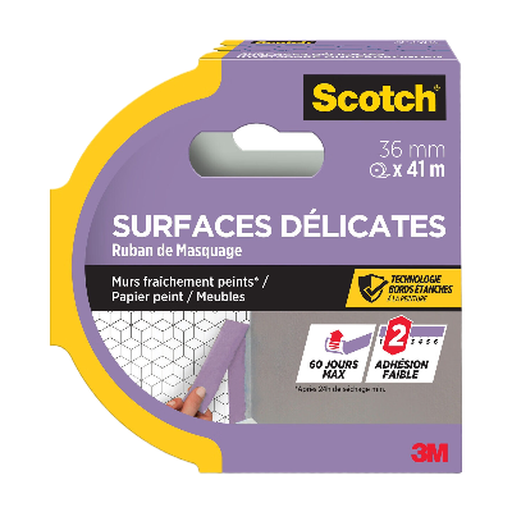
Why it is a smart choice: its low adhesion is suitable for parquet, furniture, vinyl wallpaper and sufficiently dry painted walls.
It reduces the risk of using an overly aggressive adhesive on a delicate finish. A preliminary test is still recommended.
41 m long, 36 mm wide, with clean removal advertised for up to 60 days, depending on the conditions of use.
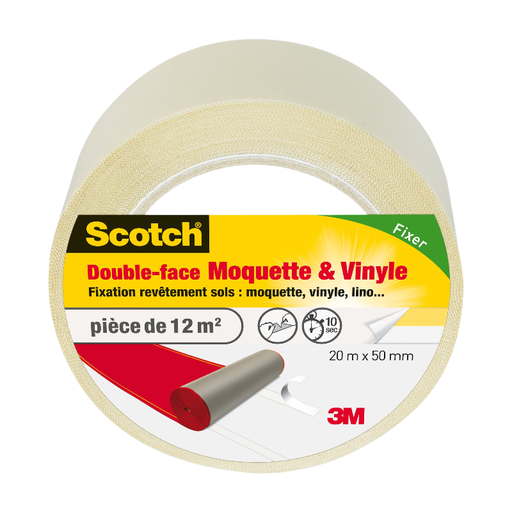
Why it is a smart choice: it is designed to secure carpet, vinyl and linoleum in residential or professional projects.
It prevents you from repurposing masking or repair tape for flooring that requires consistent adhesion across its entire length.
20 m long, 50 mm wide, advertised coverage of 12 m² and tearable by hand.
We have brought together an up-to-date selection of products suited to a range of masking, repair, mounting and protection needs.
A repositionable adhesive, such as Scotch Fix-All mounting dots, is better suited to posters, photographs and lightweight indoor decorations. It is not a substitute for permanent mounting and must not be used beyond its specified load capacity.
For a standard surface, Scotch Classic Premium Protect green masking tape is available in several widths, including 24, 36 and 48 mm. For furniture, parquet or vinyl wallpaper, choose a reference designed for delicate surfaces, typically identified by its violet colour. Always check that the paint is fully dry and test the tape on a small area first.
Yes, some references are specifically designed for glass and transparent plastic. Scotch Extremium Invisible Repair Duct Tape has a transparent, grid-free backing and measures 20 m by 48 mm. It is a repair tape intended to deliver a discreet finish—not a replacement for glazing or a structural repair solution.
It depends entirely on the product reference and the conditions of use. Some standard tapes are designed for clean removal for up to 2 days, while the delicate-surface model claims up to 60 days under the conditions specified by the manufacturer. For a sharp, clean line, it is still best to remove the tape once the paint is dry to the touch.