
Livraison le jour même ou le lendemain

Qualité garantie

Débloquez vos offres de bienvenue: Livraison GRATUITE | Jusqu'à -80 % | 30 jours d'essai gratuits à JoyPlus
Téléchargez l'application
Moving a sofa, chest of drawers or wardrobe can quickly leave scratches on wooden flooring. Scotch adhesive furniture sliders are a simple solution, but not all models are equally suitable for every piece of furniture, load or floor covering. Before buying, check their dimensions, fixing system, load capacity and the condition of the floor.
The most common mistakes come down to three misunderstandings:
Here are the criteria to consider when choosing scratch-resistant furniture sliders suitable for everyday use, whether in a flat, house or professional premises.
The stated capacity generally applies to four sliders fitted together, rather than to a single item. So estimate the total weight of the furniture, including everything inside it.
As a guide, the range featured includes several load levels:
These figures reflect the stated capacities for the various products. With particularly heavy furniture, it is better to spread the load across four stable contact points and avoid sudden movements.
Start by measuring the surface of the leg that touches the floor, then compare it with the base of the slider. A square model measuring 24 × 24 mm or a round model measuring 25 mm may be suitable for a small chair, occasional table or piece of furniture with slim legs. For a wardrobe, sofa or storage unit, the 40 mm, 50 mm or 80 mm formats distribute the load more effectively.
Honeycomb furniture sliders feature a raised structure designed to reduce friction. Product descriptions state that they allow up to 50% more glide than furniture without sliders. However, this is a figure provided for the range, not a guarantee that applies under the same conditions on every floor or with every load.
Self-adhesive furniture sliders can be fitted without tools. They are mainly suitable for smooth, clean and sufficiently wide legs. To maximise their grip:
Nail-on furniture sliders are designed for a more durable fixing on a base that is suitable for nails. They are not suitable for every piece of furniture, particularly when the leg is metal, delicate or difficult to drill.
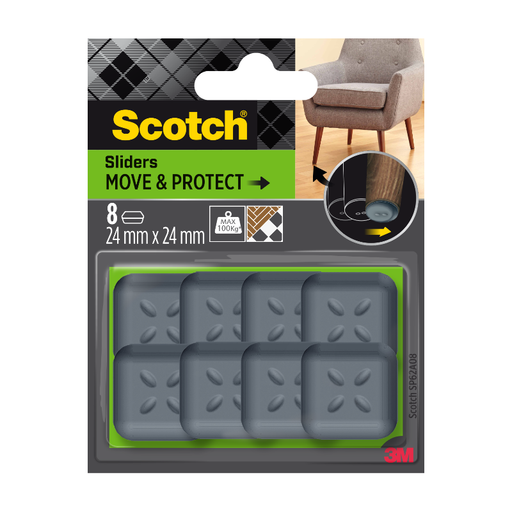
Why this choice suits this profile: With 8 pieces measuring 24 × 24 mm and a stated capacity of up to 100 kg for four sliders, this format is suitable for medium-sized household furniture and a first tool-free installation.
The number of pieces means you can replace several worn sliders or fit out multiple items of furniture. Nevertheless, check the width of each leg before installation.
A compact format, honeycomb structure, adhesive fixing and stated compatibility with different floor types.
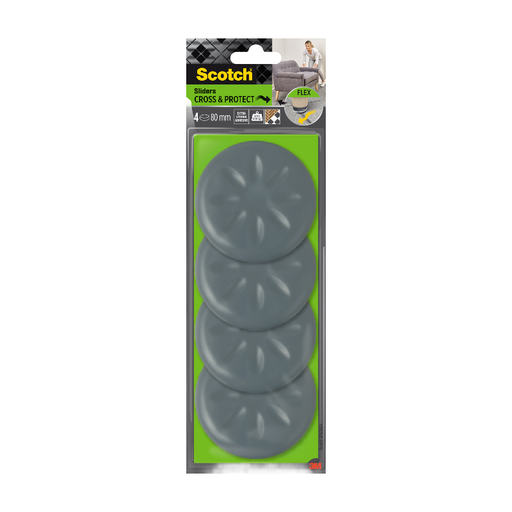
Why this choice suits this profile: Its large diameter, articulated joint and cushioning foam make it suitable for heavy furniture or pieces placed on floors with slight irregularities.
Its articulated design adapts better to tile joints and slight changes in level than a conventional flat slider. However, you should still check that the furniture is stable.
An 80 mm diameter, adhesive fixing and a stated maximum load of 600 kg for four sliders.
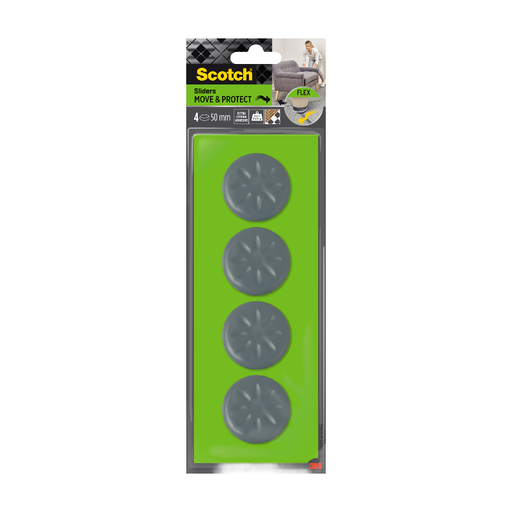
Why this choice suits this profile: This 50 mm format is suitable for sofas, kitchen furniture, fridges and items that are regularly repositioned. Its stated capacity reaches 400 kg for four sliders.
The articulated joint and cushioning foam reduce the risk of snagging on small irregularities. Even so, remove grit and debris from the floor, as these can leave marks.
A honeycomb structure, articulated joint, cushioning foam and adhesive designed for permanent installation.
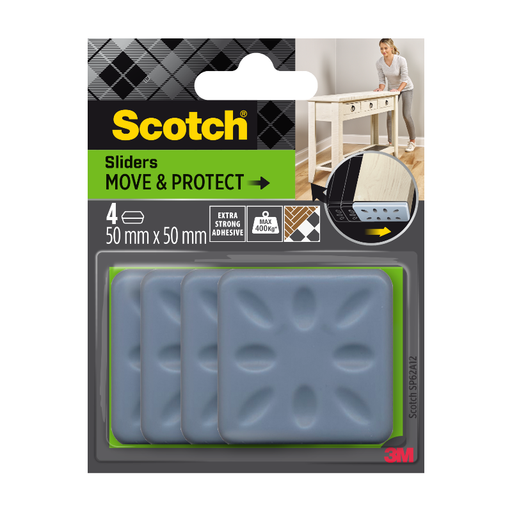
Why this choice suits this profile: Its square dimensions of 50 × 50 mm and stated capacity of 400 kg for four sliders make it suitable for large pieces of furniture that you may need to move occasionally.
Its large surface reduces the risk of choosing an undersized slider. However, make sure the underside of the leg is flat enough to accommodate the entire adhesive base.
A 50 × 50 mm format, honeycomb structure, permanent adhesive and understated grey finish.
In rented accommodation, adhesive floor protection sliders generally avoid the need to drill into furniture legs. They can be fitted quickly, provided the surface is dry, degreased and sufficiently even. On a dusty or damp base, the adhesive may come away prematurely.
Nail-on models provide a more durable mechanical fixing, but installation requires more preparation. This range includes diameters of 19, 22 and 25 mm, with a stated capacity of 100 to 150 kg for four pieces, depending on the model. They may be suitable for wooden furniture with legs that can be nailed.
Whether you have wooden flooring, tiles or laminate, also check that there is no grit beneath the slider. Even a material described as non-marking can leave a mark if abrasive particles become trapped between the furniture and the floor.
We have brought together a complete selection, updated in real time, of products that meet these demanding selection criteria and European safety standards.
Clean and dry the underside of the leg, position the slider in the centre, then press firmly for around 30 seconds. Wait 24 hours before sliding the furniture. This setting time prevents the slider from shifting under the weight of the furniture.
It depends on the weight of the furniture, how often it is moved, how clean the floor is and how worn the sliding surface has become. Inspect the sliders regularly: any item that is deformed, coming away or covered in dust should be replaced.
The product descriptions in the range state that they are compatible with various floor coverings, including wooden flooring, tiles and laminate. Even so, test one first in an inconspicuous area. On an uneven floor, all-terrain models with articulated joints may be more suitable. However, a damp or dirty floor will compromise the adhesive’s grip.