
Livraison le jour même ou le lendemain

Qualité garantie

Débloquez vos offres de bienvenue: Livraison GRATUITE | Jusqu'à -80 % | 30 jours d'essai gratuits à JoyPlus
Téléchargez l'application
Moving a wardrobe, sofa or table can leave scratches on a wooden floor, marks on laminate or scuffs on tiles. Scotch furniture sliders reduce friction and make moving furniture easier, but not every model suits every leg type, weight load or use case.
Before you place an order, three common mistakes keep cropping up:
Here are the criteria to consider when choosing a solution that works for your furniture and your floor.
Measure the part of the leg that will rest on the slider. For a round leg, compare its diameter to that of the slider. For a square or rectangular leg, check the length and width instead.
Compact sizes, such as Ø 19 mm, Ø 25 mm or 24 × 24 mm, are suitable for chairs, small pieces of furniture, side tables and narrow legs. Models measuring 35 × 24 mm or Ø 40 mm offer a larger contact surface for a chest of drawers, sofa or sideboard.
For a large wardrobe, a piano or particularly heavy equipment, the Ø 50 mm, Ø 65 mm or Ø 80 mm sizes distribute pressure better. However, you must stay within the load limit stated by the manufacturer.
Adhesive furniture sliders can be fitted without tools. They are especially practical on clean, flat and sufficiently smooth legs. Surface preparation makes all the difference: clean, degrease and then dry the surface thoroughly before removing the protective film. For the models concerned, maintain pressure for around 30 seconds. A 24-hour waiting period may then be necessary before moving the furniture.
Nail-on furniture sliders provide a more durable mechanical fix on certain wooden legs or for furniture that is moved regularly. However, fitting them requires precision and a suitable tool. Check beforehand that the base of the furniture is thick enough to take a nail without risk of splitting.
Honeycomb sliders are designed to reduce the friction surface. Product listings sometimes claim a 50% or greater improvement in glide compared to furniture without sliders. This is a design-related figure, not a guarantee that applies in every situation.
To compare sliders for heavy furniture, check the stated capacity for a set of four pieces. Depending on their size, some references support 100 kg, others 150 kg, 300 kg, 400 kg, 500 kg or 600 kg. Allow a safety margin and take into account any uneven weight distribution.
The "All-Terrain" versions feature a swivel ball joint and compensating foam. This design copes better with small irregularities, such as tile grout lines or a slightly warped wooden floor. It does not mean you can handle the furniture carelessly on a step, slope or wet surface.
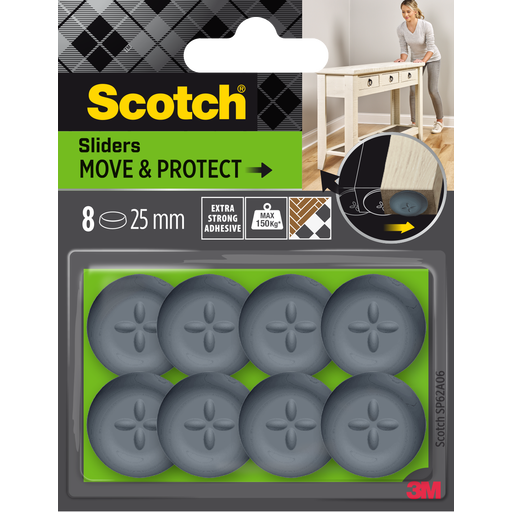
Why this choice suits this profile: its compact size and adhesive backing make it ideal for small furniture and tool-free home installation. The pack contains 8 pieces.
The clearly stated diameter reduces the risk of choosing the wrong size. The adhesive fix also avoids having to tackle a nail-on installation on a small leg.
Honeycomb structure, 8 pieces per pack and a stated load capacity of up to 150 kg for four sliders.
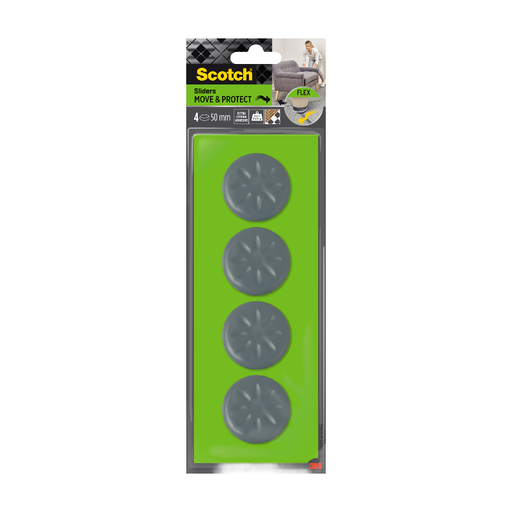
Why this choice suits this profile: the swivel ball joint and compensating foam really come into their own in a well-kept home, on wooden floors, tiles or laminate with slight irregularities.
It doesn't just rely on an "all surfaces" promise: the product listing specifically mentions a joint designed to handle irregularities.
Reinforced adhesive, 50 mm diameter, swivel ball joint and a stated load capacity of up to 400 kg for four pieces.
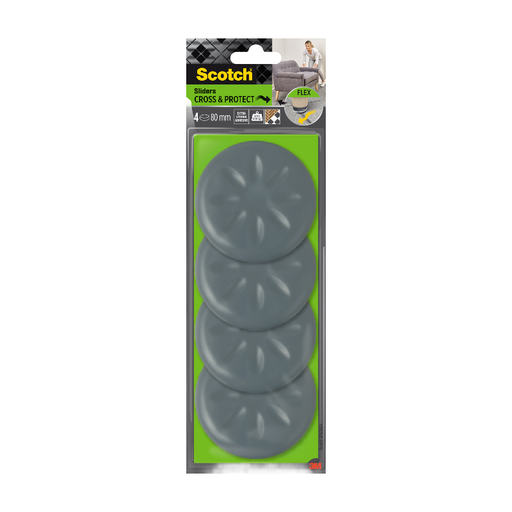
Why this choice suits this profile: its large diameter is designed for very heavy furniture and occasional moves of bulky items, provided you respect the stated capacity.
The maximum load is clearly stated: up to 600 kg for a set of four sliders. However, the weight must be properly distributed.
Ø 80 mm size, swivel ball joint, compensating foam and adhesive design for smooth or slightly uneven floors.
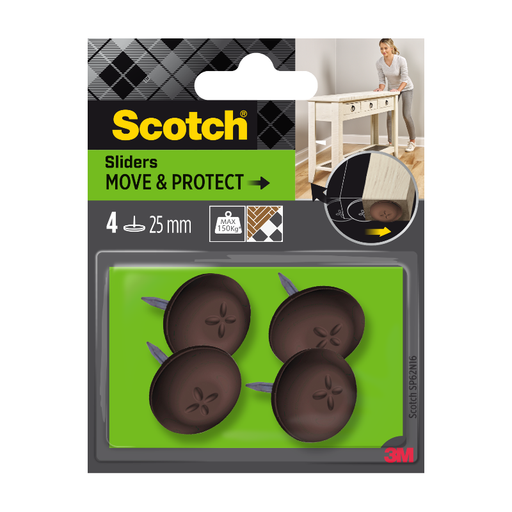
Why this choice suits this profile: the nail-on fixing is suitable for wooden legs that can take a stable mechanical fix, especially on furniture that is moved regularly.
It avoids relying on adhesive when the base is porous or uneven. However, measure the leg and check the wood thickness before fitting.
25 mm diameter, honeycomb structure and a stated load capacity of up to 150 kg for four sliders.
Floor-protection sliders are primarily designed for indoor use, either static or with slow movement. Check their condition regularly: embedded dust, peeling, cracks or deformation can reduce glide quality and mark the floor. Keep any unused small pieces out of the reach of children and pets.
We have compiled a complete, real-time updated list of products that fully meet these strict selection criteria and European safety regulations.
The product listings for the models shown indicate compatibility with all types of flooring, including wooden floors, tiles and laminate. However, the surface must be clean, dry and free from sand and grease. Carry out an initial test by moving the furniture slowly before using it regularly.
For several adhesive models, fitting requires around 30 seconds of pressure, followed by a 24-hour setting time before any movement. Always check the recommendations for the specific product you choose, especially for heavy furniture.
It all depends on the size and design: the products in this selection state a capacity ranging from 100 kg to 600 kg for four sliders. This value should be treated as the limit stated on the product listing. Allow a safety margin and ensure the weight is distributed evenly.