
当日/次日达

品质保障

开启新人专享福利: 全场免邮 | 低至 2 折 | 免费试用 30 天 JoyPlus 会员
下载 Joybuy
Moving a sofa, wardrobe or piano can quickly leave scratches, black marks or compression marks on wooden flooring, tiles or laminate. Scotch adhesive furniture sliders allow you to move furniture without tools, but not every model is suitable for the same legs or loads.
The most common mistake is choosing a slider based solely on its price or appearance. To avoid an unsuitable purchase, pay particular attention to the type of fixing, dimensions, stated maximum load and compatibility with your intended use.
An adhesive slider can be fitted quickly, provided the surface is clean, dry and sufficiently flat. On a dusty, varnished, greasy or uneven furniture leg, the adhesive may not hold as well. For furniture that is moved regularly, preparing the surface and allowing the adhesive to set for the recommended time are therefore essential.
Adhesive sliders are generally designed to remain in place, while some removable accessories are intended mainly for occasional moving. The right choice therefore depends on how the furniture will actually be used.
A capacity stated for four sliders does not necessarily mean that one slider can support a quarter of that load in every configuration. The weight must be distributed across stable legs that are correctly positioned and fully in contact with the sliders.
A heavy piece of furniture resting on three contact points, with a damaged leg or a concentrated load, may exert very different pressure from that considered in the product specifications. For a piano, safe or heavily loaded wardrobe, measure the legs and check the structure before fitting the sliders.
A square slider is not automatically suitable for a round leg. Similarly, a standard model may be less practical on a floor with tile joints or minor uneven areas. In this situation, all-terrain models with a pivot and compensating layer may be more suitable.
Adhesive furniture sliders can be fitted without drilling. They are suitable for furniture with legs that have a clean, sufficiently smooth base. Press firmly on each slider for around 30 seconds, then follow the setting time stated in the product specifications, which may be up to 24 hours before moving the furniture.
Nail-on furniture sliders require a compatible surface and a suitable tool. Their mechanical fixing may be suitable for certain wooden furniture, but it leaves a permanent fixing point. Avoid nailing into fragile or hollow materials, or materials that may split.
Measure the contact area of the leg before ordering. Available sizes include:
A slider that is too small may concentrate the pressure and come away more quickly. Conversely, a model that is too large may extend beyond the leg and make it difficult to position the furniture.
The specifications for Scotch honeycomb sliders state different capacities depending on the reference: 100 kg, 150 kg, 300 kg, 400 kg, 500 kg or 600 kg for four sliders. These figures reflect the capacities stated for the products; they do not replace a check of the furniture’s stability.
The honeycomb structure is designed to make sliding easier and reduce friction. To protect your floor, remove dust and small grit before moving the furniture. Even scratch-resistant furniture sliders can leave a mark if debris becomes trapped underneath.
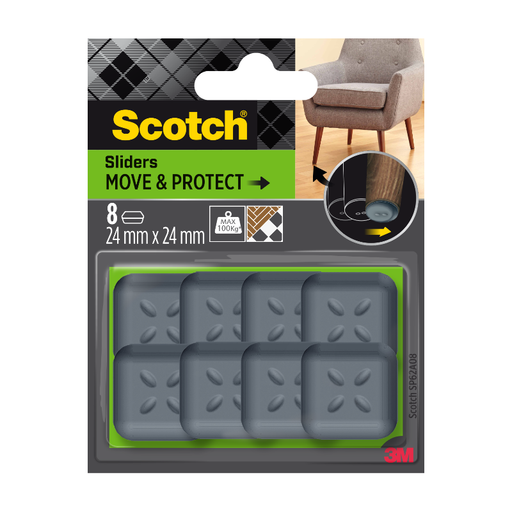
Why this choice suits this profile : Its compact size and pack of eight are suitable for small items of furniture, chairs and tables with legs that have a regular surface.
The dimensions are clearly stated and the maximum load is listed as 100 kg for four sliders. This helps you avoid choosing a model that is oversized or unsuitable.
A honeycomb structure, adhesive fixing and eight pieces per box. The manufacturer states that it can be used on all types of flooring.
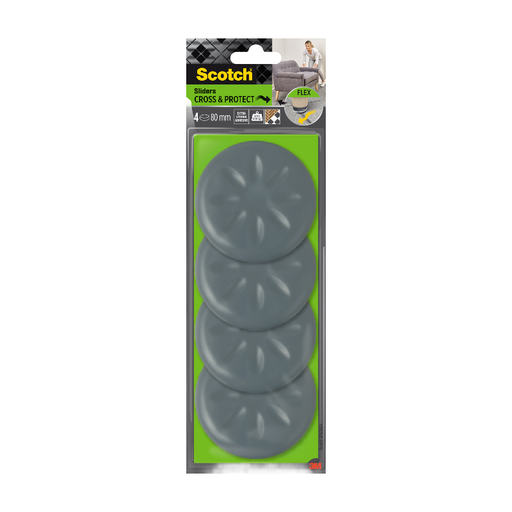
Why this choice suits this profile : Its large diameter, pivot and compensating foam are designed for very heavy or bulky furniture that needs to move across slightly uneven surfaces.
The specifications do more than state the diameter: they also specify an articulated ball joint and a compensating layer to absorb minor uneven areas.
A set of four sliders, an 80 mm diameter and a stated maximum load of 600 kg for four pieces.
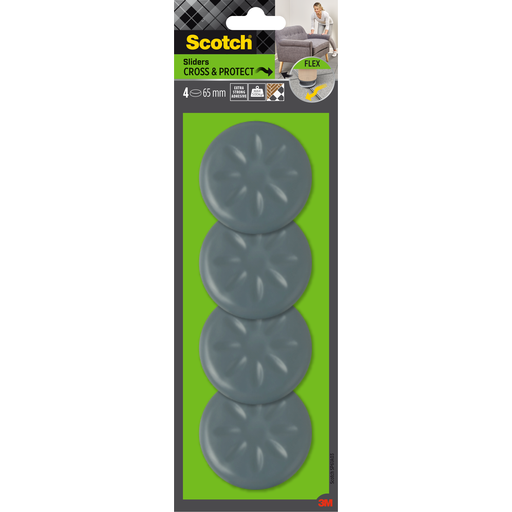
Why this choice suits this profile : This size is suitable for sofas, wardrobes, pianos and other bulky items that are moved occasionally across wooden flooring, tiles or laminate.
The stated load of 500 kg for four sliders is combined with reinforced adhesive fixing. However, installation requires a clean surface and a setting time of 24 hours.
A 65 mm diameter, articulated ball joint, compensating foam and a honeycomb structure, according to the product specifications.
For heavier loads, do not move a piece of furniture on your own. Remove fragile items and proceed slowly. Sliders are generally designed for static indoor furniture or furniture moved at low speed; they are not a substitute for professional handling equipment.
We have put together a complete, real-time updated selection of products that meet these strict selection criteria and European safety requirements.
The specifications for several models state that they are compatible with various floor coverings, including wood, tiles and laminate. However, clean both the slider surface and the floor before each move. A grain of sand or small piece of debris can cause a scratch, whatever the model used.
Hold the slider in place for around 30 seconds, then allow the adhesive to set. For models designed for heavy loads, the specifications generally recommend waiting 24 hours before moving the furniture. This precaution reduces the risk of premature detachment.
Choose high-strength adhesive sliders if you want tool-free installation and the leg is clean, smooth and compatible. Nail-on sliders may be suitable for wooden furniture that can accept a mechanical fixing. In either case, compare the shape of the leg, the furniture’s total weight and how often it will be moved before placing your order.