
当日/次日达

品质保障

开启新人专享福利: 全场免邮 | 低至 2 折 | 免费试用 30 天 JoyPlus 会员
下载 Joybuy
A sofa that leaves marks, a table that’s difficult to move, or a scratched wooden floor after rearranging the room can quickly turn into unnecessary expense. Scotch adhesive furniture sliders make it easy to move many pieces of furniture while creating a protective barrier between the legs and the floor. But you still need to choose the right diameter, the correct fixing system, and a sufficient load capacity.
A wide slider isn’t necessarily suitable for every piece of furniture. It must match the surface area of the leg, stay properly centred, and support the weight distributed across the entire item. A model that’s too small concentrates the weight on a reduced area and risks losing its grip more quickly.
The stated capacities generally refer to a set of four sliders. That doesn’t mean the furniture can be pulled abruptly or moved over a long distance. Very heavy furniture, pianos, and professional equipment should be moved slowly and with care.
An adhesive applied to a dusty, damp, or greasy leg is likely to come unstuck. The slider can then slip, go crooked, or leave the furniture in direct contact with the floor. For a long-lasting fit, clean the surface thoroughly, dry it completely, and allow the recommended setting time.
Adhesive furniture sliders are installed without tools and are suitable for furniture with relatively flat leg surfaces. They are particularly handy for a quick fit or when the furniture cannot be drilled.
Nail-on models offer a mechanical fixing that works well on certain wooden legs. However, they require more precision and aren’t suitable for all structures. In both cases, check that the slider sits perfectly flat.
Square formats, such as 24 × 24 mm or 40 × 40 mm, suit legs with regular outlines. Round models, from 25 to 80 mm in diameter, can be adapted to circular legs or equipment fitted with castors.
Honeycomb furniture sliders are designed to reduce the contact area and make sliding easier. The product sheet for the relevant Scotch models states an improvement in sliding of more than 50% compared to furniture without sliders. This figure is a product presentation detail, not a guarantee valid in every situation.
Always compare the stated load for four sliders against the total weight of the furniture and its contents. For a chest of drawers, a table, or a sofa, a capacity of 100 to 150 kg may be suitable for everyday use, depending on weight distribution. For heavy furniture, pianos, or bulky items, choose floor protection sliders with a higher capacity.
Product sheets mention compatibility with wooden floors, tiles, and laminate. However, remove any small grit and dust from under the sliders: these particles can scratch the floor, even with appropriate protection.
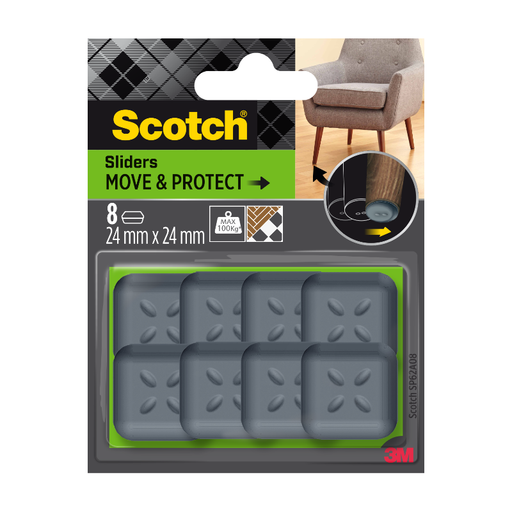
Why this choice suits this profile: Its compact size and adhesive fixing are ideal for everyday furniture such as a chair, a small table, or a storage unit.
The stated capacity reaches 100 kg for four sliders, which prevents choosing an undersized model for everyday furniture.
24 × 24 mm format, pack of 8 pieces, honeycomb structure, and adhesive fixing for tool-free installation.
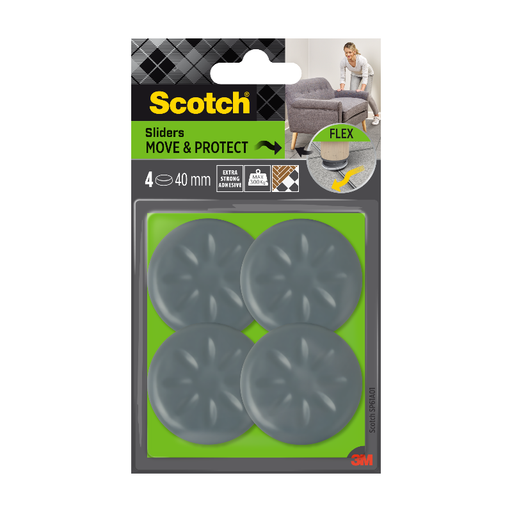
Why this choice suits this profile: Its articulated design is aimed at those looking for a more sophisticated solution for heavy furniture or floors with minor irregularities.
The ball-and-socket joint and compensating foam reduce the risk of instability on uneven surfaces. The product sheet states up to 300 kg for four sliders.
40 mm diameter, honeycomb structure, reinforced adhesive, and tool-free installation after cleaning the surface.
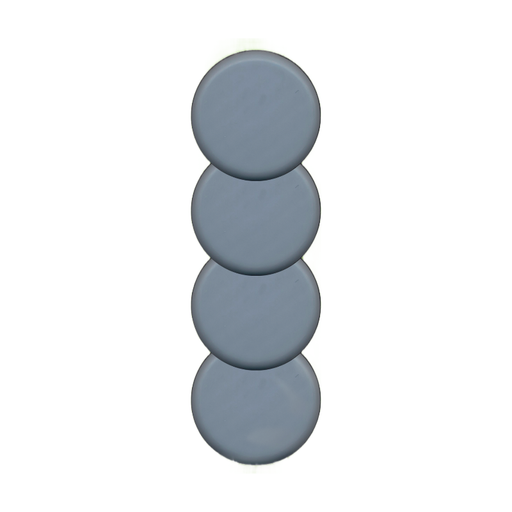
Why this choice suits this profile: This model is designed for heavy equipment with castors, particularly pianos, pool tables, and other furniture that’s difficult to move.
Its specific design for castor feet prevents using a small adhesive slider under heavily loaded equipment. The stated capacity is 500 kg for four sliders.
65 mm diameter, smooth plastic, and a pack of four sliders designed to minimise marks left by castors.
We’ve put together a comprehensive, real-time updated list of products that fully meet these strict selection criteria and European safety regulations.
Small accessories should be kept out of reach of children and pets. Also avoid using them on a damp or oily surface. For extremely heavy furniture, do not exceed the stated load and arrange for appropriate assistance.
The lifespan depends on the weight supported, how often the furniture is moved, how clean the floor is, and the quality of the fixing. Fitting on a dry, clean surface reduces the risk of peeling. Replace any slider that is deformed, cracked, or clogged with dirt.
Product sheets indicate compatibility with several types of flooring, including wooden floors, tiles, and laminate. However, make sure the surface is clean, stable, and free of debris. On a fragile or recently renovated wooden floor, test first in an inconspicuous area.
Non-slip sliders and gliding sliders don’t serve exactly the same purpose. To move furniture, choose a model whose stated capacity for four pieces covers the total weight, then move forward slowly. Very heavy furniture or items with castors may require a specific large-diameter model.