
当日/次日达

品质保障

开启新人专享福利: 全场免邮 | 低至 2 折 | 免费试用 30 天 JoyPlus 会员
下载 Joybuy
Moving a sofa, wardrobe or household appliance without scratching a wooden floor can quickly become a tricky task. Scotch adhesive furniture sliders make it easier, provided you choose a model suited to the furniture’s weight, the shape of its feet and the type of flooring.
Certain mistakes are common when buying. A diameter that is too small concentrates the weight over a limited area. Adhesive applied to a dusty foot may come away quickly. Another point to watch: a capacity stated for four sliders does not correspond to the load supported by a single piece. Here are the criteria to check before placing your order.
A slider advertised as suitable for wooden floors, tiles, vinyl or laminate does not remove the need to check the condition of the floor. Tile grout, uneven surfaces and moisture can make moving the furniture more difficult or make it unstable.
On a delicate wooden floor or a recently refurbished surface, it is best to start by testing the slider in an inconspicuous area. Anti-scratch floor sliders limit direct contact between the furniture and the flooring, but they cannot work miracles on a floor that is already damaged or if the furniture is moved too roughly.
Product listings generally state a maximum load for a set of four sliders. This figure should be compared with the total weight of the furniture, its contents and any appliances placed on top.
A fully loaded sideboard, piano or heavy chest requires high-capacity furniture sliders. For a chair, lightweight table or small chest of drawers, more compact sizes may be sufficient. If the load is unevenly distributed, also check that each slider remains firmly in contact with the floor.
An adhesive protective slider must be attached to a clean, dry and degreased surface. Dust, wax residue and moisture reduce adhesion. For Scotch All-Terrain models, the product information recommends holding the slider under pressure for around 30 seconds, then allowing the adhesive to set for 24 hours before moving heavy furniture.
This step is particularly important for a long-lasting installation. If the furniture needs to be moved immediately, a temporary solution or lifting device will often be more suitable.
Measure the underside of the foot before choosing your furniture sliders. A round 25 or 40 mm model is suitable for many narrow feet. Sizes of 50 mm or more distribute the load more effectively, provided the furniture foot has room for them.
Square models, such as 40 x 40 mm sliders, are often better suited to rectangular feet. For an elongated foot, dimensions of 70 x 19 mm or 35 x 24 mm may be more appropriate than a round disc.
Honeycomb furniture sliders feature a structured surface designed to reduce friction. For several references, Scotch states that they offer up to 50% more glide than furniture without sliders. This is information provided in the product specifications, not a guarantee that applies in the same way to all floors and loads.
On slightly uneven surfaces, All-Terrain models feature an articulated ball joint and compensating foam. This design can help the slider follow small changes in the floor, particularly when passing over tile grout.
Nail-on furniture sliders are not suitable for every structure. Check the thickness of the wood and make sure there are no cables, mechanisms or fragile materials underneath the furniture.
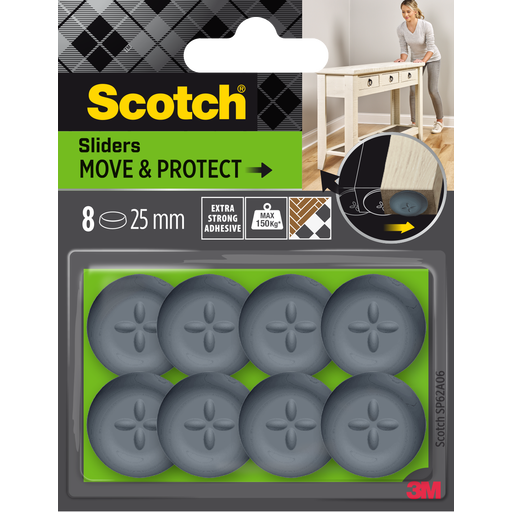
Why this choice suits this profile : With eight compact sliders, this pack is suitable for small items of furniture and everyday household use. The stated capacity is up to 150 kg for four sliders.
Its size makes it easy to check compatibility with the foot precisely and avoids over-specifying a lightweight piece of furniture. The adhesive fixing also means there is no need for drilling.
A honeycomb structure, eight pieces per pack and stated compatibility with different types of flooring.
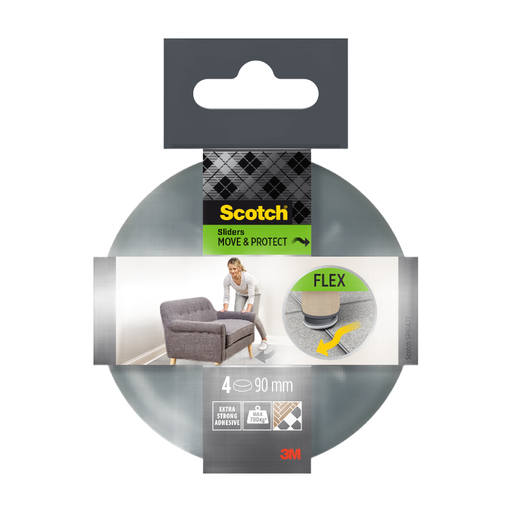
Why this choice suits this profile : Its large diameter, flexible structure and stated capacity of up to 700 kg for four pieces make it suitable for large items of furniture and slightly uneven surfaces.
The capacity and diameter are clearly stated. You can therefore check compatibility before buying, rather than relying on a vague promise of strength.
A 90 mm diameter, an articulated ball joint, compensating foam and adhesive stated to be long-lasting.
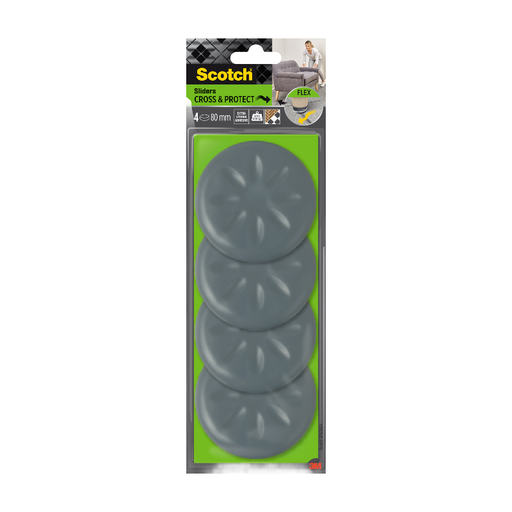
Why this choice suits this profile : This pack of four sliders is designed for heavy loads, with a stated capacity of 600 kg and an articulated design suited to moving furniture across floors with minor irregularities.
The 80 mm diameter and reference load are clearly stated. This makes it impossible to accidentally choose a small slider for a very heavy piece of furniture.
A honeycomb structure, an articulated ball joint, compensating foam and tool-free adhesive fixing.
We have put together a comprehensive, real-time selection of products that meet these demanding criteria while complying with European safety regulations.
For furniture with castors, choose castor sliders with a smooth surface. For permanent installation on wood, nail-on models offer another fixing solution, but they require a compatible support.
When a piece of furniture rests on four support points, you would generally use one slider per foot. If its base is wide, uneven or made up of several contact areas, distribute the supports without exceeding the load stated for the pack.
The product information for several references states that they can be used on wooden floors, tiles, vinyl and laminate. However, testing them first is still recommended on delicate flooring. The surface must be clean, dry and free from any debris that could become trapped beneath the sliding surface.
This varies according to the weight of the furniture, how often it is moved, the condition of the floor and the quality of the installation. Replace a slider as soon as it shows visible wear, starts to come away or no longer stays correctly aligned beneath the furniture foot.