
Livraison le jour même ou le lendemain

Qualité garantie

Débloquez vos offres de bienvenue: Livraison GRATUITE | Jusqu'à -80 % | 30 jours d'essai gratuits à JoyPlus
Téléchargez l'application
Moving a sofa, chest of drawers or wardrobe can quickly leave scratches on wooden flooring, marks on laminate or scuffs on tiles. Scotch adhesive furniture sliders reduce friction between furniture legs and the floor, without drilling or requiring any special tools.
However, not all furniture sliders are the same, and they are not suitable for every application. An unsuitable size, an incorrectly estimated load or an inadequately prepared surface can cause the slider to come away prematurely. Here are the criteria to consider before buying, along with a selection of models suited to different needs.
An adhesive slider makes it easier to move furniture, but its effectiveness also depends on the shape of the leg, how clean the surface is and the type of flooring. If the furniture is moved across a damp, dusty or greasy surface, the adhesive may come away.
The honeycomb structure of Scotch sliders is advertised as providing over 50% more glide than furniture without sliders, according to the specifications provided for these products. This is a theoretical indication, however, and should be considered in relation to your furniture and setup.
The stated capacity often applies to a set of four sliders, rather than a single piece. You therefore need to take into account the weight of the furniture, its contents and the forces exerted while it is being moved.
For example, four sliders rated for 100 kg may not necessarily be sufficient for a heavily loaded wardrobe. For heavy furniture, allow a safety margin and make sure the weight is distributed evenly.
Self-adhesive sliders can be fitted quickly and without tools. They are particularly suitable for lightweight furniture or surfaces that you do not want to drill. Nail-on furniture sliders, on the other hand, require a sufficiently solid base and provide a more durable fixing.
Adhesive should not be applied to an uneven, crumbly or dusty leg. For the best hold, clean and dry the surface thoroughly, then press the slider firmly into place before allowing the adhesive to set.
Measure the available area beneath each leg. A 24 × 24 mm slider will not cover the same area as a 40 × 40 mm model or one measuring 50 mm in diameter.
A slider that is too small may concentrate the load. If it is too large, it may extend beyond the leg and catch on an obstacle.
Always check whether the maximum load applies to four sliders. For the models in this selection, the stated capacities range from 100 kg to 400 kg per set of four, depending on the diameter, structure and range selected.
For heavy furniture, distribute the sliders across genuinely strong load-bearing points. A full bookcase, a refrigerator or a large sofa may require furniture sliders with a wider surface, or even an all-terrain model.
The products featured are advertised as compatible with various types of flooring, including wooden flooring, tiles, laminate and hard surfaces. This compatibility does not remove the need to carry out a preliminary test in an inconspicuous area.
Regularly remove dust and small grit that may collect beneath anti-scratch sliders. When the furniture is moved, these particles can act as an abrasive and damage the floor.
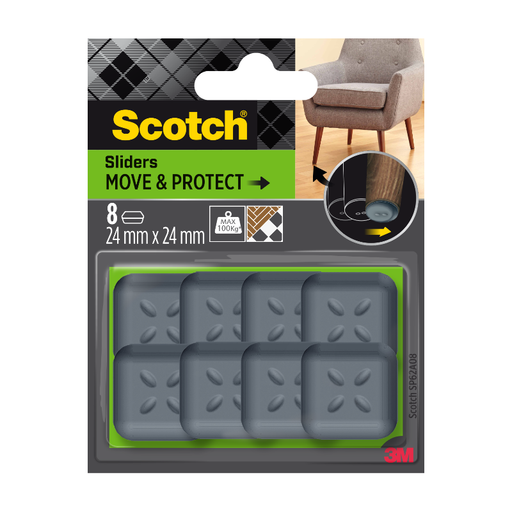
Why this product suits this profile : Its compact size and adhesive fixing make it suitable for small pieces of furniture and first-time installations, with no special tools required.
The stated load reaches 100 kg for four sliders. This model should therefore be reserved for furniture that remains within this limit.
24 × 24 mm size, eight pieces per set, honeycomb structure and advertised permanent use.
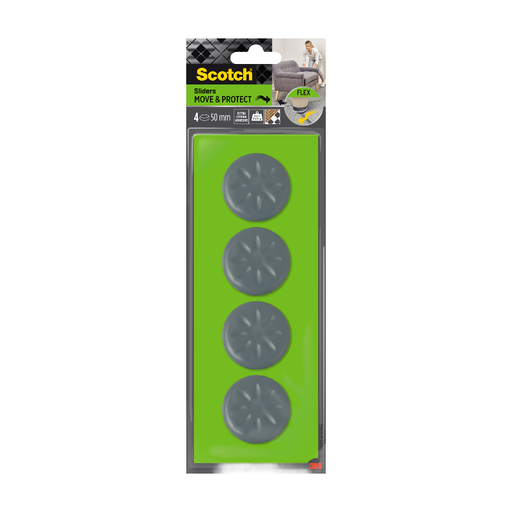
Why this product suits this profile : Its 50 mm diameter and articulated design are intended for users who move large pieces of furniture across floors with minor irregularities.
The articulated joint and cushioning foam are designed to follow tile joints and slight unevenness more effectively.
Four pieces, 50 mm diameter and a stated maximum load of 400 kg per set.
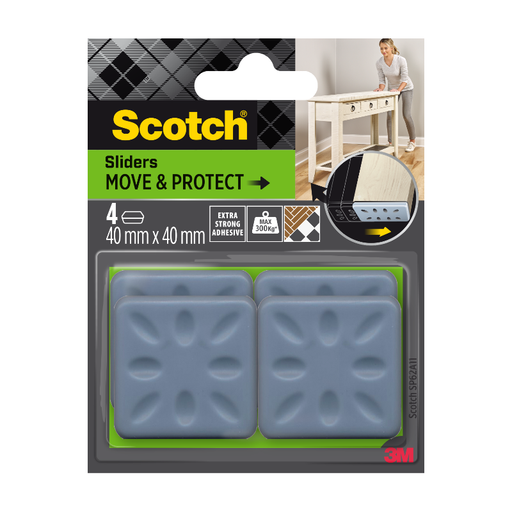
Why this product suits this profile : Its 40 mm square base provides a contact area suited to heavier furniture, provided the leg allows it to be fitted completely flat.
Its size reduces the risk of choosing a slider that is too narrow for a wide leg. The stated load must nevertheless be checked before installation.
Four 40 × 40 mm adhesive sliders, with a stated maximum load of 300 kg per set.
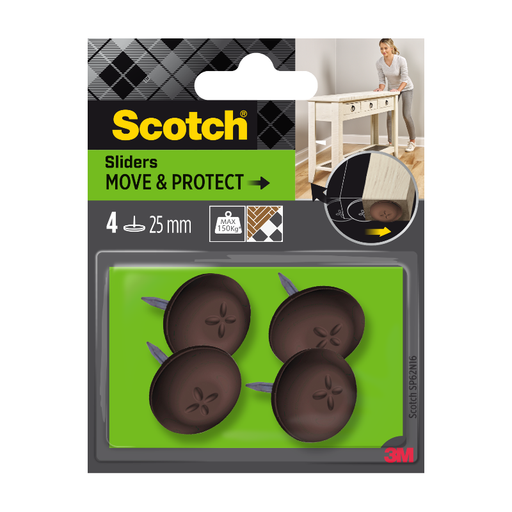
Why this product suits this profile : The nail-on fixing is suitable for sufficiently thick wooden legs, particularly for furniture that is moved regularly or used in a workshop.
It avoids relying on adhesive on a dusty surface, but requires a compatible leg and precise installation.
25 mm diameter, four pieces per set and a stated maximum load of 150 kg per set.
We have selected a complete range, updated in real time, of products that meet these exacting criteria while complying with European safety regulations.
To ensure that 3M Scotch adhesive sliders stay securely in place, follow these steps:
Adhesive models are intended for indoor furniture that remains in place or is moved slowly. Do not use them on a damp or greasy surface. Keep small parts out of the reach of children and pets.
The product specifications for the models featured indicate compatibility with all types of flooring. Nevertheless, check the condition of the slider, regularly remove dust and test it in an inconspicuous area, particularly on delicate or recently treated wooden flooring.
Its lifespan depends on the weight supported, how often the furniture is moved, humidity and how well the surface was prepared. When correctly applied to a clean surface, a slider can remain in place for permanent use. It should nevertheless be inspected regularly.
Not necessarily. Large-diameter adhesive sliders may be suitable if the surface is flat and clean, and if the load remains within the stated specifications. Nail-on models are mainly recommended for solid wooden legs when you want a durable mechanical fixing.