
Livraison le jour même ou le lendemain

Qualité garantie

Débloquez vos offres de bienvenue: Livraison GRATUITE | Jusqu'à -80 % | 30 jours d'essai gratuits à JoyPlus
Téléchargez l'application
Finding a gift that's both fun and educational can often be a puzzle. What if the solution was a science toy? When chosen well, it transforms playtime into a fantastic adventure, a far cry from quickly forgotten gadgets. It's the gift that keeps on giving, laying the foundation for logic, curiosity, and the joy of discovery.
Our editorial team has analysed dozens of products to help you navigate the options. In this guide, we'll give you everything you need to choose the right model and present our selection of the best science toys, tailored to every age and interest.
Before diving into our selection, let's review the essential criteria for making the right choice.
This is the number one criterion. A toy that's too complex can lead to frustration, while one that's too simple will quickly bore an older child. Getting it right is crucial.
Nothing is more effective than learning fuelled by passion. Observe what fascinates the child: The stars? Dinosaurs? The inner workings of the objects around them?
By choosing a STEM (Science, Technology, Engineering, and Mathematics) toy that resonates with their interests, you're giving them hours of independent exploration and play.
Here are our top picks for 2026—toys that successfully combine play, discovery, and education, selected for their quality and intelligent design.
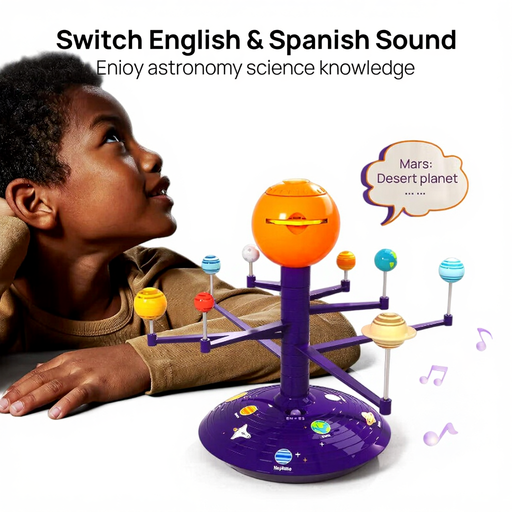
Why it stands out: More than just a toy, this is a true 3-in-1 tool. It serves as an assemblable solar system model, a projector to turn the ceiling into a planetarium, and even a language primer with its bilingual audio function (English/Spanish) that names the planets and shares facts about space.
Key Features:
Who is it for? Ideal for budding astronomers aged 3 to 8. An excellent gift that can serve as a backdrop for bedtime stories or as a first introduction to astronomy.
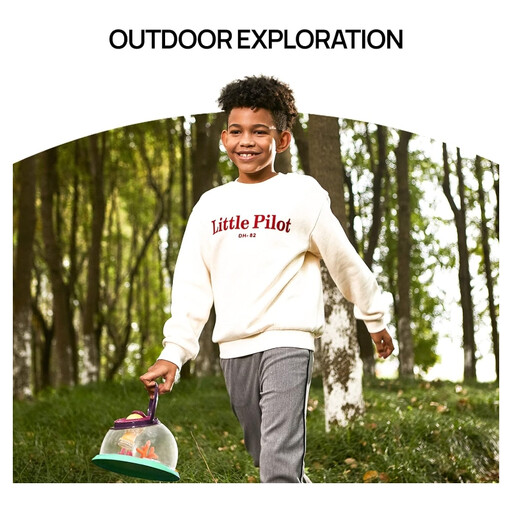
Why it stands out: Much more than a simple bug box, this explorer kit is a true pocket laboratory. Its built-in magnifying glass, offering 5X magnification and a 360° pivot, allows for observing insects from every angle without stressing them. The easy catch-and-release system teaches respect for living creatures—a valuable lesson in empathy.
Key Features:
Who is it for? Perfect for budding naturalists aged 3 to 10. A toy that encourages them to get outside, explore the garden, and discover local biodiversity with respect.
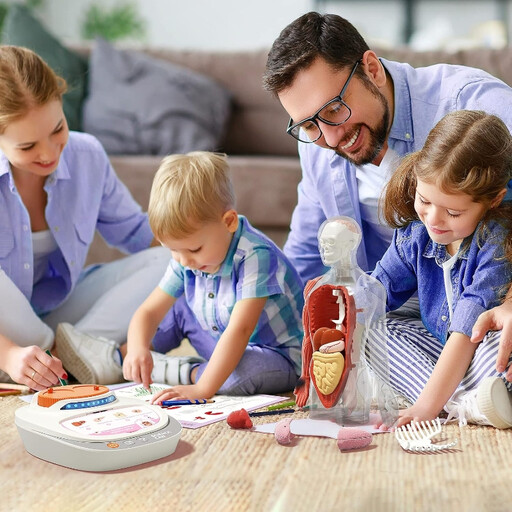
Why it stands out: This anatomical model brings biology lessons to life. Far from being a static model, it's interactive and talking, guiding the child through the discovery of organs and their functions. The pieces are made to be handled, which greatly aids in memorising their names and placement in the body.
Key Features:
Who is it for? For future doctors and biologists aged 6 to 12. A remarkable educational tool for both home and the classroom, which finally provides a fun answer to the famous question: "How does it work inside?"
Our selection is just a starting point. The world of science toys is vast and covers countless themes, from chemistry and robotics to palaeontology.
To explore further, browse our complete collection of children's toys and find the hidden gem that will spark a new passion.
The acronym STEM stands for four disciplines: Science, Technology, Engineering, and Mathematics. A STEM toy aims to develop skills in these areas in an interdisciplinary and fun way. It stimulates problem-solving, critical thinking, creativity, and curiosity to better prepare children for the world of tomorrow.
There are science kits for all ages. From age 3, simple observation sets (like our explorer kit) are perfect with adult supervision. Around ages 6-8, children can independently handle simple experiments guided by illustrated instructions. The key is to always choose a kit with a complexity level appropriate for the child's maturity.
Far more than just imparting knowledge, this type of toy forges key life skills. It teaches patience (following a protocol), logic (understanding cause and effect), perseverance (when an experiment fails and you have to start over), and above all, the self-confidence that comes from successfully completing an experiment from start to finish.