
Livraison le jour même ou le lendemain

Qualité garantie

Débloquez vos offres de bienvenue: Livraison GRATUITE | Jusqu'à -80 % | 30 jours d'essai gratuits à JoyPlus
Téléchargez l'application
Choosing a school pencil case seems simple… until the zip gets stuck, pens start piling up, or the case takes up half the bag. Whether it is for a schoolchild, student, parent or professional, the right model is about more than its pattern: capacity, organisation and materials matter just as much.
Here are the key criteria to consider before buying, along with a selection of models suited to different needs.
A slim pencil case slips easily into a schoolbag, but it may be too small for a pupil who uses felt-tip pens, highlighters, an eraser and a ruler. Conversely, an oversized model can quickly take up valuable space in the bag.
Check the outer dimensions, but also consider the shape of the internal space. A 22 cm-long pencil case can accommodate standard pens, while a model with limited height may not be suitable for thick markers.
A pencil case for girls, a children’s pencil case or a colourful model may be appealing at first glance. However, its appearance says nothing about the quality of the zip, the durability of the stitching or how easy it is to clean. Light colours and printed surfaces also tend to show stains more clearly.
Looks do matter, particularly when it comes to personalising school supplies, but they should come after practical considerations: access to the contents, durability and the manufacturer’s cleaning instructions.
A three-compartment pencil case makes it possible to separate pens, pencils and accessories. However, it is thicker than a simple model. If the user only carries a few writing instruments, this additional organisation may simply make the bag more cumbersome.
For studying, drawing or creative hobbies, multiple compartments can save time by eliminating the need to search through the entire case for a particular colour or accessory.
For a pencil case for pens used every day, check the measurements in centimetres and consider what you genuinely need to store inside:
The 22 × 6 × 6 cm OXFORD leather pencil case states that it can hold approximately 20 pens and a 15 cm ruler. Another OXFORD model measuring 22 × 6 × 4 cm can hold around 15 pens and a folding ruler. These specifications provide a useful basis for comparing capacity.
Polyester is often a practical choice for a school pencil case: it can generally be wiped clean with a damp cloth and stands up well to everyday use. The Maped Yummy model is described as being made from polyester, with a metal zip pull and plastic teeth.
A leather pencil case offers a more refined texture and can also be used as a storage pouch, travel case or holder for small accessories. However, this material requires more care: use a soft, dry cloth, protect it from moisture and avoid prolonged exposure to sunlight.
Before purchasing, check the care instructions. Several of the featured models should not be machine-washed or immersed in water.
The zip should glide smoothly without resistance and be adequately protected. For everyday school use, a single zip provides quick access to the entire contents. Three separate zips are more useful for sorting supplies by category.
Safety also deserves attention: some zip pulls include small parts or edges that should be handled with care. As manufacturers’ warnings point out, models containing small parts are not suitable for children under three years old.
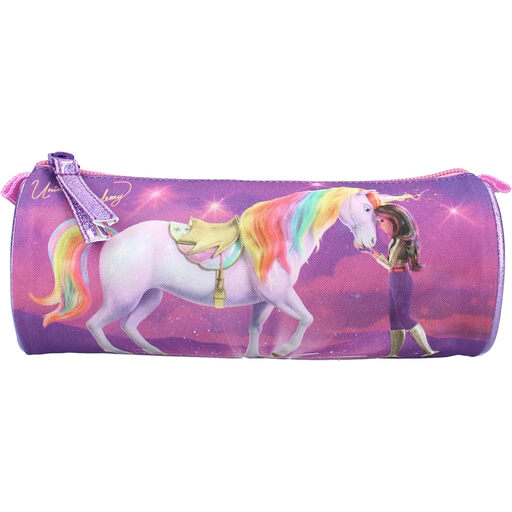
Why it is a good fit: Measuring 21 × 7 × 7 cm and weighing a stated 50 g, it is well suited to a child carrying everyday school supplies in their bag.
Its dimensions make it more than a simple choice based on appearance. The synthetic material can be wiped clean with a damp cloth, but the pencil case is not machine-washable.
Pink zip, inner lining and double-sided print. Its compact format fits easily into a child’s backpack.
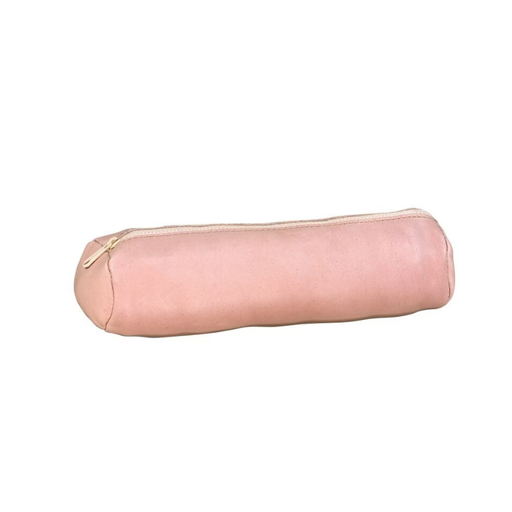
Why it is a good fit: With a single compartment and a supple leather construction, this versatile pencil case is suitable for the office, school or travel.
The single compartment is clearly stated, so there is no need to expect a complex organisational system for a small collection of supplies.
Zip fastening, internal name label and dimensions of 22 × 6 × 6 cm. The manufacturer recommends cleaning with a soft, dry cloth.
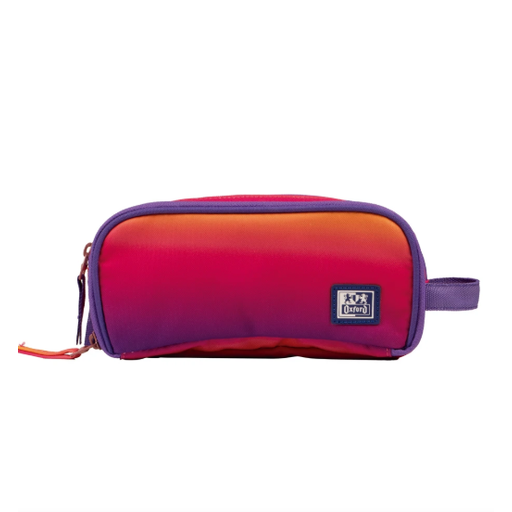
Why it is a good fit: Its three zipped compartments keep pens, pencils, felt-tip pens, erasers and other small supplies neatly separated.
The compartments are clearly separated and each has its own zip, so organisation does not depend on one large pocket.
Dimensions of 22 × 10 × 8 cm, polyester exterior and easy cleaning with a damp cloth.
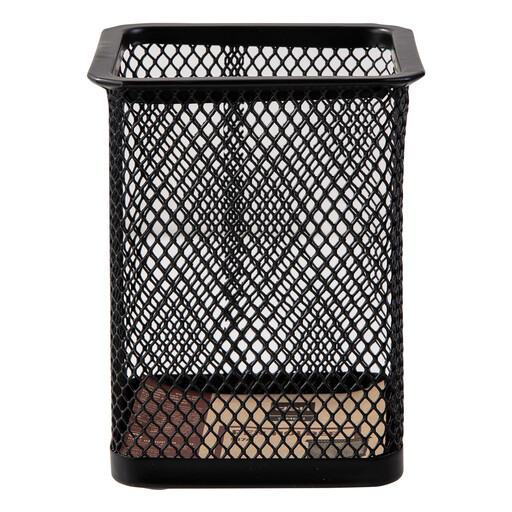
Why it is a good fit: On a workstation, an open pen holder is often more practical than a pouch designed for carrying.
It is clearly designed for desk use: this is not a closed pencil case intended to protect supplies inside a bag.
Its square shape and black finish blend discreetly into a desk or shelving unit.
We have brought together an updated selection of products that meet these criteria for storing pens and small accessories.
For a primary-school child, it is best to choose a children’s pencil case that is lightweight, easy to open and easy to spot inside a schoolbag. A simple zip and easy-care material will make everyday use more straightforward.
At secondary school, a pencil case with multiple compartments can be useful if the student carries a lot of supplies. However, remember to check the model’s thickness once filled: some can quickly take up considerable space.
For a student or professional, a compact pencil case or leather pouch makes it possible to carry the essentials while fitting neatly into a laptop bag or briefcase.
Artists and creative hobbyists should look for generous capacity, separate compartments and a wide enough opening. In this context, dimensions and zip durability matter more than appearance alone.
A format of approximately 21 to 22.5 cm is suitable for standard pens and pencils. If you use a 15 cm ruler, check that the depth and shape of the interior allow you to store it without bending it or putting pressure on the zip.
It is useful for separating different categories of supplies: writing, colouring and accessories. If you only carry a few pens, a compact single-compartment model will be easier to use and less bulky.
Avoid filling it to the brim, remove pencil-sharpener residue regularly and follow the manufacturer’s care recommendations. A damp cloth is suitable for some textiles, while leather is best cleaned with a soft, dry cloth. Before putting the supplies back inside, always make sure the pencil case is completely dry.