
Livraison le jour même ou le lendemain

Qualité garantie

Débloquez vos offres de bienvenue: Livraison GRATUITE | Jusqu'à -80 % | 30 jours d'essai gratuits à JoyPlus
Téléchargez l'application
A school pencil case needs to withstand daily journeys, hold essential stationery and make it easy to find what you need in your schoolbag. Yet sometimes, an attractive design is enough to sway the decision. A flimsy fastening, poorly designed shape or overestimated capacity can quickly make a pencil case bulky and impractical.
Before buying a pencil case for school, three criteria deserve your attention: the size and shape, the materials and the internal organisation. Here are the most common mistakes to avoid, along with a selection of models suitable for children, teenagers, students and creative minds.
A girls’ pencil case with patterns, a colourful boys’ pencil case, a Disney pencil case or a unicorn pencil case can catch your eye at first glance. But its appearance says nothing about the durability of the fabric or the quality of the fastening. For everyday use, look instead at the outer material, stitching, handle and type of zip.
Polyester and synthetic materials are easy to care for: a wipe with a damp cloth is usually all that is needed. Leather requires more care, but it can be perfectly suitable for school, work or life on the go if the care instructions are followed.
A pencil case measuring 21 to 22.5 cm in length is often enough for pens, pencils and small everyday stationery items. However, it may not be suitable for a ruler, a large quantity of felt-tip pens or drawing equipment.
At the other end of the scale, a large-capacity pencil case takes up more room in your bag and can quickly become heavy when full. It is therefore better to compare the stated capacity with the user’s actual needs rather than automatically choosing the largest model.
A single compartment lets you put your stationery away in seconds, but pencils can easily get mixed up and their leads may break. Dividers, elastic loops and dedicated pockets are particularly useful for students, artists and children who carry several types of tools.
A pencil case sold with felt-tip pens and pencils can be a good starting point for creative activities. Conversely, an empty stationery organiser gives you complete freedom over what to put inside.
Start by making a list of the stationery used every day:
A round pencil case makes good use of the available length, but its diameter may limit storage space for bulky accessories. Always check the complete dimensions, not just the length.
Lightweight and easy to clean, polyester is well suited to intensive school use. Synthetic materials generally offer the same benefits. For leather, opt for gentle cleaning and protect the pencil case from moisture by following the manufacturer’s instructions.
A hard pencil case offers greater protection against being crushed in a schoolbag. On the other hand, it is less easy to slide into tight spaces. It can be a good choice for children who carry lots of small stationery items or for anyone who wants to keep their accessories well protected.
The zip should glide smoothly without catching and withstand repeated opening. A metal zip pull is often easier to grip, while a plastic-toothed zip helps keep the overall weight down.
For children under 3, check the warnings concerning small parts, particularly zip pulls and accessories. Felt-tip pens, pencils and other stationery should also be used under supervision whenever required by the recommended age.
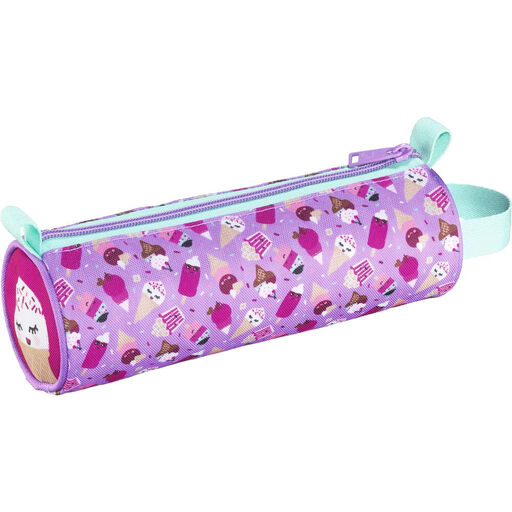
Why this model suits this profile : Its round shape holds everyday school stationery, while its pink design featuring ice creams and popcorn is sure to appeal to children.
The dimensions are clearly stated and the polyester fabric can be cleaned with a damp cloth. However, the manufacturer advises against machine washing.
22.5 × 7.5 cm size, fabric handle and fastening with a metal zip pull.
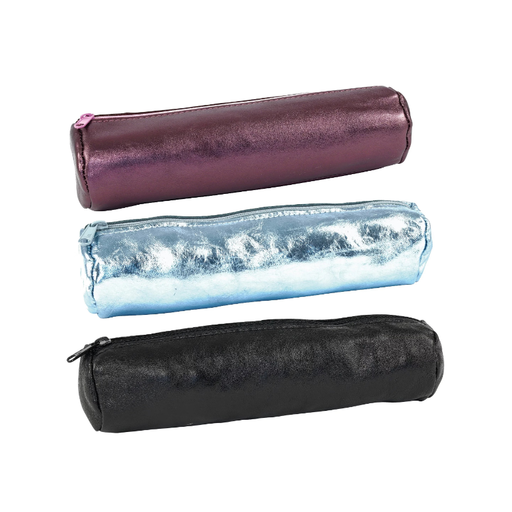
Why this model suits this profile : Its full-grain lambskin and iridescent finish give it a polished look, making it suitable for the office, studying and travel.
The stated capacity is specific: around 20 pens and a 15 cm ruler. It does not claim to be a large-capacity pencil case without explaining what it can actually hold.
22 × 6 × 6 cm size, inner label and versatile design that can also be used as a glasses case or small pouch.

Why this model suits this profile : Its hard shell and spacious interior are suitable for children and teenagers who carry lots of pens, pencils, erasers and rulers.
The hard shell reduces the risk of the contents being crushed in a schoolbag, a common problem with an overfilled soft pouch.
Hard outer shell, zip fastening and stated space for several stationery items.
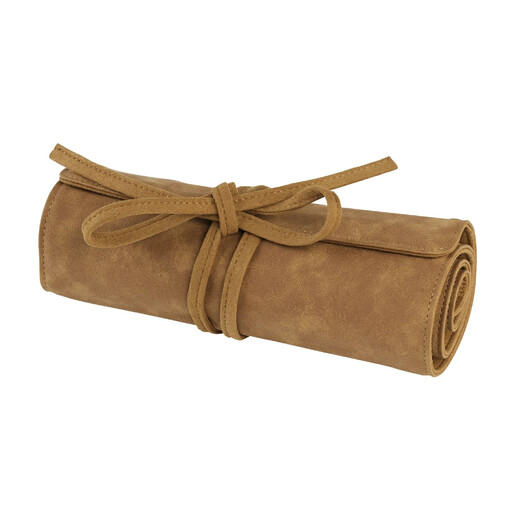
Why this model suits this profile : Its roll-up design keeps pencils, brushes, markers and other tools separate, while making it easy to carry everything in a bag.
Dedicated slots stop tools from getting mixed up and reduce the risk of overfilling a single compartment.
Adjustable slots, soft protection and an integrated fastening for transport.
We have brought together a complete, real-time updated selection of products that meet these demanding criteria and European safety standards.
For primary school, choose a lightweight model that is easy to open and easy to spot in a schoolbag. Colourful designs can help children quickly identify their belongings, but a reliable fastening remains the top priority.
At secondary school, a large-capacity or hard pencil case can be a good choice if the pupil uses several pens, highlighters and geometry instruments. For a student or employee, a leather pencil case or understated pouch can also be used to store small accessories.
Artists and drawing enthusiasts should choose a stationery organiser fitted with loops or compartments. For colouring, a set such as the Maped Jungle Fever Pencil Case 12 Feutres + 12 Pencils contains 24 tools: 12 felt-tip pens and 12 coloured pencils.
A pencil case approximately 22 cm long can hold a 15 to 20 cm ruler, depending on its diameter and shape. Whenever the information is available, always check the internal dimensions.
For most polyester or synthetic models, use a slightly damp cloth. Avoid machine washing if the manufacturer advises against it. For a leather pencil case, use a soft cloth and avoid water, direct sunlight and moisture wherever possible.
Its lifespan depends on how often it is opened, the weight it carries and how carefully the fastening is handled. Avoid overfilling the compartments, remove sharp objects you are not using and store the pencil case in your schoolbag without compressing it.