
Livraison le jour même ou le lendemain

Qualité garantie

Débloquez vos offres de bienvenue: Livraison GRATUITE | Jusqu'à -80 % | 30 jours d'essai gratuits à JoyPlus
Téléchargez l'application
The infamous school supplies list… an annual ritual that often turns into a real headache. Between the different sizes, paper weights, and ruling types, it's easy to get lost. Should you opt for a 24x32 notebook or an A5 notepad? Is 90gsm paper really enough?
Our mission: to help you make sense of it all. This guide breaks down the essential criteria for choosing the perfect school notebook for every need, from middle school to higher education, and even for your personal projects.
Before you rush to the store or fill your online cart, here are the points to check to avoid making the wrong choice and prevent unnecessary purchases.
Size is often the first consideration, and for good reason: it's usually dictated by the school supply lists.
Expressed in grams per square metre (gsm), the paper weight defines the paper's thickness and opacity. A detail that changes everything!
A notebook's sturdiness largely depends on its binding and cover. While staple-binding is the simplest, it's also less durable than a spiral or stitched binding for thick notebooks. As for the cover, a polypropylene model is an excellent option: it protects against spills and tears, and saves you from buying a separate notebook protector. Smart and cost-effective!
Now that we've covered the basics, let's move from theory to practice. Here is a selection of products that cater to different profiles, from the schoolchild to the budding artist.
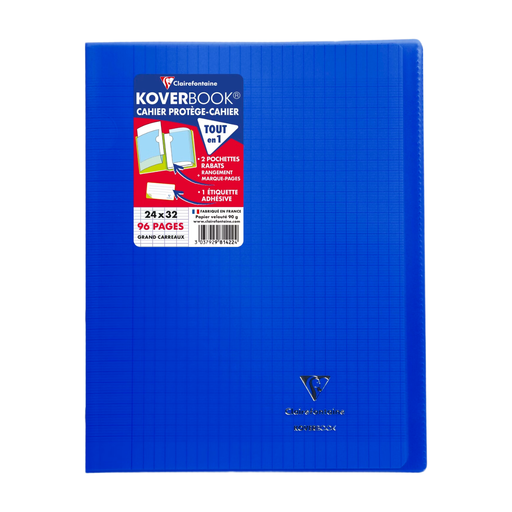
Why it stands out
This Clairefontaine notebook is the all-in-one solution favoured by students and parents alike. Its transparent polypropylene cover acts as an integrated notebook protector, offering robust protection throughout the year. Its 24x32 size meets the requirements of most school supply lists.
Key features
Who is it for?
Ideal for middle and high school students looking for a practical and durable notebook for intensive daily use.
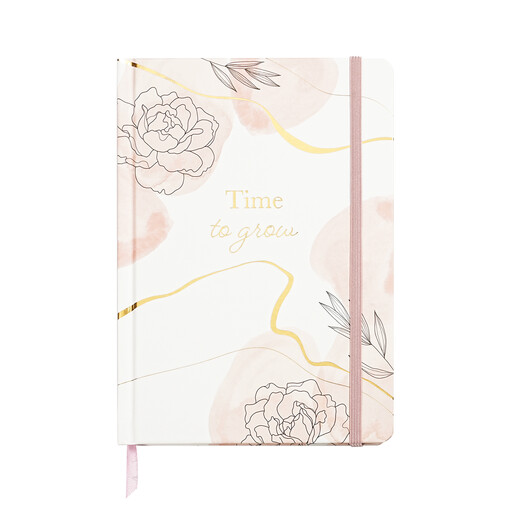
Why it stands out
This A5 notebook successfully combines elegance with practicality. Its rigid cover with a pink marble pattern makes it a beautiful object, equally at home in a university lecture hall, at the office, or as a personal diary.
Key features
Who is it for?
For students, professionals, journaling enthusiasts, or anyone looking for a stylish and practical notebook that also makes an excellent gift idea.
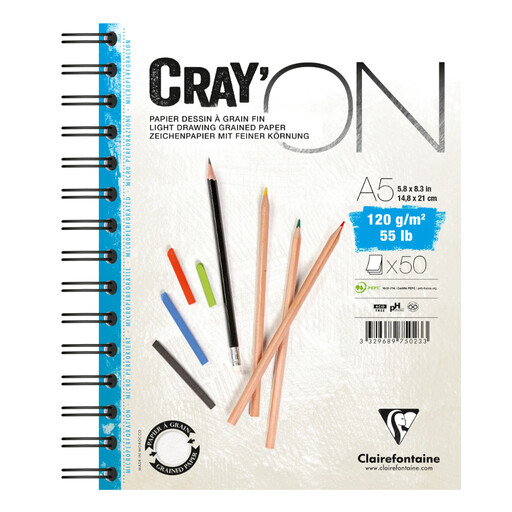
Why it stands out
This drawing pad is specially designed for dry media. Its extra-white cellulose paper has a very fine grain surface on one side and a smooth surface on the other, offering a versatility highly appreciated by artists.
Key features
Who is it for?
For art students, amateur illustrators, and professionals who use dry media such as pencil, charcoal, pastel, or sanguine.
Is drawing, sketching, or painting more your thing? If you're looking to explore a wider variety of sizes and paper weights, you should love our dedicated selection.
? Discover our range of affordable sketchbooks
An A4 notebook measures 21 x 29.7 cm, the size of a standard printer sheet. A 24x32 cm notebook is slightly larger. This extra space is very practical in a school setting, as it allows you to paste A4 sheets inside without having to fold or trim them.
A higher paper weight, like 90gsm, prevents ink from bleeding through the page, making reading and writing on the reverse side more comfortable. This is particularly important if you use fountain pens or markers. Thicker paper is also more resistant to repeated erasing.
The Séyès ruling is the standard for large-squared notebooks in France. It consists of a main 8 mm grid, with finer horizontal lines spaced 2 mm apart. This system guides handwriting by defining the height of uppercase letters (three interlines) and lowercase letters (one interline).