Parents who want a pre-portioned option
If you’d rather not divide up a large bag yourself, multipacks of sealed packets are a handy choice. Auchan, Carrefour and E.Leclerc all offer products with individual packets weighing 25–30 g.


For the occasional addition of crisps to a school lunchbox, a sealed 25–30 g packet makes it easy to see how much you’re packing without opening a large bag. A 40 g tube is a different portion. Then compare the salt, ingredients and allergen information for the product you’ve chosen, and check the school’s rules. Manger Bouger recommends limiting salty foods; individual packaging doesn’t change that recommendation.
If you’d rather not divide up a large bag yourself, multipacks of sealed packets are a handy choice. Auchan, Carrefour and E.Leclerc all offer products with individual packets weighing 25–30 g.
The packet weight alone isn’t enough to distinguish between two recipes. Check the salt, ingredients and allergen information on the pack you choose. If a Nutri-Score is shown, it can help you compare similar products.
Plain and flavoured varieties offer a choice, but their ingredients aren’t interchangeable. Check each product, especially if allergies are a consideration.
For a lunchbox, start by checking the weight of each individual pack. Then look at the label for your chosen recipe and see whether that format is available at your usual shop.
| What matters | What to check | Who this is for |
|---|---|---|
| Amount per pack | Check the net weight of each packet and the number of packets, rather than relying on the word ‘individual’. The formats mentioned here range from 25–30 g packets to a 40 g tube. | Some parents want a pre-portioned amount so they can prepare a lunchbox without decanting crisps. Around 36% of consumers put having a pre-defined portion first. |
| Ingredients and allergens | Compare the salt per portion and per 100 g, the ingredients, the Nutri-Score if it appears on the packaging, and the allergen information for the exact product. | If ingredients or an allergy determine your choice, checking the pack before settling on a flavour is a priority. Around 36% of consumers put checking the label first. |
| Availability at your usual shop | Look for your preferred weight and recipe at your usual shop, then check that the multipack is available there. | Families preparing several lunchboxes may want to pick up the same format during their usual shop. Around 28% of consumers prioritise being able to buy it easily. |
To compare the formats, Auchan lists Lay’s Nature at 25 g per packet and Vico Barbecue at 27.5 g; Carrefour and E.Leclerc also offer multipacks with 30 g packets. The nutritional information on Auchan’s Lay’s Nature product page gives 0.21 g of salt per 25 g packet; this figure doesn’t apply to other recipes. Manger Bouger recommends limiting salty foods and using the Nutri-Score to compare similar processed products, but not as a recommendation to eat a product in its own right.
A 40 g tube of Pringles Original doesn’t weigh the same as a 25 g packet of Lay’s Nature or a 27.5 g packet of Vico. Its compact shape doesn’t tell you how much it contains.
Compare the net weight of each pack before choosing between a tube and packets.
Auchan’s product page for Vico Barbecue mentions milk and says it’s made in a facility that uses peanuts. Carrefour lists other possible traces for its Original à l’ancienne product. These warnings don’t automatically apply to other recipes from the same brands.
Read the ingredients and allergen information on the packaging you actually buy, especially if they affect your choice.
A small packet makes lunchbox preparation easier, but Manger Bouger recommends limiting salty foods.
Think of crisps as an occasional option and check the school’s rules before packing them.
These products give you a guide to different formats and recipes. Always check the label for the specific product rather than making assumptions about an entire brand.
Auchan lists Lay’s Nature in a multipack of six 25 g packets. Lay’s France also offers a pack of individually wrapped flavoured varieties.
Auchan lists Vico multipacks of six 27.5 g packets, including La Classique nature and Barbecue.
Carrefour offers its Original à l’ancienne nature product in six 30 g packets.
E.Leclerc offers Pom’Lisse plain and à l’ancienne crisps in packs of 6 × 30 g, among other products.
Pringles France offers its Original crisps in a 40 g tube.
If you need individual packs for a lunchbox, this Joybuy selection includes potato sticks in five 20 g packets. They’re sticks, not multipacks of plain crisps weighing 25–30 g like the ones discussed above.
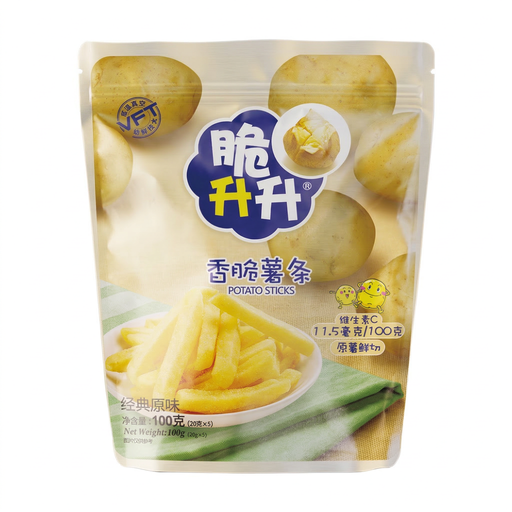 Image unavailable
The five separate packets are handy if you’re looking for a sealed pack to pop into a lunchbox. Each packet contains 20 g, so it’s a different size from the 25–30 g crisp multipacks. Check the ingredients and allergens on the pack before choosing it for your child.
If you want a pre-portioned option, start by checking the weight of each packet. The multipacks mentioned here include 25 g packets from Lay’s, 27.5 g from Vico and 30 g from Carrefour or E.Leclerc. A 40 g Pringles tube is also an individual pack, but contains a different amount.
An individual packet tells you how much you’re serving, but it doesn’t change Manger Bouger’s recommendation to limit salty foods. Crisps are therefore best as an occasional lunchbox option, rather than something to pack every day.
Compare the weight and number of packets, then check the nutritional information, including the salt per portion and per 100 g. Also read the ingredients and allergen information for each recipe. Manger Bouger suggests using the Nutri-Score, if shown, to compare similar processed products.
Yes, because the information varies by product. Carrefour lists possible traces of gluten, milk, mustard and celery for its Original à l’ancienne nature crisps, while the Vico Barbecue product page includes different information. If you have an allergy, check the packaging of the product you’re actually buying.
Yes. According to the French Ministry of National Education, the school’s internal rules set out expectations for school life, including hygiene and safety. Check your school’s rules before preparing a lunchbox.