People keeping an eye on calories
If you’d like to serve savoury biscuits as an afternoon snack while keeping track of how much is eaten, compare the kcal per 100 g, then work out how they add up for the portion you plan to serve.


To choose lower-calorie savoury biscuits for an afternoon snack, compare their energy values per 100 g, then consider how much you plan to serve. If the energy values are similar, also check the salt content and, if shown, the Nutri-Score of comparable products. Check the allergens for each specific product.
If you’d like to serve savoury biscuits as an afternoon snack while keeping track of how much is eaten, compare the kcal per 100 g, then work out how they add up for the portion you plan to serve.
A lower-calorie product isn’t necessarily lower in salt. The ‘salt’ line lets you compare products on a like-for-like basis.
Before sharing a packet, check the ingredients and allergens listed for that specific product. Don’t assume its ingredients are the same as those of another flavour.
| What matters to you | What to check | Who is it for? |
|---|---|---|
| Calories and portion size | Compare the kcal per 100 g, then consider how much you’ll actually serve. | If you want to include savoury biscuits in an afternoon snack without judging by the whole packet, the portion you serve matters just as much as comparing the labels. Around 42% of consumers prioritise calories and portion size. |
| Salt and Nutri-Score | If the energy values are similar, compare the salt per 100 g and the Nutri-Score, where shown, for comparable products. | If several products suit the portion you have in mind, the salt content may help you decide. Around 33% of consumers prioritise this balance. |
| Ingredients and allergens | Read the ingredients list and check which allergens are highlighted on the specific packet. | If you’re sharing a snack with someone who needs to avoid certain ingredients, the product’s composition matters more than comparing calories. This is the main consideration for around 25% of consumers. |
The DGCCRF says that displaying it is voluntary. Nutrition information, which is compulsory for most pre-packed foods, can still be used when no score is shown.
Compare the energy value and salt per 100 g; use the Nutri-Score as an additional guide if it’s displayed.
A claim about fat content doesn’t tell you the product’s total energy value on its own.
Check the kcal per 100 g and work out how much energy is in the portion you plan to serve.
Manger Bouger lists savoury biscuits among the foods to limit when they’re high in salt. Two products with similar calorie counts may still need an extra comparison on this point.
Check the salt per 100 g before choosing between them.
Ingredients and allergens can differ from one recipe to another.
Check the specific packet again, especially if you’re switching flavour or format.
Carrefour stocks Belin’s Monaco Emmental crackers among its savoury biscuits.
Vico offers several types of savoury snacks, including lentil crisps featured on its website.
Carrefour’s range includes crackers and breadsticks, including sesame breadsticks labelled ‘lighter’.
Auchan features savoury puffed biscuits and says it displays the Nutri-Score for relevant products on its website and app.
E.Leclerc stocks Marque Repère savoury biscuits and provides information about the Nutri-Score of its own-brand products.
This individually packed savoury cracker could be included in a comparison for an afternoon snack. Check its label before comparing it with the savoury biscuits you’re considering.
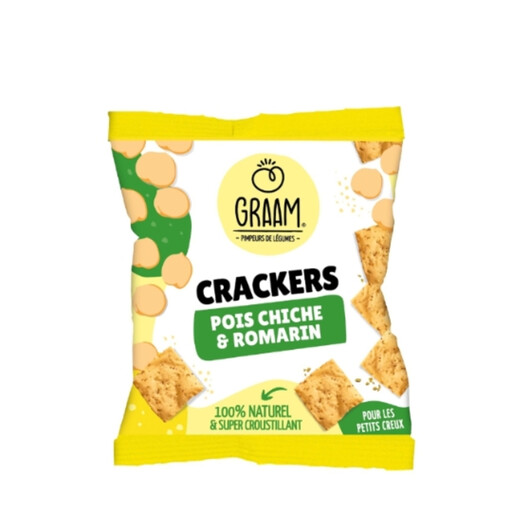 Image unavailable
The 30 g packet makes it easy to compare products based on a defined portion for an afternoon snack. Before choosing, compare its energy value per 100 g with those of other products, and check the ingredients and allergens on the specific packaging.
No. According to the DGCCRF, displaying the Nutri-Score is voluntary. Nutrition information, on the other hand, is compulsory for most pre-packed foods and lets you check details including energy and salt.
First compare the kcal per 100 g, the common basis for nutrition information as specified by the DGCCRF. To find the energy value of the portion you’ll serve, multiply this figure by the number of grams served, then divide by 100.
Calories and salt answer two different questions. Manger Bouger recommends limiting foods high in salt, including savoury biscuits, so also compare the ‘salt’ per 100 g for the products you’re considering.
Read the ingredients list on the specific packet. As the DGCCRF explains, allergens must be highlighted on pre-packed products. Check again if you switch recipe or format.