You’re prioritising lower fat
You want to keep savoury biscuits on the menu, but choose a recipe whose “reduced fat” claim clearly states what it is being compared with. This claim is no substitute for checking the other nutritional values.


If your priority is to reduce fat, check the recipe and the product it is being compared with when you see a “reduced fat” claim. If you mainly want to include protein in your aperitif, compare the protein content per 100 g instead: a reduction in fat alone tells you nothing about protein content. In either case, check the salt and allergens in the recipe you choose.
You want to keep savoury biscuits on the menu, but choose a recipe whose “reduced fat” claim clearly states what it is being compared with. This claim is no substitute for checking the other nutritional values.
If you’re following a high-protein diet, you want to know how much protein is in the biscuit itself rather than infer it from the presence of lentils, seeds or grains.
If these factors determine your choice, check the ingredients list and the label for the exact flavour before relying on claims highlighted on the pack.
When comparing savoury biscuits, start with your main priority, then check the values per 100 g and the exact recipe. A “reduced fat” claim, protein content and Nutri-Score don’t answer the same question.
| Criterion | What to check | Who is it for? |
|---|---|---|
| Fat | Fat per 100 g and the specific product used as the reference for any “reduced fat” comparison. | If I’m mainly looking to reduce the fat in my savoury biscuits, I want to know which product the recipe is being compared with. This would be the main priority for around 39% of consumers. |
| Protein | Protein per 100 g, rather than inferring the amount from the ingredient names alone. | To include protein in my aperitif, I need a figure rather than an impression created by the packaging. Around 38% of consumers would put protein content first. |
| Salt and allergens | Salt per 100 g, followed by the ingredients, allergens and any “may contain” statements for the flavour you choose. | If salt or a particular ingredient affects what I can serve, I check the exact recipe before choosing based on a nutritional claim. This would come ahead of other criteria for around 23% of consumers. |
A comparison of fat content doesn’t tell you how much protein a biscuit contains. Auchan’s product pages for Nature Addicts cheese and sesame rice crackers highlight reduced fat, while its listing for Bjorg oat, tomato and herb crackers states 13 g of protein per 100 g.
Before choosing, compare both figures in the nutrition table per 100 g, as well as the salt and energy values.
In France, displaying the Nutri-Score logo is optional, as the Ministry of the Economy explains. Its absence doesn’t mean a biscuit is less suitable for your needs, and the logo alone won’t tell you how much protein it contains.
If it appears on the packaging, use it as an additional guide and check the nutritional information per 100 g.
Salt content can vary from one recipe to another. Auchan’s listing for Bjorg oat, tomato and herb crackers states 1 g of salt per 100 g; it’s worth considering this alongside the other foods you plan to serve with your aperitif.
Compare the “salt” value per 100 g and take into account how much you plan to serve.
Two recipes in the same range can have different ingredients and allergen warnings. The range name alone isn’t enough to determine whether a particular flavour meets your requirements.
Check the ingredients list, stated allergens and any “may contain” warnings on the exact pack.
The cheese and sesame rice crackers featured by Auchan focus on a fat comparison with the average for savoury biscuits and crisps.
The oat, tomato and herb crackers are a useful comparison if protein is a priority for you.
Some Vico lentil crisps are marketed as having less fat than standard crisps.
The Monaco cracker assortment featured by Auchan is designed for sharing.
This chickpea cracker could be included in a comparison of savoury aperitif biscuits. If your priority is lower fat, look for an explicit comparison with a reference product on the packaging rather than trying to infer it from the ingredients.
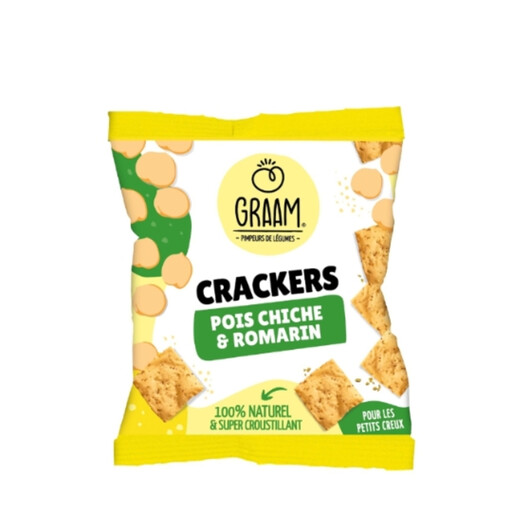 Image unavailable
If protein is important to you when choosing an aperitif snack, compare this cracker’s values per 100 g with those of the other recipes you’re considering. The pack contains 30 g; if they matter to you, check the fat, salt and ingredients for this product too.
No. The Ministry of the Economy states that displaying Nutri-Score is optional. The DGCCRF, however, explains that nutrition declarations are mandatory for prepacked foods, subject to the rules applicable to the product concerned. Use them to compare fat, protein and salt, among other values.
No. “Reduced fat” refers to a comparison of fat content, not the amount of protein. Check both values per 100 g for the recipe you’re considering and see what the stated reduction is compared with.
Under European Union Regulation (EC) No 1924/2006, this claim requires at least 20% of the food’s energy value to come from protein. The presence of lentils or seeds in a biscuit’s name isn’t enough to establish that the claim applies.
Check the pack for the flavour and size you’re buying, including any warnings about traces. Ingredients and allergens can vary between recipes from the same brand, so don’t rely on the list for a different flavour.