Hosts catering for someone avoiding an allergen or gluten
You need to find a product that suits a guest’s specific dietary restriction, without assuming it’s suitable based on the brand or simply because it says “gluten-free”.


For Christmas drinks and nibbles, start with the ingredient each guest needs to avoid: a biscuit labelled “gluten-free” isn’t necessarily free from milk, soya or other allergens. Check the ingredients and any “may contain” warnings on every packet before putting together your selection. Among products that meet the needs you’ve been told about, compare the nutrition information per 100 g. If a Nutri-Score is shown, it can help with your comparison, but Santé publique France says displaying it is voluntary.
You need to find a product that suits a guest’s specific dietary restriction, without assuming it’s suitable based on the brand or simply because it says “gluten-free”.
You want to provide an easy-to-identify option for each need you’ve been told about, while offering other savoury biscuits to guests without those restrictions.
You want to compare products that meet your guests’ needs using the nutrition information and, if it appears on the packet, the Nutri-Score.
Start by finding out about your guests’ dietary restrictions; comparing nutrition information and planning how to serve the food come next.
| What matters | What to check | Who is this for? |
|---|---|---|
| An allergen or gluten that must be strictly avoided | Ask which ingredient is the concern, then check the highlighted allergens and any “may contain” warnings. For gluten, look for an explicit “gluten-free” label. | If a guest needs to avoid a specific ingredient, a recipe simply described as different isn’t enough to establish that it’s suitable. Around 36% of consumers would put verified suitability at the top of their list of concerns. |
| Ingredient preference | Choose a claim that matches the preference you’ve been told about, then check the ingredients: “gluten-free”, “lactose-free” and “milk-free” don’t mean the same thing. | When choosing a recipe to meet a non-medical preference, I want to know exactly what the packaging claim covers. This would be the priority for around 29% of consumers. |
| Nutrition comparison | Compare nutrition information per 100 g across products in the same category, particularly salt and saturated fat. Check the Nutri-Score if one is shown. | Once dietary restrictions have been taken into account, some consumers want to compare savoury biscuits based on their nutritional content. Around 21% would make this their main criterion. |
| Selection and serving | Check which products your shop stocks and keep the packaging beside any products served separately. | If several bowls are being passed around during the evening, I want everyone to be able to find the packaging for the option that suits them. Ease of organisation would come first for around 14% of consumers. |
The claim doesn’t cover every ingredient: Schär gluten-free crackers sold by Carrefour contain soya flour.
Check the packet for the allergen in question, and ask your guest which “may contain” warnings they need to take into account before serving the product.
Santé publique France says that displaying the Nutri-Score is voluntary. Its absence alone isn’t enough to assess the nutritional value of a savoury biscuit.
Compare nutrition information per 100 g across similar products, including those without the logo on the packet.
The main ingredient doesn’t tell you everything about a product. For example, Auchan’s information for Nature Addicts gluten-free rice crackers lists milk and soya.
Check the exact ingredients and any “may contain” warnings rather than guessing whether an allergen is present based on the name of the grain or legume.
A brand of conventional savoury biscuits found in many in-store selections.
The range includes lentil crisps in a variety of recipes.
The retailer stocks crackers and other savoury biscuits, including Schär gluten-free products.
Its savoury biscuit range includes conventional products and options labelled as gluten-free.
E.Leclerc has a section of this range dedicated to savoury biscuits for drinks and nibbles.
This selection features rosemary chickpea tuiles as a different option for Christmas nibbles. If a guest needs to avoid gluten or a specific allergen, check the packet before offering them.
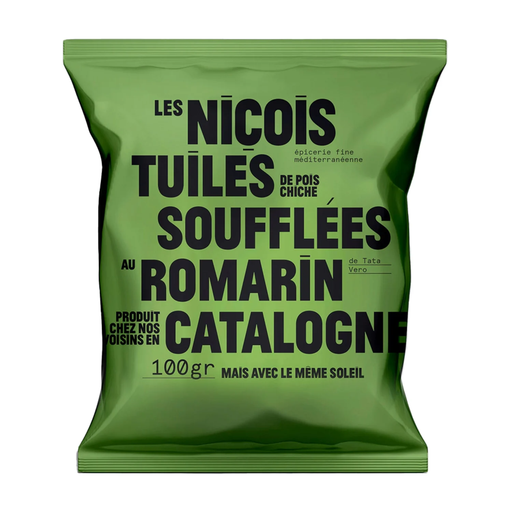 Image unavailable
A different take on savoury biscuits, made with chickpeas and rosemary. Before serving them to someone avoiding certain foods, check the packet for the claim they’re looking for, the ingredients and any “may contain” warnings. Don’t assume that chickpeas mean the product is free from allergens.
No. Santé publique France says that displaying it is voluntary. The DGCCRF states that nutrition declarations are compulsory for the prepacked foods covered by the rules. Use this information to compare values per 100 g when a Nutri-Score isn’t shown.
Not necessarily: the “gluten-free” claim alone doesn’t tell you whether soya or milk is present. For example, Schär gluten-free crackers sold by Carrefour contain soya flour. Check the ingredients and packet information for the allergen in question.
First ask which ingredient they need to avoid and which “may contain” warnings they take into account. Then read the ingredients list and check the highlighted allergens on every packet. The DGCCRF reminds shoppers that this labelling is required for prepacked foods in France.
They can add a different recipe to your selection, but ingredients vary by flavour. Vico’s paprika lentil crisps, for example, contain milk and may contain traces of other allergens. To compare nutrition information, check the values per 100 g for the products you’re considering.