Which criteria should you check first?
To choose between laundry, dishes and changing your habits, start with your main need, then compare appliances within their own category.
| Your priority |
What to check |
Who it matters to |
| Frequent laundry |
Litres per Eco 40-60 cycle for washing machines with a suitable capacity; programme duration. |
When one wash follows another, I want to reduce water use without choosing a drum that’s too large for my loads. Around 29% of consumers prioritise this laundry-related need. |
| Frequent dishwashing |
Litres per eco cycle, place-setting capacity and installation compatibility. |
If the dishwasher runs often, its consumption matters to me, but I also need to be able to fill it sufficiently. Around 29% of consumers prioritise reducing the water used for dishwashing cycles. |
| Which appliance to replace first |
Difference in litres per cycle compared with a similar model, considered alongside the actual number of cycles for each appliance. |
With two appliances at home, I’d rather identify which replacement could make the biggest difference to my water use before making a decision. Around 21% of consumers prioritise this targeted approach. |
| Putting off a purchase |
How often you run partial loads, whether you can use the eco programme and your pre-rinsing habits. |
My machines still work, so I want to see first whether fuller loads and stopping pre-rinsing will meet my needs. Around 21% of consumers prioritise changing how they use their appliances. |
ADEME points out that consumption varies by model and programme. For European energy labels, the reference programme for washing machines is Eco 40-60, while for dishwashers it is the eco programme with the appliance loaded to capacity. Their litres-per-cycle figures therefore don’t represent the same service. Compare models separately within each category before considering how the differences relate to how often you use them.
A selection for washing dishes
This table-top dishwasher may be worth considering if you’re looking for a 6-place-setting model for your kitchen. To assess its water efficiency, check the ECO programme’s consumption figure for the variant on offer and compare its capacity with your usual loads.
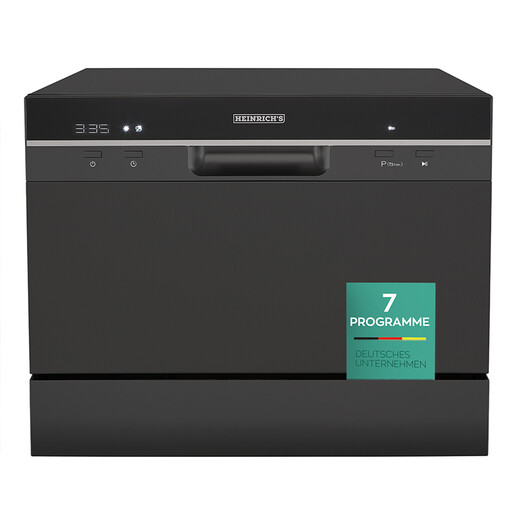 Image unavailable
Heinrich's HTG 8840 Schwarz, 6-place-setting table-top dishwasher
Worth considering if a 6-place-setting table-top appliance suits your dishwashing needs and the space available.
The product name lists 7 programmes, a digital display and a stated noise level of 47 dB. Check the dimensions and connection requirements before buying. Also confirm which programme and measurement conditions the stated 6,5 l per wash relate to before comparing this figure with an energy-label value.
View on Joybuy
Frequently asked questions
Can you directly compare the litres per cycle for a washing machine and a dishwasher?
No. These figures relate to different reference loads and programmes: Eco 40-60 for washing machines and the eco programme with the dishwasher loaded to capacity. First compare models within each category, then consider how often you actually run cycles to decide which replacement to look into.
Is the eco programme still useful if the cycle takes a long time?
Yes, if the duration works for you. ADEME recommends the eco programme to reduce water and electricity use. Its longer duration doesn’t mean that the stated water-consumption figure applies to other programmes.
When should you change your habits before replacing an appliance?
If your appliances still work but you often run partial cycles or pre-rinse dishes, start by changing these habits. Wait until the dishwasher is sufficiently full and load the washing machine without packing the drum too tightly, then reconsider whether replacing an appliance would be worthwhile.
What washing machine capacity should you choose to avoid extra cycles?
Choose a capacity that suits the amount of laundry you usually wash. Then compare the litres per Eco 40-60 cycle for models with a suitable capacity. A larger drum won’t by itself reduce the number of cycles if your loads are still small.


