Hosts planning a separate sweet treat
You’d like to serve a biscuit labelled “no added sugars” after the aperitif. Carrefour’s product listings for Gerblé and Karéléa biscuits show why it’s also important to check sweeteners and allergens.


Serve a savoury biscuit with your saucisson; if you’d also like to offer something sweet, serve it separately. A biscuit labelled “no added sugars” is not necessarily “sugar-free”, so check the exact wording, nutritional information, ingredients and allergens for the product you choose.
You’d like to serve a biscuit labelled “no added sugars” after the aperitif. Carrefour’s product listings for Gerblé and Karéléa biscuits show why it’s also important to check sweeteners and allergens.
You’re looking for a biscuit to serve with saucisson or other aperitif foods. St Michel describes its savoury biscuits as ideal for nibbling on their own or with an accompaniment.
You need to check the allergens in a specific product. Carrefour’s listings for Gerblé and Karéléa biscuits mention wheat and milk, as well as possible traces that vary by product.
First, decide whether the biscuit is to go with the saucisson or be served separately as something sweet. If it’s the latter, the sugar claim doesn’t replace checking the label.
| Criteria | What to check | Consumers concerned |
|---|---|---|
| Sugar claim | Know the difference between “sugar-free” and “no added sugars”, then check “of which sugars” per 100 g. | If sugar content is my main concern, I don’t want to confuse no added sugar with no sugars in the biscuit. Around 42% of consumers would prioritise this distinction. |
| Sweet option | Choose the type of biscuit you want and check the sweeteners and fat content on the label. | If I’m serving a separate sweet treat, I first look for a sweet biscuit with no added sugars and ingredients suitable for my guests. Around 33% of consumers would share this priority. |
| Savoury accompaniment | Check that the product is intended for aperitifs, and read its ingredients and allergen information. | With saucisson, I’d rather serve a savoury aperitif biscuit than offer a sweet biscuit as an accompaniment. Around 25% of consumers would put this savoury use first. |
Carrefour’s listing for Karéléa palmiers explains that the “no added sugars” claim doesn’t rule out naturally occurring sugars.
Check the exact wording and look at the “of which sugars” line in the nutritional information, per 100 g and, if shown on the pack, per serving.
Carrefour’s listings for Gerblé cocoa and vanilla biscuits and Karéléa palmiers state that they contain maltitol and wheat. Check the other ingredients and any trace warnings for each product individually.
Read the ingredients list and allergen information, even when sugar claims feature prominently on the front of the pack.
Cocoa and vanilla biscuits and palmiers are for a separate sweet treat; St Michel describes its savoury biscuits as an aperitif option.
If you’d like to serve both, pair the savoury biscuit with the saucisson and save the sweet biscuit for another time in the evening.
For a separate sweet option, Carrefour lists Gerblé cocoa and vanilla filled biscuits with no added sugars, in a 176 g box.
Carrefour lists Karéléa palmiers with no added sugars in a 100 g pack, an option to consider for the sweet part of the evening.
St Michel describes its savoury biscuits and mini madeleines as made for aperitifs, to nibble on their own or with an accompaniment.
These two products suit different choices for the evening: a Swedish biscuit labelled “no added sugars” and Tuc Bacon, which you could consider for the savoury spread. The sugar claim on the first product doesn’t apply to the second.
 Image unavailable
Worth considering if you’re looking for an option labelled “no added sugars” for your evening. This doesn’t mean “sugar-free”, so check the “of which sugars” line and allergen information on the pack.
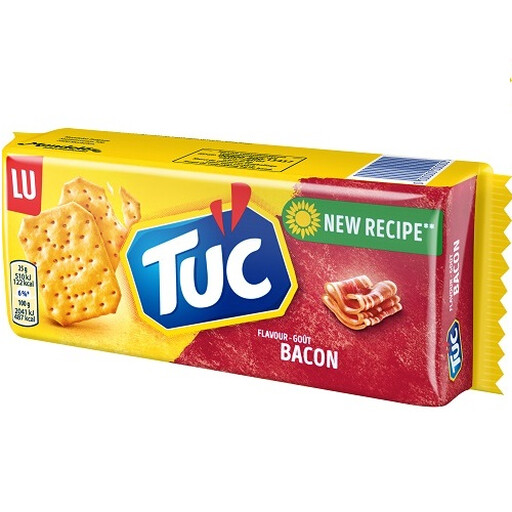 Image unavailable
Worth considering if you’re looking for a biscuit for the savoury part of your aperitif. Don’t choose it if you need a “sugar-free” option: the listing states that it contains glucose syrup and sugars. Check the allergens for this product too.
No. A biscuit with no added sugars may still contain naturally occurring sugars. Carrefour’s listing for Karéléa palmiers explains this. To find out how much sugar is in the product you choose, check the “of which sugars” line.
You can serve it during the evening, but a sweet biscuit won’t necessarily work as a savoury accompaniment. If you’re serving both, offer the sweet biscuit separately. St Michel describes its savoury biscuits as aperitif snacks to nibble on their own or with an accompaniment.
Check the label for each product. Carrefour’s listings for Gerblé cocoa and vanilla biscuits and Karéléa palmiers mention wheat and milk, but the possible trace warnings differ.
No. It refers to added sugars, not the biscuit’s overall composition. When choosing between two products, also consider the serving size, ingredients and nutritional information, particularly the fat content per 100 g.