If you want to keep the sugars shown on the tin to a minimum, start by comparing sardines in olive oil with those in sauce. Connétable lists 0 g of sugars per 100 g of drained fish for one olive oil product, compared with 1.0 g per 100 g of product for one tomato recipe. These figures are based on different amounts, so bear that in mind. For easy-to-share toasts, also check whether the tin explicitly says ‘boneless’.
Who is this choice for?
Hosts keeping an eye on sugar figures
When choosing a tin for an aperitif, you may want to know whether the sauce adds sugars. The Connétable product information lists 0 g of sugars per 100 g of drained fish for the olive oil product examined, and 1.0 g per 100 g of product for the tomato recipe examined.
Guests who avoid bones
For sharing on toast, a tin explicitly labelled ‘boneless’ makes choosing easier. Connétable offers a skinless and boneless product that can be served on bread or used in cooking; Auchan also offers a boneless product.
Cooks who like to choose their own seasoning
You can start with sardines in olive oil and make your own topping, or choose a recipe that already includes tomato. Read the ingredients and nutritional information on the tin you choose: the two preparations are not the same.
What should you check?
For an Italian evening, first choose between a base you can season yourself and a ready-made recipe. Then check the sugars listed and how the sardines are presented if you’re planning to serve sharing bites.
| Criteria |
What to check |
Who is this for? |
| Sugars listed |
Read the ‘of which sugars’ line and check what it applies to, such as ‘product’ or ‘drained fish’. |
If I want to keep the sugars listed to a minimum, I need to be able to read the figure for the recipe I’m serving. Around 42% of consumers make this their priority. |
| Serving boneless sardines |
Look for explicit ‘boneless’ and, if needed, ‘skinless’ labelling. |
For toast that everyone can help themselves to, I’d rather not have to remove the bones while serving. This is the top priority for around 33% of consumers. |
| Ready-to-serve recipe |
Compare the ingredients list of a tin of sardines in olive oil with one in sauce. |
When I’m putting bites together quickly, a recipe that already includes tomato can save me from preparing a separate topping. This is the priority for around 25% of consumers. |
Mistakes to avoid
-
Assuming ‘reduced sugars’ means ‘0 g of sugars’
According to guidance published by the DGCCRF on 14 December 2007 concerning Regulation (EC) No 1924/2006, the claim ‘reduced sugars’ is based on a reduction of at least 30% compared with a similar product. A figure of 0 g on a label does not, by itself, establish this comparison.
When describing a tin, use its ‘of which sugars’ figure rather than making an unsubstantiated comparative claim.
-
Comparing figures based on different amounts
The Connétable product information examined gives figures for the olive oil product per 100 g of drained fish, and for the tomato recipe per 100 g of product. The figures should therefore be compared with care.
Check the wording alongside the nutritional information and, when comparing two tins, look for figures based on the same amount.
-
Looking only at sugars
Not all olive oil products have the same figures: Connétable lists 0.90 g of salt per 100 g of drained fish for the product examined, while E.Leclerc lists 0.5 g of salt per 100 g for the Pêche Océan product examined.
Also check the salt, oil and drained weight on the tins you’re considering serving.
-
Assuming every presentation is suitable for your guests
Sardines contain fish, and the presence of skin, bones or sauce affects how you serve them.
Before preparing your bites, read the ingredients and allergens on each tin. If bones are a concern, choose a product that explicitly says they have been removed.
Sardine brands to know
Connétable
Its range includes sardines in olive oil, sardines in tomato sauce, and skinless and boneless sardines, so you can choose what suits your recipe and how you plan to serve them.
- For the olive oil product examined, the brand lists 0 g of sugars per 100 g of drained fish; for the tomato recipe examined, it lists 1.0 g per 100 g of product.
- These two product information sheets use different bases, so don’t compare their figures directly as if they applied to the same amount.
Saupiquet
Saupiquet’s range includes fillets and whole sardines, among other options, with a choice of recipes.
- The brand’s catalogue makes it easy to browse the different presentations before choosing a specific tin.
- To compare sugars or salt, check the nutritional information for the product you choose.
Carrefour Classic’
Carrefour offers sardines in extra virgin olive oil in a 135 g pack.
- Carrefour’s product information for this item lists sardines, 29% extra virgin olive oil and salt.
- To make a choice based on sugars, check the figure listed on the tin rather than inferring it from the ingredients list.
Auchan
The Auchan product examined is boneless sardines in olive oil, an option to consider for toast.
- Auchan’s product information says ‘boneless’ and includes storage instructions for after opening.
- Don’t apply the storage instructions for this product to another tin without checking first.
Pêche Océan / Marque Repère
E.Leclerc offers a 135 g tin of sardines in olive oil.
- The E.Leclerc product information examined lists 0.5 g of sugars and 0.5 g of salt per 100 g.
- Check the information on the tin you actually buy, especially if you choose a different size.
Sardines available on Joybuy
This selection includes sardines in olive oil, a tomato and basil recipe, and a version with Espelette pepper. To choose based on sugars or boneless serving, compare the information on each tin.
 Image unavailable
CONNÉTABLE Sardines in extra virgin olive oil, 135 g
An olive oil option to consider if you’d like to make your own toast topping. To compare its sugars with a recipe in sauce, check the figure and what it applies to on the label.
View on Joybuy
 Image unavailable
EL TATO Sardine fillets in olive oil, 115/81 g
These sardine fillets in olive oil could be a good choice for toast. If your guests avoid bones, look for confirmation on the packaging: the word ‘fillets’ alone doesn’t guarantee they’re boneless.
View on Joybuy
 Image unavailable
CONNÉTABLE Sardines in extra virgin olive oil, 140 g
This olive oil option is ideal for a dish you can season to your own taste. If skinless or boneless sardines are important for serving, check that the 140 g tin carries the relevant wording.
View on Joybuy
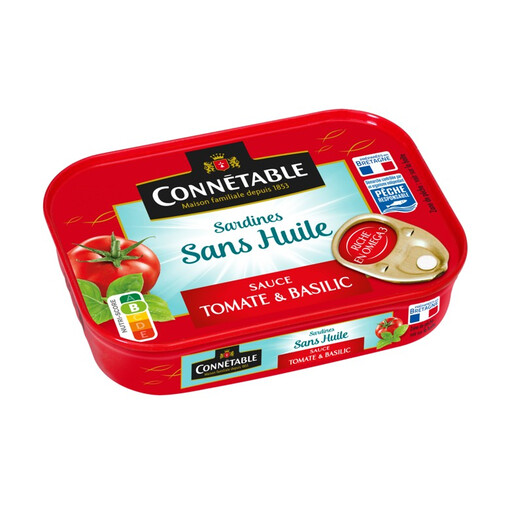 Image unavailable
CONNECTABLE Sardines with tomato and basil, 1/6 tin, 115 g
This tomato and basil recipe is for anyone who prefers a tin that’s already seasoned. If you’re choosing based on sugars, read the nutritional information and ingredients list for this product rather than relying on figures for a different tomato recipe.
View on Joybuy
 Image unavailable
CONNETABLE Sardines in olive oil with Espelette pepper, 1/6 tin, 115 g
Choose this recipe if you’d like Espelette pepper seasoning rather than a base to flavour yourself. Check the ‘of which sugars’ line on this tin: its figure can’t be inferred from that of unseasoned sardines in olive oil.
View on Joybuy
Frequently asked questions
Do sardines in olive oil always contain less sugar than sardines in tomato sauce?
No, you need to check the specific products. Connétable lists 0 g of sugars per 100 g of drained fish for the olive oil product examined, and 1.0 g per 100 g of product for the tomato recipe examined. These figures are based on different amounts.
Can a tin that lists 0 g of sugars be called ‘reduced sugars’?
Not on the basis of that figure alone. The guidance published by the DGCCRF on 14 December 2007 for Regulation (EC) No 1924/2006 states that the claim ‘reduced sugars’ requires a reduction of at least 30% compared with a similar product. Without an established comparison, simply use the figure on the label.
Which sardines should I choose for toast if some guests find bones a problem?
Look for a tin explicitly labelled ‘boneless’, or ‘skinless and boneless’ if both matter. Connétable offers a skinless and boneless product that can be served on bread; check the description of the specific product you buy.
How should I store sardines after opening the tin?
Follow the instructions on the tin you’ve chosen. The Auchan product information for the boneless sardines examined says to store them between 0 and +4 °C and consume within 48 hours of opening. Don’t automatically apply this storage time to another product.


