Students keeping an eye on portion size
You want to know how many sardines are actually in the tin so you can plan your meal. Drained weight is more useful than net weight alone when the tin contains a covering liquid.


To put together a student dinner with sardines, compare the ‘of which sugars’ figure for the specific product rather than relying on ‘plain’ or a claim about reduced sugar content. Saupiquet plain sardine fillets contain less than 0.2 g of sugars per 100 g drained, while Connétable La Sardine Nature contains 0 g per 100 g, according to their respective product information. Check the drained weight too, so you know how much fish you’re getting, then choose the recipe and presentation to suit how you plan to prepare your meal.
You want to know how many sardines are actually in the tin so you can plan your meal. Drained weight is more useful than net weight alone when the tin contains a covering liquid.
You compare the ‘of which sugars’ figure, ingredients and salt content of specific recipes. Product information from Saupiquet, Connétable and Auchan shows that these values can vary between products, even among sardines in water.
You’d prefer a pre-seasoned recipe or boneless sardines to add to bread, pasta or a salad. Remember to check the ingredients of the recipe you choose too.
When choosing sardines for a student dinner, start with the amount of fish shown on the tin, then compare the ingredients and how easy the specific recipe is to prepare.
| Criteria | What to check | Who might find this useful? |
|---|---|---|
| Amount of fish | Compare the net weight with the drained weight: the net weight includes the covering liquid. | When planning my meal, I want to know how much sardine will be left once the tin has been drained; around 42% of consumers might put this first. |
| Sugars, ingredients and salt | Check the ‘of which sugars’ and ‘salt’ figures per 100 g, as well as the ingredients list. See whether the figures are for the drained product. | If I’m comparing several recipes, I want to know what’s in them rather than relying on their names; around 33% of consumers might make this their priority. |
| Recipe and presentation | Check whether the sardines are in water, in oil, marinated or boneless, then check the ingredients for the specific product you’ve chosen. | Bones put me off, or I’d prefer a pre-seasoned recipe to make dinner quickly; nearly 25% of consumers might prioritise this convenience. |
These terms describe different things. For example, Connétable lists 0 g of sugars per 100 g for its oil-free lemon and basil marinade, compared with 1.0 g per 100 g for its oil-free tomato recipe.
Compare sugars, fat and salt separately per 100 g, then read the ingredients list. A low declared sugar content does not, on its own, prove that a product has less sugar than another.
Net weight includes the covering liquid too. For example, Auchan’s 135 g tin of sardines in water has a drained weight of 95 g, according to its product information.
Check the drained weight when comparing pack sizes or working out how much to serve.
A marinade and a recipe in water won’t necessarily contain the same ingredients or have the same nutritional values. The recipe name alone also won’t tell you all the allergens listed on the packaging.
Read the full ingredients list and allergen information on the specific tin before choosing it.
The Connétable skinless and boneless product listed by Auchan contains 1 g of salt per 100 g. This presentation is for people who prefer a particular texture; it doesn’t indicate a specific salt content.
Choose it if bones are your main concern, and compare the salt content separately on the label.
These products give you specific recipes and pack sizes to compare; the figures for one tin won’t apply to every product in the brand’s range.
The brand offers plain fillets as well as whole sardines with chilli.
The range includes sardines in water, oil-free marinades and a skinless, boneless option.
Its sardines in water give you a chance to compare a 135 g tin with its drained weight of 95 g.
E.Leclerc offers several sardine recipes, including a Pêche Océan oil-free lemon and basil preparation.
These tinned options offer different ways to enjoy sardines in a simple dinner: in water, in oil or boneless, depending on the product. To compare them, check the ingredients and drained weight on each tin.
 Image unavailable
An extra virgin olive oil recipe if you’d like to serve the sardines with their oil. The stated pack size is 140 g; check the drained weight and nutritional information for the specific product.
 Image unavailable
An option to consider if bones put you off and you prefer sardines in water. The stated pack size is 98 g; check the drained weight and salt content on the label.
 Image unavailable
A small sardine option in olive oil, if that’s the kind of product you’re after. The name gives the size as 16/20u and the weight as 115/81 g; check what the two weights refer to before comparing drained quantities.
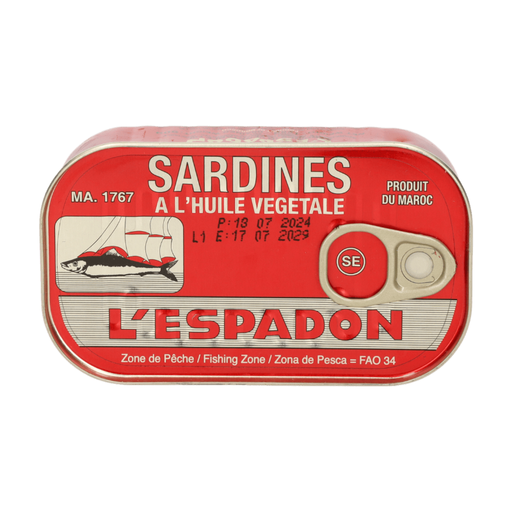 Image unavailable
A tin in oil to consider if you want something to go with your meal without having to make a sauce. The stated pack size is 125 g; check the drained weight and nutritional values for this product before comparing it with others.
No: ‘in water’ describes the recipe, not how its sugar content compares with another product. Saupiquet states that its plain fillets contain less than 0.2 g of sugars per 100 g drained, while Connétable lists 0 g per 100 g for La Sardine Nature. Check the figures on the tin you’re considering.
Drained weight tells you how much fish there is without the covering liquid. For example, Auchan’s 135 g tin of sardines in water has a drained weight of 95 g, according to its product information.
No: the figures depend on the specific recipe. Connétable lists 0 g of sugars per 100 g for its oil-free lemon and basil marinade and 1.0 g per 100 g for its oil-free tomato recipe; the Pêche Océan oil-free lemon and basil product information lists 0.7 g per 100 g.
Yes, the products shown here don’t all have the same salt content: Saupiquet lists 0.65 g of salt per 100 g drained for its plain fillets, while Connétable lists 0.90 g per 100 g for La Sardine Nature. Anses recommends reading food labels to find out what foods contain.
Follow the storage instructions for after opening on the packaging of the product you’ve opened. Check them before putting away any leftovers, as the instructions apply to that specific product.