Simple dinners where you need to plan portions
You’d like to serve sardines with bread, potatoes, rice or vegetables, and check the drained weight to plan the meal.


For a simple dinner, start by choosing a format your guests will enjoy: whole sardines if they don’t mind the bones, or fillets or a boneless option if they do. A seasoned variety may suit your planned dish. Then check the drained weight, ingredients and instructions for after opening on the tin you choose.
You’d like to serve sardines with bread, potatoes, rice or vegetables, and check the drained weight to plan the meal.
You’d rather choose fillets or a product labelled ‘boneless’ to make serving easier.
You’re choosing between sardines in plain olive oil and a seasoned variety to complement the other ingredients in your dinner.
When serving tinned sardines for dinner, start with how much you need and whether bones will affect the meal. Then choose a recipe and check the label.
| What to consider | What to check | Who it matters to |
|---|---|---|
| How much to serve | Drained net weight and how many tins you’ll need for the meal. | If I’m serving several plates, I want to know how many sardines will be left once the liquid is drained. Around 40% of consumers would prioritise this usable quantity. |
| Bones and serving | Whether the tin says ‘boneless’ or ‘fillets’, and the drained weight of the format you choose. | If bones might put a guest off their meal, I’d prefer an easier format to serve. Around 30% of consumers would prioritise this convenience. |
| Dinner recipe | The oil and seasonings listed in the ingredients. | If I’m adding sardines to toast or a dish that’s already seasoned, I want a flavour that goes well with the rest. Around 20% of consumers would put their choice of recipe first. |
| Label and storage | Ingredients, nutritional information and instructions for after opening. | If I’m planning to keep some of the tin for later, its ingredients and storage instructions guide my choice. Around 10% of consumers would put these checks first. |
Two tins with a similar net weight may contain different amounts of sardines once you drain off the liquid.
Check the drained net weight when planning portions.
The oil, other ingredients and salt content can vary between products. Auchan also says that the ingredients in its product may vary depending on the store’s online grocery service and the purchase date.
Read the ingredients list and nutritional information on the tin you choose, especially if you need to avoid a particular ingredient.
Whole sardines aren’t as easy to serve as fillets or a boneless option.
If bones could be a problem for one of your guests, check the exact product description before you choose.
Instructions for after opening vary by product. Saupiquet says to keep its sardine fillets in olive oil in the fridge and eat them within two days.
Follow the instructions on your tin and plan how you’ll use the rest once it’s open.
E.Leclerc lists sardines in olive oil in a 135 g tin, among other options.
The range includes a 135 g tin of sardines in extra virgin olive oil.
Auchan lists a 135 g tin of sardines in extra virgin olive oil, with a drained weight of 95 g.
Connétable offers whole sardines in olive oil, as well as other recipes and formats.
Saupiquet sardine fillets in olive oil are a different format from whole sardines.
These tinned options include sardines in olive oil, with lemon or in water, as well as a fillet format. Choose according to your dinner recipe and how you’d like to serve them.
 Image unavailable
If bones might make serving tricky at dinner, check the tin for information about bones. The stated size is 140 g; also check the drained weight before planning portions.
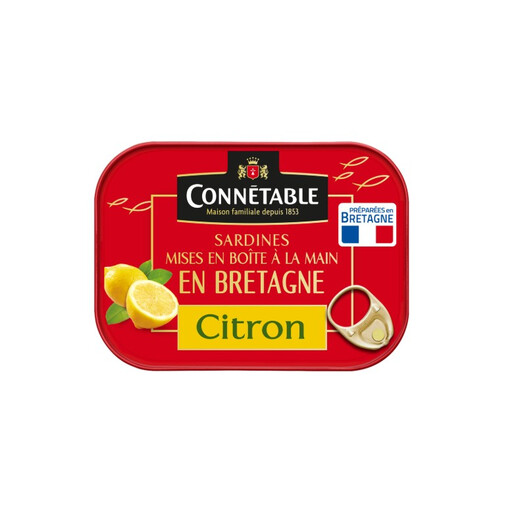 Image unavailable
If you’re planning a lemony dish, this 115 g format combines sardines, extra virgin olive oil and lemon. Check the drained weight to work out how much to serve.
 Image unavailable
If bones make serving tricky, this 98 g product is labelled ‘boneless’. It is preserved in water rather than oil, so choose it to suit your planned dish and check the drained weight on the tin.
 Image unavailable
Fillets work well on toast or in pasta. The product name gives the weights as 115/81 g: check the label to see what each figure refers to. For this product, follow the instruction to eat it within 24 hours of opening.
 Image unavailable
For a dinner served with bread or potatoes, this tin contains sardines in extra virgin olive oil. It has a net weight of 135 g; check the drained weight to work out how much sardine to serve.
Check the drained net weight to find out how much sardine there is without the covering liquid. Net weight alone won’t tell you this; then work out how many tins you’ll need for your guests.
Choose a product labelled ‘boneless’ if bones might put someone off their meal. Fillets are another format to consider, but check the exact product description and drained weight of each tin.
Follow the instructions for after opening on the product you’ve bought. For its sardine fillets in olive oil, Saupiquet says to keep them in the fridge and eat them within two days; instructions may vary for other products.
When choosing pre-packed tinned sardines sold in France, check the ingredients, net quantity, drained net weight if there is a covering liquid, and nutritional information. The DGCCRF sets out the labelling rules that apply to this information; also read the storage instructions for the specific tin.