Parents of children who are sensitive to fish bones
A product labelled ‘boneless’ or ‘skinless and boneless’ can make serving easier. Check the label on the tin you choose: this description does not apply to every product from a brand.


If your child is sensitive to fish bones, choose a tin that is explicitly labelled ‘boneless’. Fillets can be convenient to add to a dish, but that alone does not guarantee that they are bone-free. To compare recipes and pack sizes, check the ingredients, fish allergen information and drained weight on the exact tin, then adjust the serving to suit your child’s age.
A product labelled ‘boneless’ or ‘skinless and boneless’ can make serving easier. Check the label on the tin you choose: this description does not apply to every product from a brand.
Tinned sardines can be added to a dish without cooking the fish. To keep meals varied, Manger Bouger recommends alternating oily and white fish.
Drained weight helps you compare the amount of sardines in a small tin, a full tin or a multipack, and choose a size that suits the number of people eating.
When choosing sardines for a child’s dinner, start with the texture they are happy to eat. Then consider how much to serve and the recipe of the specific product.
| Criteria | What to check | Who is it for? |
|---|---|---|
| Bones and texture | Look for the word ‘boneless’ on the exact product; ‘fillets’ alone does not guarantee this. | If my child refuses to eat fish with bones, I want to serve them sardines that need less checking. Around 40% of consumers would put this need first. |
| Practical pack size | Compare the drained weight with the number of people eating before choosing a tin or multipack. | When I’m making this meal for several people, I look for an amount we can use up. Around 30% of consumers would have this as a priority. |
| Serving size | Consider the drained weight in relation to your child’s age and the rest of the meal. | For a young child, I don’t want to assume that a whole tin is automatically the right portion. Around 20% of consumers would put this question first. |
| Recipe and allergen | Read the ingredients, the ‘salt’ line in the nutritional information and the fish allergen information. | If I want a simple recipe, I check exactly what’s in the tin. If my child is allergic to fish, I don’t choose sardines. Around 10% of consumers would make this check their top priority. |
A small tin of fillets, a tin of whole sardines and a multipack may not contain the same usable amount of fish.
Check the drained weight and choose a pack size that makes sense for the number of people at the table.
Preparing whole sardines at the table is different from serving a product explicitly labelled ‘boneless’.
If your child is sensitive to texture, check the label on the exact product before serving it.
Removing the bones can also take more time at dinner.
The products in spring water described by Carrefour and Auchan contain salt and are still fish products.
Read the label on the tin you choose. If your child has a known fish allergy, don’t serve them sardines.
A product listing or catalogue offer doesn’t guarantee that the item will be available at the shop where you do your food shopping.
If the recipe or pack size matters for this dinner, confirm the product with the shop in question.
The range includes boneless sardines, as well as recipes that are skinless and boneless.
The range includes classic and grilled fillets, as well as whole sardines in a variety of recipes.
The product listing for its sardine fillets in spring water states a drained weight of 70 g.
E.Leclerc offers whole sardines and fillets in several pack sizes and recipes.
The product listing for its sardines in spring water gives a tin weight of 135 g, including 95 g drained weight.
This selection includes sardines in water or oil, fillets and a product labelled ‘boneless’. Start by choosing the texture and recipe you’re looking for, then check the pack size on the packaging.
 Image unavailable
An option for a dinner where a recipe with olive oil is suitable. The stated pack size is 140 g; before serving it to your child, check the packaging for information about bones and the drained weight.
 Image unavailable
The fillet format may suit you if you want to add sardines to a dish. The title gives a weight of 115/81 g; check the packaging to see what these figures refer to and whether the product is labelled as boneless.
 Image unavailable
The 16 to 20 small sardines listed can be shared out when serving. The title gives a weight of 115/81 g; check the product for bones before offering it to a child.
 Image unavailable
The ‘boneless’ label may mean less time spent checking before serving. This recipe is in water and the stated pack size is 98 g; check the ingredients and drained weight on the exact tin.
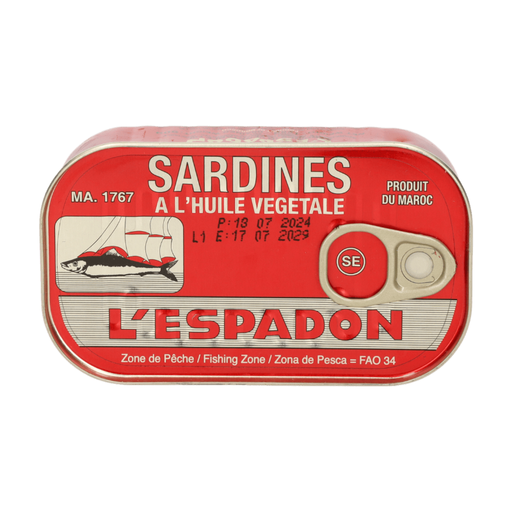 Image unavailable
A tin of sardines in oil with a stated pack size of 125 g. Check the drained weight and whether there are bones on the packaging to work out how much to serve and how much preparation is needed.
Yes, tinned sardines can be part of children’s meals. For children aged 4–17, Manger Bouger recommends alternating oily fish, including sardines, with white fish. Tinned fish is one way to eat fish.
The amount depends on factors including your child’s age and the rest of the meal. For children aged 4–6, Manger Bouger gives a guide of around 50 g of fish. The amount increases gradually, reaching around 100 g at about 11 years old. Use the drained weight on the tin as a guide, but don’t apply these recommendations for 4–17-year-olds to a younger child.
No, the word ‘fillets’ alone doesn’t guarantee that they are bone-free. If this is an important factor in your choice, look for ‘boneless’ on the exact product and check it again when serving.
Read the ingredients on the packaging: sardines are fish. In France, the DGCCRF says that allergenic ingredients must be highlighted in the ingredients list on pre-packed foods. If your child has a known fish allergy, don’t serve them sardines.