
Livraison le jour même ou le lendemain

Qualité garantie

Débloquez vos offres de bienvenue: Livraison GRATUITE | Jusqu'à -80 % | 30 jours d'essai gratuits à JoyPlus
Téléchargez l'application
Successful sanding depends less on the force you apply than on the right combination of abrasive, machine and surface. Yet disappointing purchases are often caused by overlooked specifications: an incompatible disc, an unsuitable grit or an accessory that clogs after just a few minutes.
Whether you are preparing a piece of furniture, smoothing a partition wall, removing old paint or working on car bodywork, this selection of sanding tools and accessories helps you compare solutions based on your actual needs.
A generous pack is not necessarily suitable for every job. Pay particular attention to the grit range. A set made up only of fine grits will be of little use for removing a layer of paint, while an assortment that is too aggressive could mark wood or filler.
When preparing a surface before painting, you will generally start with a coarser grit to level it, then move on to medium and fine grits to achieve a smooth finish.
A sanding disc must match the backing pad diameter, the attachment system and, where the machine has them, the number and layout of the dust-extraction holes. 125 mm, eight-hole discs are suitable for many 125 mm random orbital sanders, but always check your machine’s backing pad carefully.
Likewise, a 93 × 185 mm hook-and-loop abrasive sheet cannot replace a 125 mm round disc. The triangular, or delta, shape is designed to reach corners and narrow areas.
An abrasive that clogs quickly slows down the work and encourages you to apply more pressure to the machine. Dust extraction, perforated backing pads and abrasives with an anti-clogging coating improve user comfort, but they do not remove the need to wear safety goggles and suitable respiratory protection.
When working on old painted surfaces, do not sand a coating that may contain lead or asbestos without following the relevant safety precautions and regulations. Waste must also be disposed of in accordance with local guidelines.
Aluminium oxide abrasive paper is commonly used for wood, metal, paint and various preparation tasks. Low grits, such as 40 or 60, are mainly used for heavy-duty material removal. Grits from 80 to 120 are suitable for levelling and intermediate smoothing. Grits from 180 to 240 and above are intended for finishing, depending on the material.
For an abrasive intended for wood and metal, check the included grit range as well as the strength of the backing. A roll of abrasive paper can be cut to the required dimensions, making it practical for hand sanding or certain specialist backing pads.
Before buying, check:
A hook-and-loop abrasive sheet can be replaced quickly, while a roll offers greater flexibility on irregular surfaces. For contours, a flexible sanding sponge follows shapes better than a rigid sheet.
A random orbital sander is suitable for large, flat surfaces and regular work on wood or paint. An angle sander or triangular tool makes it easier to reach corners. For walls and ceilings, a plasterboard sanding kit with a handle and extension allows you to work at height more comfortably.
Dry sanding and wet sanding involve different requirements. Water can reduce clogging on certain materials, but not all abrasives and machines are designed for this method. Always follow the manufacturer’s recommendations.
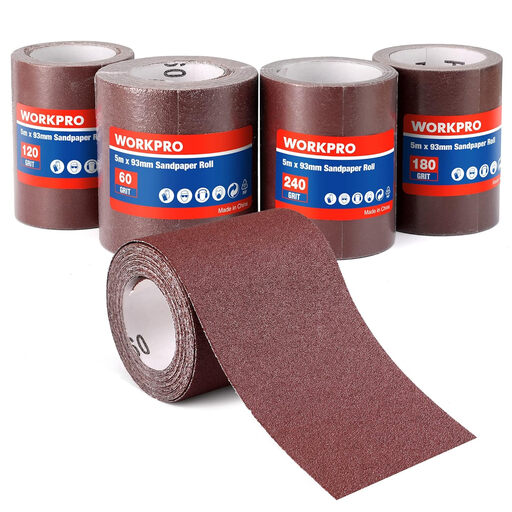
Why this choice suits this user: The four 5 m rolls provide a flexible solution for hand sanding, small renovation jobs and preparing wooden, metal or painted surfaces.
The 60, 120, 180 and 240 grits cover several stages, while the cut-to-size format means you do not need to buy a specific sheet for every small task.
Four clearly marked grits, 93 mm-wide rolls and aluminium oxide abrasive.
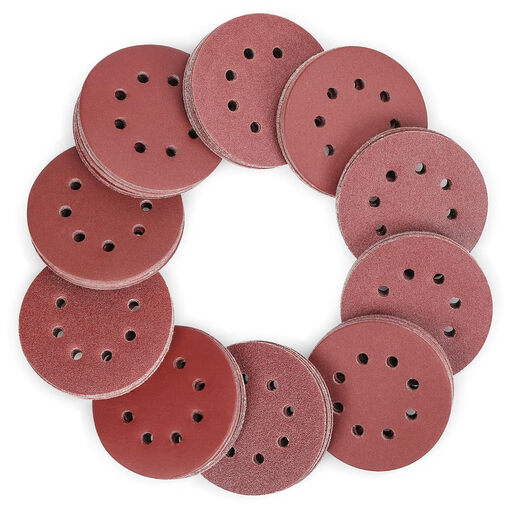
Why this choice suits this user: This assortment is designed for anyone looking to work through several finishing stages with a 125 mm random orbital sander.
The 125 mm diameter, hook-and-loop backing and eight holes are clearly specified; you still need to check that they are compatible with your machine.
150 discs, nine grits from 60 to 600 and quick-change hook-and-loop attachment.
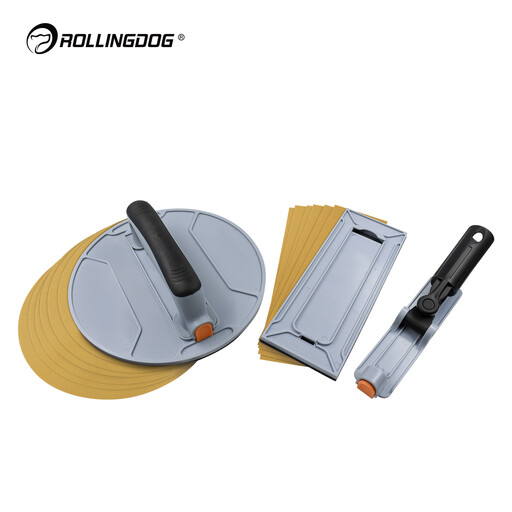
Why this choice suits this user: Plasterers, painters and renovation professionals can move from large wall areas to edges and hard-to-reach places.
The kit is not limited to a single head: it includes a radial backing pad, a rectangular backing pad, a handle and abrasives in 80, 120 and 240 grits.
Two sanding formats and a removable handle compatible with a pole featuring a tapered push-fit connection.
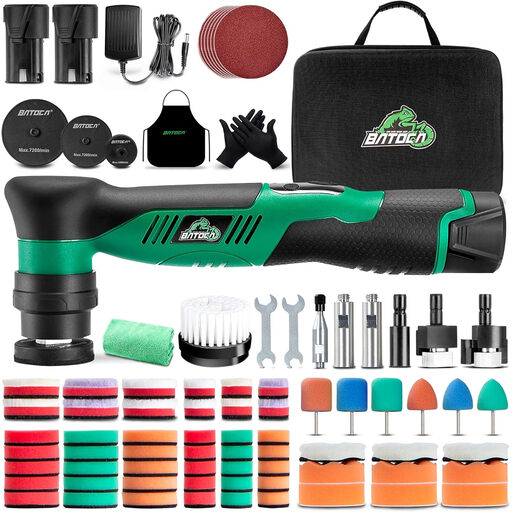
Why this choice suits this user: Its compact design is made for car detailing and small areas such as headlights, badges, alloy wheels and contours.
The three advertised configurations, six speeds and two batteries allow the tool to be adapted to different tasks, provided you follow the manufacturer’s instructions.
Two 12 V, 2.0 Ah batteries, 25, 50 and 75 mm backing pads, and an adjustable speed of 2,000 to 5,500 rpm according to the product specifications.
We have brought together a complete, real-time updated selection of products that meet these demanding criteria, as well as European safety standards.
Start with a grit suited to the condition of the surface. A 60 to 80 grit can be used to remove an old finish or correct uneven areas. Then move on to 120 grit, followed by a finer grit if you want a perfectly smooth finish. Avoid staying in the same place for too long to prevent digging into the surface.
It depends on the material, the pressure applied, the efficiency of the dust extraction and the surface being sanded. Replace the disc as soon as it becomes clogged, worn or torn. Applying more pressure will not revive an abrasive that has reached the end of its life and could cause the machine to heat up more quickly.
A wall sander is suitable for large plasterboard surfaces, filler and ceilings. An angle sander or triangular accessory is better suited to corners, edges and precision work. For a versatile project, combining a tool designed for large surfaces with suitable abrasive sheets avoids putting excessive strain on a single machine.