Parents keeping an eye on added salt
For school holiday lunches, you want something convenient without overlooking the salt in the condiments you serve. Look for the claim on the specific product, then check the salt content per 100 g.


For a quick lunch during the school holidays, choose a ready-made tomato sauce labelled “no added salt” if its ingredients, salt content and pack size suit the meal you’re planning. If you have time to season it yourself, tomato pulp or purée gives you more freedom to create your own sauce. Either way, check the “salt” figure per 100 g, as “no added salt” does not mean “salt-free”.
For school holiday lunches, you want something convenient without overlooking the salt in the condiments you serve. Look for the claim on the specific product, then check the salt content per 100 g.
If you’re cooking pasta for several people, tomato pulp or purée gives you the freedom to choose the seasonings and decide how much sauce to serve.
A ready-made tomato sauce saves you from having to prepare a tomato base. However, check that the specific product carries the claim you’re looking for and that the pack size is enough for lunch.
First decide between a ready-made sauce and a base you can cook with, then compare the salt content and the quantity you need for the meal. These are separate considerations: a sauce that’s quick to serve won’t necessarily meet your preference when it comes to salt.
| Criteria | What to check | Who is it for? |
|---|---|---|
| Salt | The exact claim on the packaging and the salt content per 100 g, taking the serving size into account. | If I want to keep an eye on the salt in my sauce, the nutrition information matters just as much as the claim on the front of the pack; around 42% of consumers make this their top priority. |
| Speed | Check whether it’s a ready-made sauce or tomato pulp or purée that needs preparing. | When lunch needs to be served without preparing any seasoning, I choose a ready-made sauce; speed is the main priority for around 33% of consumers. |
| Cooking for the family | Type of tomato base, net weight and storage instructions after opening. | When I’m making several portions, I prefer to make the sauce to suit everyone’s tastes, even if it takes a little time; around 25% of consumers prioritise this flexibility. |
The 500 g Jardin BiO étic pulp featured by Auchan is labelled “no added salt”, yet contains 0.02 g of salt per 100 g.
Compare the “salt” figure in the nutrition information and take the amount of sauce you’ll serve into account, rather than relying on the claim on the front of the pack.
A tomato base lets you choose your own seasonings, but it needs preparing; ready-made Prosain tomato sauce doesn’t.
If you’re in a hurry for lunch, check which type you’re buying. If you choose a base, plan how you’ll season it.
Preparation can take time and may require extra ingredients, such as herbs or other seasonings.
Nutri-Score, organic status or a claim about preservatives won’t tell you the salt content of a sauce on its own.
Check the salt content per 100 g separately for every product you’re considering.
Auchan’s product listing for Mutti purée 3 × 200 g carries the claim “no added salt”, but its ingredient list includes “salt”.
If no added salt is essential to your choice, check the ingredients on the packaging of the exact variant or contact the manufacturer before buying.
A 200 g ready-made tomato sauce featured by Carrefour under the name “No Added Salt”.
A 500 g carton of organic tomato pulp to cook with, featured by Auchan as having no added salt.
Tomato purées to season yourself, including 500 g and 3 × 200 g packs featured by Auchan.
The brand’s range includes Sauce Tomates Cuisinées, made to serve with pasta.
These two tomato purées can be used as a base for pasta sauce, but they need preparing, unlike a ready-made sauce. If the “no added salt” claim is essential, check the packaging and ingredients of the variant you buy.
 Image unavailable
A 500 g tomato purée to prepare and season for pasta. If you’re specifically looking for a product with no added salt, check the claim and ingredients for this variant before choosing it.
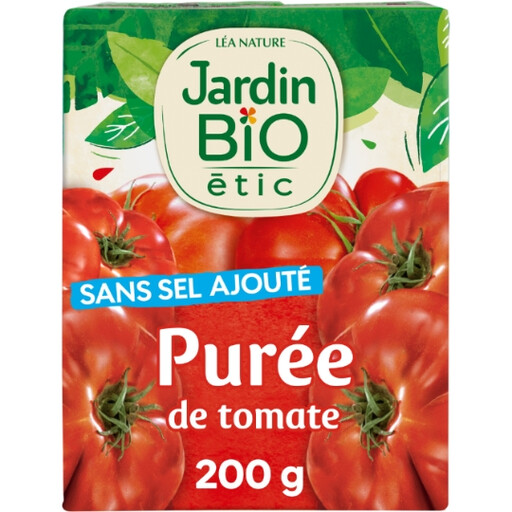 Image unavailable
This 200 g purée is a base for a sauce that you can season yourself. Joybuy’s product listing describes it as having no added salt; check that the quantity is enough for lunch and look at the salt content on the packaging.
No. This claim doesn’t mean the salt content is zero. Auchan’s listing for the 500 g Jardin BiO étic pulp, described as having no added salt, states that it contains 0.02 g of salt per 100 g. So be sure to check the nutrition information too.
Sauces and condiments are among the dietary sources of sodium cited by Anses. To compare two sauces, check their salt content per 100 g and consider how much you plan to serve.
Follow the instructions for the product you buy. Auchan’s listing for the 500 g Jardin BiO étic pulp recommends keeping it in the fridge and using it within 3 days of opening, while its listing for the 500 g Mutti purée says 5 days in the fridge. Check the instructions on your packaging.
No. Compare their salt content per 100 g, product type and pack size too. A ready-made sauce saves you a step, while purée or pulp needs to be turned into a sauce.