People avoiding added sugars
If your priority is avoiding sugar added to the recipe, look for the claim ‘no added sugars’, then read the ingredients and the ‘of which sugars’ line. This claim doesn’t mean the dressing contains no sugar at all.


To choose a salad dressing with sugar content in mind, compare the ‘of which sugars’ line and the ingredients rather than relying on the word ‘light’, which may refer to fat. The DGCCRF advises that nutritional values are given per 100 g or 100 ml, so compare like with like. Then check for the claim ‘no added sugars’ if that’s your priority, and choose a size that suits how much you’ll use.
If your priority is avoiding sugar added to the recipe, look for the claim ‘no added sugars’, then read the ingredients and the ‘of which sugars’ line. This claim doesn’t mean the dressing contains no sugar at all.
If you’re keeping an eye on several aspects of a salad dressing, compare its sugars, fat and salt on the same basis, per 100 g or per 100 ml. A claim about fat alone doesn’t tell you about the sugar content.
If you’ll use the bottle more than once, choose a size you can finish while following the storage instructions after opening. Also check the ingredients and allergens in the recipe you choose.
Start by deciding what matters most: avoiding added sugars, comparing several nutritional values or choosing a size that suits the week ahead. You can consider all these factors, but each calls for a different check.
| Criteria | What to check | Who is it for? |
|---|---|---|
| Added sugars | The ‘no added sugars’ claim, the ingredients list and the ‘of which sugars’ line. | I want to rule out recipes with added sugar without assuming they contain no sugar at all; around 40% of consumers would make this their top priority. |
| Nutritional values | Sugars, fat and salt, using the same unit for the bottles being compared. | If I’m comparing several recipes, I don’t want to choose based on the ‘light’ claim alone; around 30% of consumers would prioritise comparing the nutritional values. |
| Size and storage | The bottle size and storage instructions after opening. | For my weekly shop, I’m looking for a bottle my household can use according to the instructions; around 30% of consumers would put this need first. |
The Amora light vinaigrette featured by Auchan contains honey. So a claim about fat doesn’t answer a question about sugar.
Check which nutrient the claim refers to, then look separately at the ‘of which sugars’ line and the ingredients list.
No added sugars doesn’t rule out sugars that occur naturally in the ingredients of a salad dressing.
If the amount of sugar matters to your choice, check the bottle’s ‘of which sugars’ value too.
The plain light vinaigrette from Auchan featured by the retailer contains mustard, sulphites and milk, among other ingredients. Choosing based on sugar content doesn’t replace checking the other ingredients.
Read the full label, especially for any allergens that affect you, and check the salt value.
Once opened, a bottle should be used according to the product’s own instructions. The plain light vinaigrette from Auchan should be refrigerated after opening and is best used within a month.
Before choosing a size, check these instructions and consider whether your household will use the bottle within the recommended time.
The Carrefour product pages consulted list balsamic and shallot varieties carrying the ‘no added sugars’ claim.
Auchan offers a light mustard and honey vinaigrette in a 38 cl bottle.
The 50 cl plain light vinaigrette featured by Auchan lets you look at the ingredients and nutritional information for a specific product side by side.
E.Leclerc features the ECO+ plain light vinaigrette in a 1 L bottle.
Aldi offers Dilecta plain, mustard and herb vinaigrettes in 500 ml bottles.
This red wine variety could be included in a comparison of salad dressings for the week. Its name alone isn’t enough to conclude that it has reduced sugar content: check its nutritional information and ingredients based on what matters most to you.
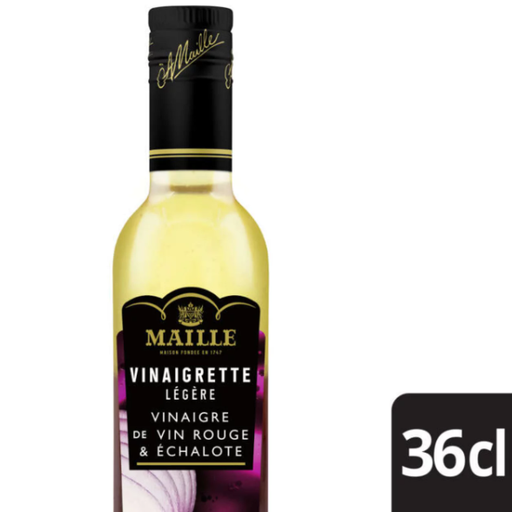 Image unavailable
To compare this dressing with other recipes, check the ‘of which sugars’ line on the same basis and read the ingredients if you want to avoid added sugars.
Size: 36 cl. If mustard or sesame is a concern for you, check the allergen information on the label.
No: a salad dressing carrying the ‘no added sugars’ claim may contain sugars that occur naturally in its ingredients. If the amount shown matters to your choice, check the ‘of which sugars’ line too.
No: the claim may refer to fat rather than sugars. The Amora light vinaigrette featured by Auchan contains honey, among other ingredients; compare the ‘of which sugars’ value for each recipe you’re considering.
For a straightforward comparison between two salad dressings, use values given in the same unit. The DGCCRF says that nutritional information is provided per 100 g or 100 ml; don’t treat these two bases as directly equivalent.
Check the allergens listed for the specific recipe you’re buying. The plain light vinaigrette featured by Auchan contains mustard, sulphites and milk, among other ingredients. The DGCCRF advises that allergenic ingredients must be highlighted on the labels of prepacked foods.
Choose a size that suits how you plan to use it and follow the storage instructions for that bottle after opening. For example, the plain light vinaigrette featured by Auchan should be refrigerated after opening and is best used within a month.