
Livraison le jour même ou le lendemain

Qualité garantie

Débloquez vos offres de bienvenue: Livraison GRATUITE | Jusqu'à -80 % | 30 jours d'essai gratuits à JoyPlus
Téléchargez l'application
A baby walker and grow-with-me tricycle can support several stages of a child’s development, from their first steps to their first turns of the pedals. The key is choosing a model that genuinely adapts as they grow. A product that looks appealing in photos can quickly prove bulky, impractical or poorly suited to everyday use.
Before placing your order, three common pitfalls are particularly worth avoiding.
A push-along walker is generally suitable for a child who can already stand and is beginning to move around while holding on to something. The models featured here are designed for use from 9, 12 or 15 months, depending on their design. The manufacturer’s recommended age must always be followed, especially where small parts or a removable activity panel are involved.
With a grow-with-me baby tricycle, the approach is different: an adult can initially push the child, who can then gradually learn to steer and pedal. Pedals that can be disengaged, a footrest and an adjustable seat allow the tricycle to adapt to their abilities, rather than assuming they will be able to pedal from their very first outing.
Focus on practical features that are easy to check:
Some tricycles mention EN 1888-1 certification, a European standard that applies to pushchairs. This does not replace reading the instructions or checking that the product is being used as intended by the manufacturer. A tricycle with safety harness must remain under adult supervision, on a stable surface and away from stairs, traffic and bodies of water.
A wooden baby walker can be a good choice for homes looking for a sturdy toy without batteries or a mains connection. Rubberised wheels reduce noise and help minimise the risk of marking certain floors. However, you still need to check the screws and joints regularly.
Tricycles with metal frames are often better suited to regular outdoor use. However, be sure to consider their weight, width, any folding mechanism and how easy they are to clean. A washable cover, rear basket or removable bag can be particularly useful day to day, especially for carrying snacks and your child’s essentials.
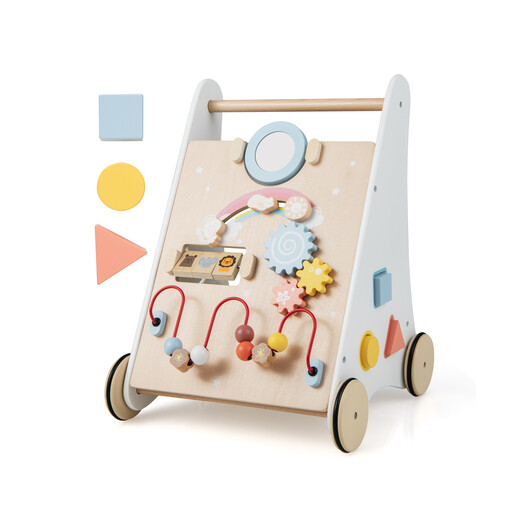
Why it’s a smart choice : It’s ideal for families looking for a battery-free developmental and motor-skills toy that can be used at home from 12 months.
Its push-along walker design focuses on simplicity rather than an overload of electronic features. The rubber-edged wheels are designed to reduce noise and minimise slipping.
A wooden frame, integrated activities, a rear basket and a compact 34,5 × 32,5 × 45 cm format.
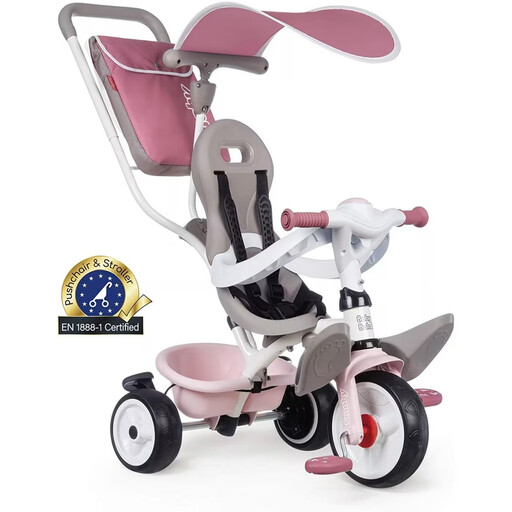
Why it’s a smart choice : This model is designed for families who want to keep using the same tricycle for supervised walks and then for their child’s first independent outings.
The parent handle is removable, while the freewheel system at the front stops the pedals from turning when an adult is pushing.
A harness, safety bar, retractable footrest, parking brake and quiet EVA wheels.
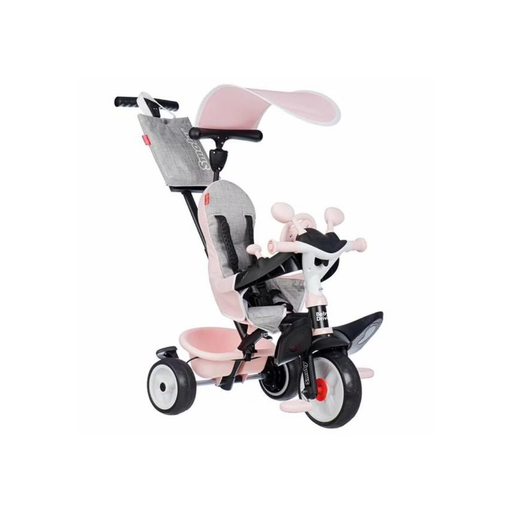
Why it’s a smart choice : It’s designed for regular outings, with features that improve your child’s comfort and make everyday use easier for the adult.
The parking brake, harness and activatable controls clearly distinguish push-along mode from independent mode.
An adjustable handle reaching 98 cm, an adjustable UV-protective canopy, a washable padded seat, a removable bag and a rear basket.
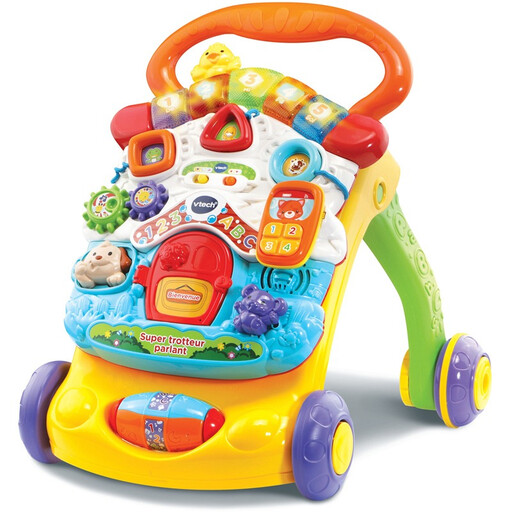
Why it’s a smart choice : It combines an activity centre and a push-along walker for families looking for a fun piece of equipment that can be used from 9 months.
The wheel speed adjustment lets you adapt movement to your child’s abilities. The activity panel can be removed.
Two modes of use, light-up buttons, gears, a shape sorter and interactive sounds. Use on a flat surface and under adult supervision.
We’ve put together a complete, real-time-updated selection of products that meet these demanding criteria and European safety standards.
No. You need to consider the recommended age, your child’s ability to sit or stand and the environment in which the product will be used. Sounds and activities are play features, not an indication of your child’s ability to walk. Adult supervision remains essential.
It all depends on the model, your child’s size and the adjustments available. Some can accompany your child from 10 months to over 3 years, while others are designed for use from 15 months or 2 years. Before each change of configuration, check the weight limit, seat height and the manufacturer’s recommendations.
After every outing, remove any dirt caught in the wheels and check the screws, brakes, pedals and locking systems. Clean the frame with a slightly damp cloth. Removable covers should be washed according to their care label. Store the tricycle away from damp and never use a model if any part is loose or damaged.