
Livraison le jour même ou le lendemain

Qualité garantie

Débloquez vos offres de bienvenue: Livraison GRATUITE | Jusqu'à -80 % | 30 jours d'essai gratuits à JoyPlus
Téléchargez l'application
On a long journey in a motorhome, caravan, or with a trailer, tire pressure deserves regular monitoring. Low pressure, rising temperature, or a slow leak can go unnoticed between stops. Installed in the cabin, an RV tire pressure monitoring system displays this information in real time and can trigger a tire pressure alarm as soon as a value exceeds the defined thresholds.
However, not all RV TPMS systems are created equal. The number of sensors, maximum supported pressure, wireless range, and valve type are all important points to check before placing an order.
A kit equipped with four sensors is generally suitable for a car or a small four-wheel trailer. However, a motorhome with dual rear wheels, a multi-axle caravan, or a vehicle-and-trailer combination may require an RV TPMS with 4 or 8 sensors, or even more.
Be cautious with kits advertised as including six sensors: the actual contents of the box may sometimes differ from the commercial product title. The number of wheels being monitored should match the number of sensors actually supplied.
The bodywork, metal chassis, and distance between the rear wheels and the display can weaken the signal. On a caravan or a long vehicle, an extra TPMS signal repeater can make all the difference. Also check the maximum supported distance, which is sometimes listed in feet rather than metres.
A system advertised for 20 feet covers approximately 6.1 metres. If your vehicle or towing setup is longer, choose a solution designed for a greater range, with a repeater included or available separately.
External tire sensors screw directly onto the valves, replacing the standard valve caps. The models featured here are recommended for use with metal valves, which are better suited to a screw-on sensor than an ageing, worn, or cracked rubber valve.
The measurement range must also cover the pressure actually used. A system limited to 116 PSI, or approximately 8 bar, may not be suitable for a truck or semi-trailer whose tires require higher pressure.
A reliable tire pressure monitor should display, at a minimum:
Some models use automatic calibration of the reference pressure. Product specifications mention thresholds of -15% for low pressure and +25% for high pressure. These values should be calculated from the vehicle manufacturer’s recommended pressure, not from a personal estimate.
Systems operating at 433.92 MHz transmit information wirelessly between the sensors and the display. To monitor the tires on a long vehicle combination, a repeater installed between the vehicle and trailer can improve reception.
Before setting off, check the position of each sensor on the display. A front-left wheel identified as the rear-right wheel, for example, could make an alert difficult to interpret when it matters most.
Displays are generally recharged via USB-C. External sensors use coin-cell batteries, notably CR1632 or CR2032 batteries. Battery life varies by model and usage conditions: around two years for some Tymate kits and up to four years for certain GUTA kits.
Sensors should remain properly screwed on without being overtightened. Check their condition regularly, particularly after travelling on damaged roads or in conditions likely to cause exposure to mud and gravel.
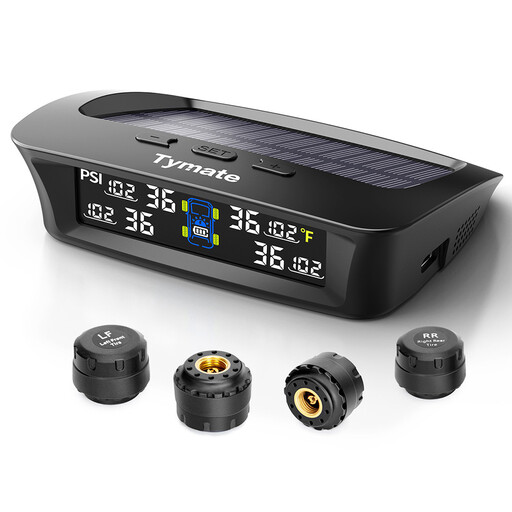
Why this choice suits this profile: a straightforward setup for a small car, a light towing configuration, or a vehicle under 20 feet, approximately 6.1 metres.
The product listing clearly states a maximum length of 20 feet and four sensors. This model is therefore best avoided for a large motorhome or semi-trailer.
Advertised range of 0 to 116 PSI, colour LCD display, temperature monitoring from -20 to 85 °C, and replaceable CR1632 batteries.
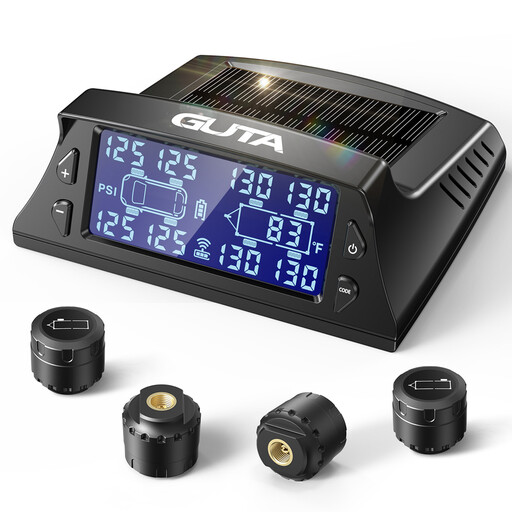
Why this choice suits this profile: it is designed for motorhome, caravan, and under-20-foot vehicle owners looking for a broader pressure range.
Its advertised range of 0 to 199 PSI reduces the risk of choosing a monitor that is incompatible with highly inflated tires.
Rapid-leak, pressure, and temperature alarms, automatic calibration, backlit LCD display, and CR2032 sensors.
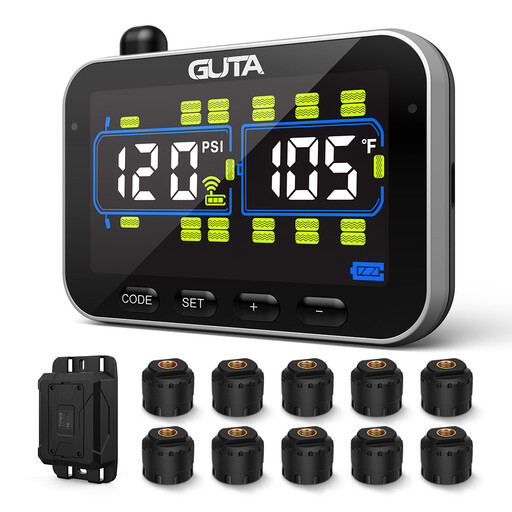
Why this choice suits this profile: this configuration is suitable for combinations with numerous wheels, long trailers, and certain professional or fleet applications.
The ten sensors and repeater address the challenges associated with distance and multi-axle vehicles, provided it is used with a 12 V vehicle under 50 feet.
0 to 203 PSI range, six advertised alarm modes, 78 × 44.5 mm display, and advertised battery life of approximately 15 hours under intensive use.
Why this choice suits this profile: it allows more wheels to be monitored on a motorhome towing a trailer or on a vehicle with multiple axles.
The kit includes ten pre-paired sensors and a repeater. It is still essential to check compatibility with the recommended pressure and metal valves.
Monitoring from 0 to 203 PSI, advertised temperature range of -40 to 105 °C, CR2032 battery, and stated compatibility with vehicles under 50 feet.
We have brought together an up-to-date selection of products meeting precise technical criteria for trailers, caravans, and recreational vehicles used in France.
Before your first journey, fully charge the display and check the pressure using a reliable gauge. Install each sensor on the corresponding valve, then verify that its position is correctly identified on the display. On a long trailer, position the repeater between the wheels and the display, following the manufacturer’s recommendations.
The CE and RoHS markings shown on the product listings correspond to the declarations of conformity provided for these references. They do not replace the manufacturer’s recommendations or manual tire inspections. A TPMS is a monitoring tool: it does not eliminate the need to inspect the condition of the sidewalls, tread depth, and wheel fastening.
Yes, particularly when the caravan wheels are far from the driver. A system with a separate display and repeater can show pressure and temperature during the journey. Simply make sure to choose a number of sensors that matches all the wheels you need to monitor.
Technical specifications indicate approximately two years for the CR1632 batteries used in certain Tymate models, and up to around four years for the CR2032 batteries in some GUTA models. Battery life depends on usage frequency, temperature, and storage conditions. A low-battery alert indicates when replacement is due.
Not directly if the system is designed for a 12 V power supply. Some 24 V vehicles may require a suitable converter, but this setup must be confirmed before purchase. Also check that the system’s pressure range covers the pressure recommended for the truck’s tires.