
Livraison le jour même ou le lendemain

Qualité garantie

Débloquez vos offres de bienvenue: Livraison GRATUITE | Jusqu'à -80 % | 30 jours d'essai gratuits à JoyPlus
Téléchargez l'application
Hitting the road in an RV is the ultimate freedom. But that freedom rests on a fundamental pillar: the safety of your tires. An RV TPMS (Tire Pressure Monitoring System) isn't a gadget—it's your safety co-pilot. However, the market is flooded with models unsuitable for the unique demands of recreational and heavy-duty vehicles, leaving you vulnerable to unpleasant surprises.
As a Product Expert at Joybuy, my mission is to help you navigate the options. Here are the pitfalls to avoid and the criteria to check to make the right choice.
Too many RV or trailer owners end up with an unusable monitoring system shortly after purchase. Here’s why:
To avoid falling into these traps, here are the technical specifications on which you must be uncompromising.
For a trailer TPMS or any vehicle over 6 meters long, a signal repeater isn't an option—it's essential. This small device, ideally placed near the rear axle, captures the signal from the furthest sensors and powerfully relays it to the display in the cab. A good wireless tire pressure monitor for large vehicles must offer this option or include it by default. Most reliable systems operate on the 433.92MHz frequency, which provides the best balance of range and obstacle penetration.
This is the non-negotiable criterion. Ensure the system's monitoring range fully covers the pressures recommended by your vehicle's manufacturer. For an RV or a heavy-duty TPMS, aim for a range up to 13 or 14 bar (approximately 200 PSI). This ensures the system can not only handle your operating pressures but also alert you to critical over-inflation. An accuracy of < 2 PSI (about 0.1 bar) is a hallmark of reliability.
It all depends on your setup. A semi-integrated or fully integrated RV has 4 or 6 tires. If you're towing a caravan or trailer, you'll need additional trailer pressure sensors. Opt for an RV tire pressure monitoring system that allows you to add sensors with ease. Some systems can manage up to 24 tires, making them perfect for fleets or the largest rigs.
Let's get practical. Here are a few solutions that meet the needs of specific types of travelers, based on the reliability criteria we've just discussed.
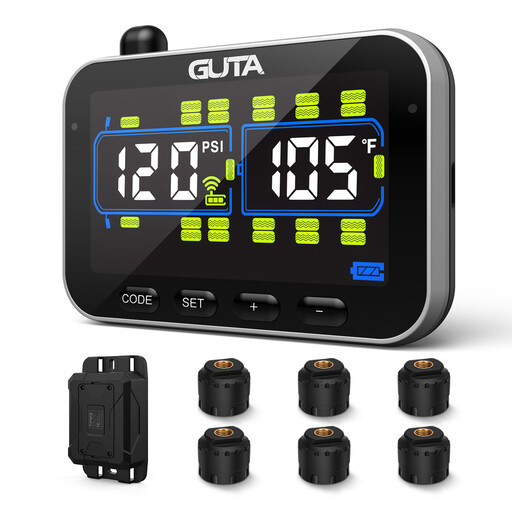
Why we chose it: Perfect for single or dual-axle RVs (up to 6 tires). This kit is an all-in-one solution that includes everything needed for reliable monitoring on a medium to large vehicle.
The included repeater ensures a stable signal, even on the longest vehicles. Its pressure range of up to 14 BAR (203 PSI) is perfectly calibrated for RV tires, eliminating any risk of incompatibility.
A complete, factory pre-paired solution for a quick installation. The color display is highly readable, and the 6 alarm modes (fast leak, low/high pressure, etc.) ensure 360° monitoring.
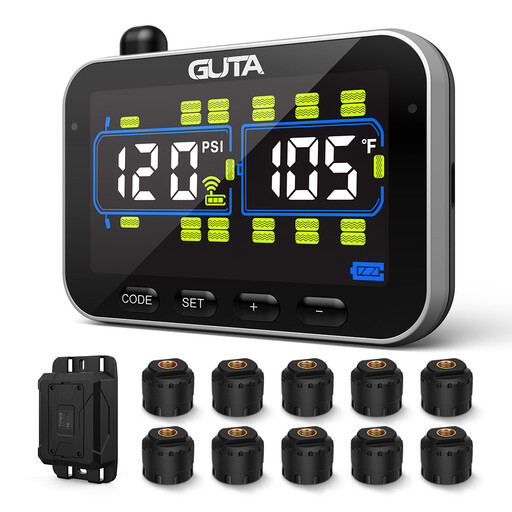
Why we chose it: Designed for large setups: an RV with a car hauler trailer, a dual-axle caravan, or a small truck. With its 10 sensors, it covers the entire rig without compromise.
This kit is designed for vehicles up to 15 meters (50 feet) long thanks to its powerful signal repeater. It is expandable up to 24 tires, offering maximum flexibility for the most complex configurations.
Modularity and simplified maintenance. The external sensors use standard CR2032 batteries, which are very easy to replace (with a lifespan of about 4 years), protecting you from the costly maintenance trap.
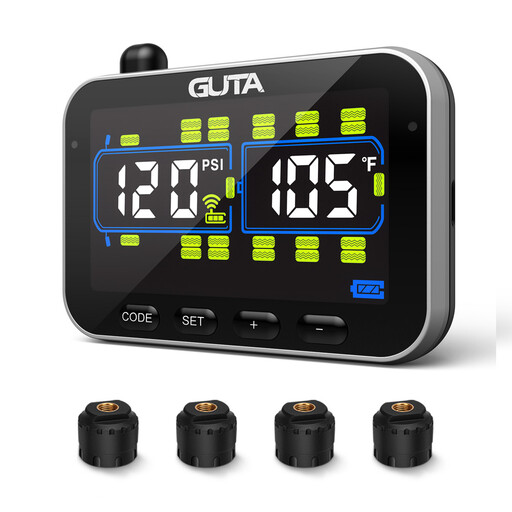
Why we chose it: The smart, cost-effective choice for vans, van conversions, or small semi-integrated RVs (4 tires) that still require high-quality, high-pressure monitoring.
It retains the same high-pressure range (0-14 BAR) as its larger counterparts, avoiding the critical incompatibility trap. Designed for shorter vehicles (under 6 meters), it operates without a repeater, which is perfectly suited for this use case.
Access to professional-grade monitoring at an accessible price point. The system remains scalable: if you add a small trailer, a repeater can be purchased separately.
We have curated a complete selection of products that meet our strict criteria for reliability and safety.
Battery life varies by model and usage, but for external sensors, you can generally expect 2 to 4 years. Quality RV systems favor standard, user-replaceable batteries (like CR1632 or CR2032). A system that alerts you to the sensors' battery level is a major plus for avoiding unpleasant surprises.
On the robust metal valves found on most RVs and heavy-duty vehicles, the risk is virtually non-existent. External sensors are very lightweight (typically under 10 grams). As a precaution, however, you should still inspect the condition of your valves before installation, especially if they are rubber, to check for any cracks or signs of wear.
Not at all. Modern systems are designed to be installed by anyone in minutes. The external sensors simply screw onto the valves in place of the caps. The models we recommend are often pre-paired at the factory, so the display automatically recognizes each sensor. All that's left is to mount the display on your dashboard and, if your kit includes one, plug the repeater into a 12V outlet.