
Livraison le jour même ou le lendemain

Qualité garantie

Débloquez vos offres de bienvenue: Livraison GRATUITE | Jusqu'à -80 % | 30 jours d'essai gratuits à JoyPlus
Téléchargez l'application
For any owner of an RV, caravan, or trailer, safety on the road is non-negotiable. A tire blowout while driving can have disastrous consequences, not only for your vehicle but also for your safety and that of other road users. This is where the RV TPMS (Tire Pressure Monitoring System) comes in, a piece of equipment that has become essential.
However, the market is saturated with options, and it's easy to fall into traps that make a purchase useless, or even dangerous. As a Product Expert at Joybuy, my role is to help you navigate the options. To help you avoid any unpleasant surprises, here are the mistakes to avoid and the essential criteria to check to make an informed choice.
Before you even start comparing features, you need to know how to spot the deal-breakers found in many models that are completely unsuitable for recreational or commercial vehicles.
To ensure you choose an RV tire pressure monitoring system that is truly reliable, three technical parameters are essential.
The very first thing to check is the pressure range supported by the system. For an RV or commercial vehicle, opt for a model capable of measuring pressures up to 13 or 14?bar (approximately 188 to 203?PSI). This ensures compatibility with the majority of heavy-duty vehicle tires.
Next, determine the number of sensors you need. A standard RV might only need 4 sensors. However, if you have a dual-wheel rear axle or are towing a caravan, a 6-sensor TPMS kit (or 8, 10...) becomes essential for complete monitoring.
For vehicles over 7?metres long or for any setup with a trailer, a signal repeater is no longer an option—it's a necessity. This small unit, which simply plugs into a 12V socket at the rear of the towing vehicle, amplifies the signal from the furthest sensors to ensure stable communication with the display. A wireless TPMS equipped with a repeater is the only way to guarantee reliable operation for a trailer tire pressure monitor or for heavy-duty truck tire pressure monitoring.
A good system does much more than just display the pressure. It must alert you clearly and immediately in case of danger via several types of tire pressure alarms. The essential alerts are:
To illustrate these criteria in practice, here is our selection of systems suited for different needs.
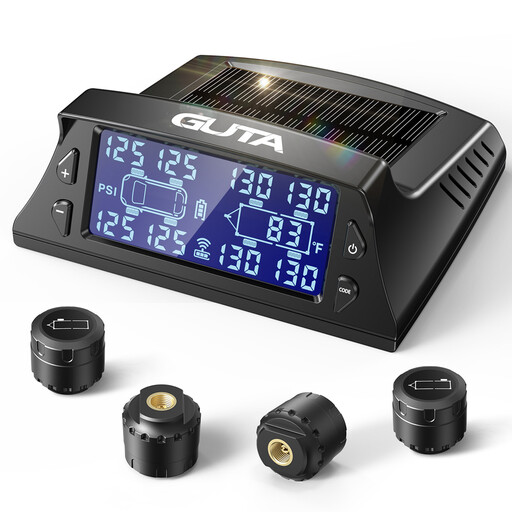
Why this choice? A simple and reliable solution for standard low-profile or A-class motorhomes. It gets straight to the point, with no frills.
Its pressure range of up to 13 bar (188 PSI) is perfectly calibrated for RV tires, unlike models designed for cars.
Ultra-simple screw-on installation, 5 types of alerts, and an automatic sleep mode to optimise battery life.
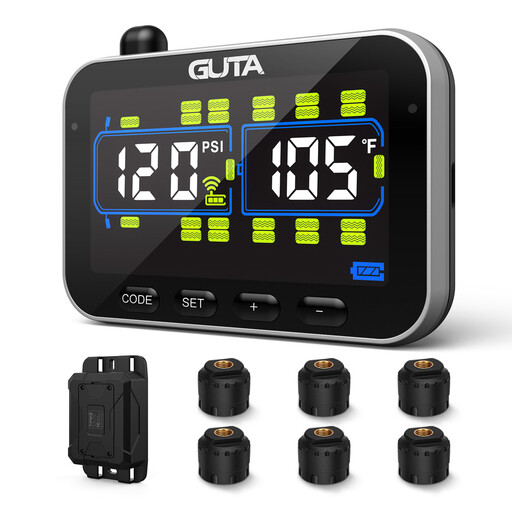
Why this choice? The solution designed for large vehicles, towing setups, or dual wheels. This kit includes everything you need to stay safe on long journeys.
The included signal repeater puts an end to communication loss on vehicles over 7 metres or with a trailer.
Large, easy-to-read colour display, 6 factory-paired sensors, and 6 types of alerts for total peace of mind.
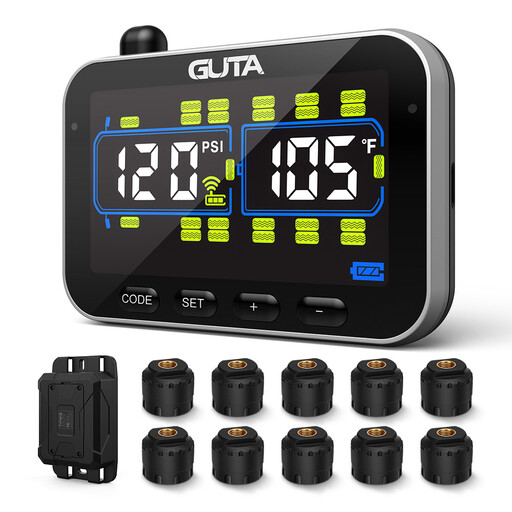
Why this choice? The ultimate configuration for heavy-duty RVs, semi-trailers, and road trains that require monitoring a large number of tires.
It offers a turnkey solution for heavy-duty truck tire pressure monitoring, with a suitable pressure range and enough sensors to equip up to 10 wheels.
The system is expandable (up to 24 tires) and the sensors are pre-paired to radically simplify installation, even on multi-wheel configurations.
Discover our full selection of products that meet our reliability criteria and current safety standards.
Battery life varies depending on the sensor model and the battery used, but it generally ranges from 2 to 4 years. For example, a sensor with a CR2032 battery can last up to 4 years, compared to about 2 years for a model with a CR1632 battery. The major advantage of the systems we recommend is that these batteries are standard and very easy to replace yourself.
The rule of thumb is simple: if the distance between the furthest sensor (usually the rear wheel of the trailer or RV) and your dashboard exceeds 7 metres, a repeater is no longer an option—it is essential. It counteracts signal loss caused by distance, interference, or the vehicle's metal structure, thereby guaranteeing the immediate transmission of any critical alert.
Yes, absolutely. External sensor systems are specifically designed to be installed by anyone. The process is child's play: simply unscrew the original valve caps and replace them with the TPMS sensors. Most kits even provide a small tool to tighten an anti-theft lock nut. However, remember to check the condition of your valves, especially if they are rubber. For greater safety and durability, metal valves are often recommended.