
Livraison le jour même ou le lendemain

Qualité garantie

Débloquez vos offres de bienvenue: Livraison GRATUITE | Jusqu'à -80 % | 30 jours d'essai gratuits à JoyPlus
Téléchargez l'application
Hitting the road in an RV is the ultimate taste of freedom. But with that freedom comes a great responsibility?: ensuring your vehicle's safety, especially as the miles add up. A puncture or even simple under-inflation on the highway can quickly turn a dream getaway into a total nightmare. Proper tire pressure is crucial, not only for your safety but also for improving your fuel economy and extending the life of your tires.
This is where a Tire Pressure Monitoring System (TPMS) becomes invaluable. This guide is designed to help you navigate the complex market of available models and to present our selection of the best RV TPMS solutions, whether you're driving a camper van, an A-class motorhome, or a rig with a trailer.
Before diving into our top picks, let's break down the features that truly make a difference. Here are the three key points to check to make the right choice.
The first criterion is straightforward?: how many tires do you need to monitor?? For a standard RV, you'll need 4 to 6 sensors. If you're towing a caravan or trailer, you'll need a trailer tire pressure monitoring system with 8, 10, or even more sensors. Also, remember to check the pressure range (in Bar or PSI) supported by the system. A TPMS for a truck or large motorhome must be able to measure much higher pressures than a standard car. Most consumer models rely on an external tire pressure sensor, which simply screws onto the valve stem, making installation easy for anyone.
Communication between the sensors and the monitor is wireless. For long vehicles, such as A-class motorhomes or rigs with trailers, the distance can weaken the signal. A good wireless tire pressure monitor must therefore ensure a stable transmission. This is why many kits for large vehicles include a signal repeater. This small device, usually plugged into a 12V socket at the rear of the vehicle, boosts the signal from the farthest sensors to ensure flawless communication with the display unit in the cab.
A good system does more than just display the pressure?: it must trigger a clear and immediate tire pressure alarm if a problem occurs. The most common alerts are?:
As for the monitor's power supply, there are two main options?: USB connection (often Type-C on recent models) and solar charging. The latter provides excellent battery life and avoids cluttering the dashboard with cables.
Our editorial team has carefully reviewed several models to bring you a selection that meets a variety of needs. Reliability, ease of use, and genuinely practical features were our top priorities.
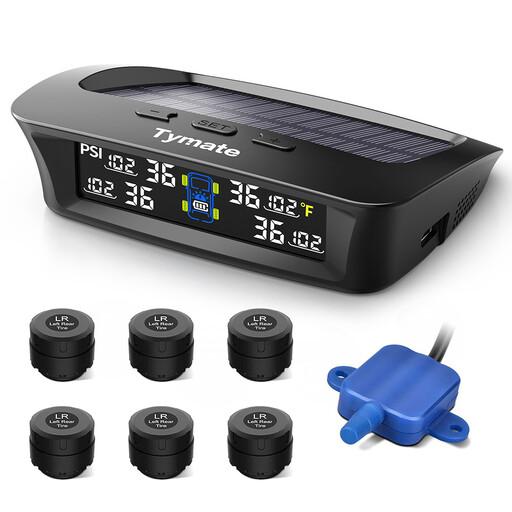
Why it stands out?: This system is the perfect choice for owners of medium-sized RVs or those towing a small trailer. Supplied with 6 sensors and a repeater, it easily covers vehicles up to 15 metres long. Its colour LCD screen is very clear, and the monitor recharges via a solar panel, with a USB-C port for backup.
Highlights?:
Who is it for? Ideal for owners of low-profile, over-cab, and van conversion motorhomes, as well as those towing a dual-axle trailer.
See details for the Tymate 6-sensor product
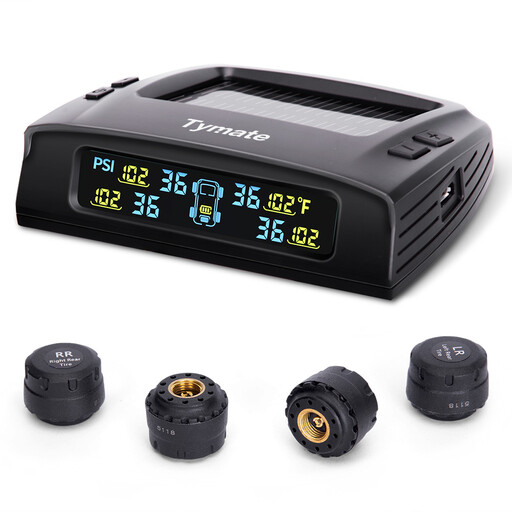
Why it stands out?: A more compact version designed for shorter vehicles. With its 4 sensors, it retains the strengths of its bigger sibling, such as the smart back-lit colour screen and 6 alarm modes. Its solar-powered monitor makes it especially discreet for daily use, with no cables to manage.
Highlights?:
Who is it for? Perfect for owners of vans, compact camper vans, SUVs, or family cars who want to keep an eye on their tires with ease.
See details for the Tymate 4-sensor product
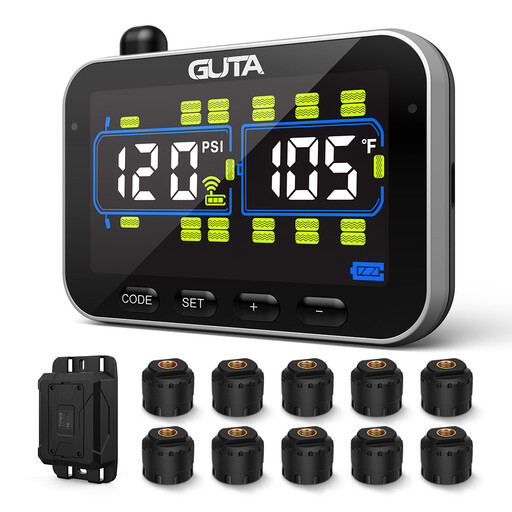
Why it stands out?: Built for extra-large rigs, this GUTA system is an ultra-robust solution. With 10 included sensors and the ability to manage up to 24, it's aimed at large motorhomes, heavy trailers, and even small truck fleets. Its extended monitoring range of up to 188 PSI (13 Bar) and included repeater make it a top choice for the most demanding applications.
Highlights?:
Who is it for? For owners of large motorhomes (liners), fifth-wheel trailers, semi-trailers, and managers of small commercial vehicle fleets.
See details for the GUTA 10-sensor product
Our selection is just a starting point to get you on the right track. If you haven't found what you're looking for or have more specific needs (a different number of sensors, advanced features, etc.), many other solutions are available.
? Discover our full range of tire pressure monitors
An external tire pressure sensor screws directly onto the valve stem, replacing the original cap. Its biggest advantage?? Installation and battery changes are incredibly simple. In contrast, an internal sensor is mounted inside the tire, replacing the valve. While better protected from theft and impacts, it must be installed by a professional during tire mounting.
Most consumer systems, like the ones in our selection, use external sensors. Installation is a breeze?: just screw each sensor onto the correct valve (they are often pre-configured at the factory), mount the display on your dashboard, and, if necessary, plug in the repeater. It takes about fifteen minutes, all in all.