
Livraison le jour même ou le lendemain

Qualité garantie

Débloquez vos offres de bienvenue: Livraison GRATUITE | Jusqu'à -80 % | 30 jours d'essai gratuits à JoyPlus
Téléchargez l'application
Hitting the road in an RV is the definition of pure freedom. But when you're on the move, safety is non-negotiable. A simple slow leak or, worse, a tire blowout on the highway can turn a dream trip into a nightmare. This is precisely where a Tire Pressure Monitoring System, or RV TPMS, comes in?— an essential piece of equipment.
This guide breaks down how these systems work and helps you choose the perfect model for your recreational vehicle, whether you have a motorhome, a caravan, or a trailer setup. The goal? To give you everything you need to make the right choice, with complete confidence.
To ensure you make the right choice, several technical criteria must be considered. These will guarantee the system's effectiveness and its perfect compatibility with your setup.
First step: how many tires do you need to monitor? A standard RV will only need 4 sensors. However, if you're towing a caravan or trailer, a 6-sensor TPMS (or more) is a must. Make sure the model you choose can handle the total number of wheels in your setup. The simplest and most common solution is pressure monitoring with external sensors: they simply screw onto the valve stems in place of the original caps.
On a vehicle as long as an RV, and even more so with a trailer, the distance between the furthest sensors (like those on the trailer) and the in-cab display is a real challenge. The quality of the wireless TPMS is therefore crucial to ensure a stable transmission. This is why many kits for recreational vehicles include a signal repeater. This small device, placed in a strategic location on the chassis, relays and amplifies the sensor signal to ensure perfect communication with the monitor, thus preventing any data loss.
A good tire pressure alarm system does more than just display numbers. It must alert you instantly and unambiguously in case of an issue. Prioritise models that offer clear and distinct alerts for:
The display itself should be perfectly readable day and night, with clear icons to immediately identify the faulty tire.
To guide you, we've reviewed several models available on the market. Here are the ones that caught our eye for their performance, ease of installation, and suitability for RV owners.
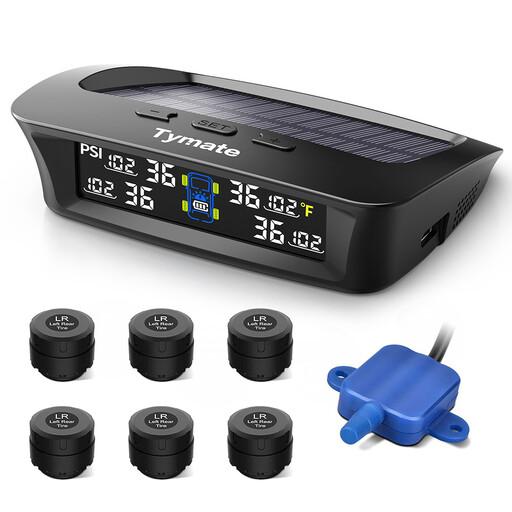
Why It Stands Out This system is a turnkey solution, specially designed for RVs with a trailer. Supplied with 6 sensors and a signal repeater, it ensures reliable tire pressure monitoring, including on the trailer, for vehicle combinations up to 15 metres long. Its LCD colour screen and six alarm modes make it a top-tier safety ally.
Advantages
Who is it for? The perfect choice for owners of RVs, caravans, or trailers who want a ready-to-use solution capable of monitoring up to 6 tires with a flawless signal over long distances.
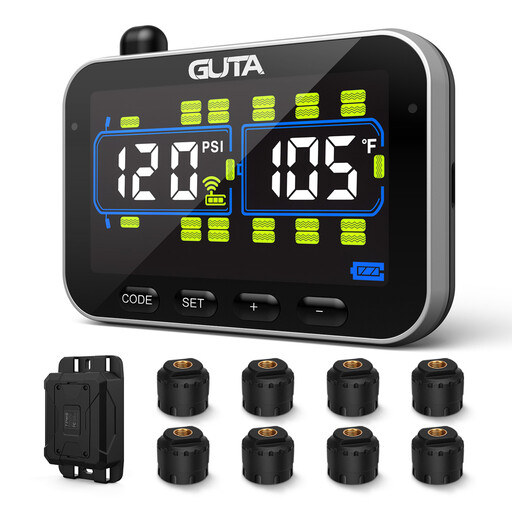
Why It Stands Out The GUTA system is aimed at the largest setups. With 8 sensors and a pressure range supporting up to 13 bar (188 PSI), it is built for large motorhomes (heavy-duty class) and heavily loaded trailers. Its large screen and expandability up to 24 tires (via additional sensors) give it impressive versatility.
Advantages
Who is it for? Perfect for owners of large motorhomes (heavy-duty class), semi-trailers, horseboxes, or for professionals managing a small fleet who need to monitor many tires simultaneously.
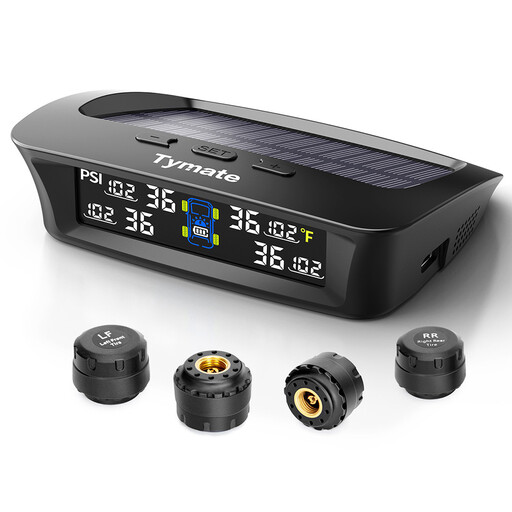
Why It Stands Out This version of the Tymate TPMS is a more compact and affordable option, designed for shorter vehicles. With its 4 sensors, it is ideal for a camper van, a small low-profile motorhome, or a tractor unit alone. It retains the brand's flagship features, such as the colour screen and smart alarms.
Advantages
Who is it for? Ideal for drivers of camper vans, small low-profile motorhomes, or light commercial vehicles who don't have a trailer to monitor and are looking for a simple, reliable, and effective RV tire pressure sensor system.
Is your setup unique, or are you looking for an alternative? Many other solutions are available to keep an eye on your tires' health.
Discover our full range of safety monitors
Not at all. Installing a system with external sensors is incredibly simple. You just need to replace your valve caps with the sensors after screwing on the anti-theft lock nuts (if provided). Pairing with the display is almost always done at the factory. The entire process rarely takes more than fifteen minutes.
Absolutely. Today's external sensors are designed to be both robust and reliable. They are waterproof and can easily withstand road spray. Most kits include anti-theft lock nuts to secure them. As for their accuracy, typically within 0.1 bar (around 1.5 PSI), it is more than sufficient to ensure your safety.
Battery life varies by model, but you can generally expect between 2 and 4 years. Rest assured, the system will warn you well in advance when a sensor's battery is running low, giving you plenty of time to change it. Replacement is a breeze and only takes a few moments.