
Livraison le jour même ou le lendemain

Qualité garantie

Débloquez vos offres de bienvenue: Livraison GRATUITE | Jusqu'à -80 % | 30 jours d'essai gratuits à JoyPlus
Téléchargez l'application
By the Joybuy Team, Your Product Experts
Hitting the road in an RV is a promise of freedom and adventure. But for the journey to remain a pleasure, safety must never be overlooked. An underinflated or overheating tire can quickly turn a dream getaway into a total nightmare. This is precisely where an RV TPMS (Tire Pressure Monitoring System) becomes essential. This device monitors the health of your tires in real time and alerts you to the slightest issue, long before it becomes a critical problem.
This guide is designed to help you navigate the options. We will break down the key criteria for choosing your RV tire pressure monitoring system and present our selection of the best models available today. The goal? To let you hit the road with complete peace of mind.
Price is a factor, but it's far from the only one. To find the system perfectly suited to your vehicle, several technical criteria must be scrutinized.
The first question to ask is simple: how many tires do you need to monitor? A Class A motorhome, a caravan, or a trailer logically requires more sensors than a simple van.
The tires on motorhomes, caravans, and heavy-duty vehicles are inflated to much higher pressures than those on passenger cars. It is therefore essential to choose a TPMS with an appropriate measurement range.
Modern systems are ingeniously designed to simplify power and installation.
To help you make an informed choice, here is a selection of products that meet specific needs, from large motorhomes with trailers to converted vans.
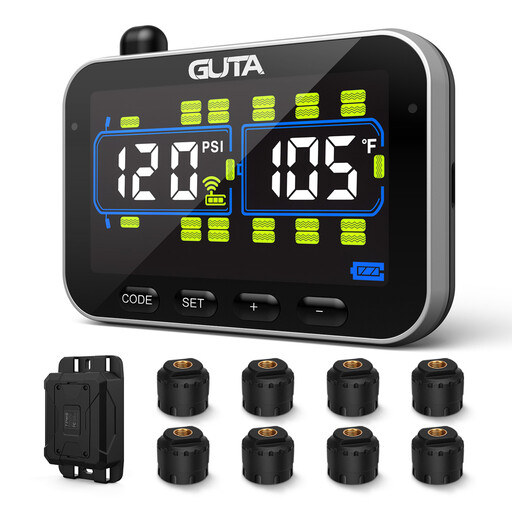
Why It Stands Out This system is built for large rigs. With its 8 sensors and included signal repeater, it ensures reliable monitoring for long motorhomes, setups with a caravan, or even semi-trailers. Its very wide pressure range (0-14 BAR / 0-203 PSI) makes it compatible with almost all heavy-duty vehicle tires.
Pros
Who Is It For? Owners of Class A motorhomes, dual-axle caravans, car haulers, or any towed setup with a total length approaching or exceeding 15 meters (50 feet).
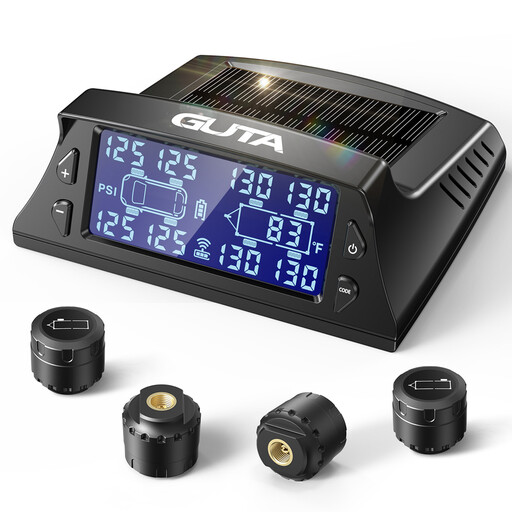
Why It Stands Out This model offers an excellent compromise for mid-sized vehicles. It retains the wide pressure range of its larger sibling (0-13 BAR / 0-199 PSI) but with 4 sensors, making it perfect for a low-profile motorhome, a van, or a single-axle trailer. Its automatic sleep mode and wake-up via vibration detection efficiently preserve its battery.
Pros
Who Is It For? Drivers of low-profile motorhomes, camper vans, or standard-sized trailers (under 7 meters / 23 feet long). For longer vehicles, adding a repeater is highly recommended.
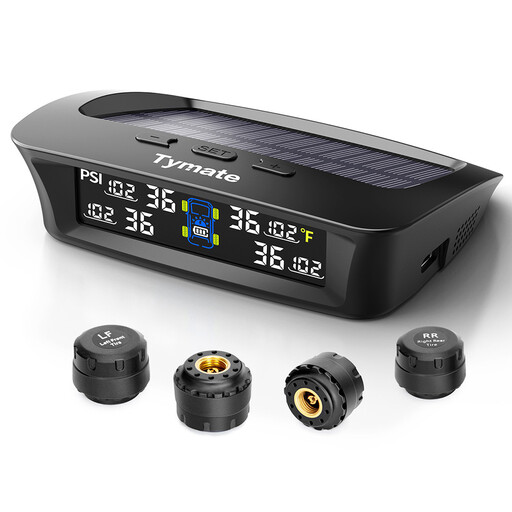
Why It Stands Out An excellent solution for more compact vehicles. Its pressure range (0-8 BAR / 0-116 PSI) is perfectly suited for vans, converted campers, and small towing vehicles. Its key feature? A monitor that recharges with solar energy, reducing cable clutter in the cabin.
Pros
Who Is It For? Ideal for camper vans, small trailers, or for equipping the towing vehicle, provided the total length does not exceed 6 meters (20 feet) and the tire pressure is below 8 BAR.
The market for tire pressure monitoring systems is vast. If the products in our selection don't exactly match your specific setup (number of tires, vehicle type, budget), many other solutions are available.
To explore a wider range of systems with different sensor counts or specific features, feel free to browse our full category.
Explore Our Full Range of Tire Pressure Alarms
No, for privately used recreational vehicles in France, installing a TPMS is not a legal requirement, unlike for new cars since 2014. However, its installation is highly recommended for obvious safety reasons, especially on heavy and long vehicles where a tire failure can have dramatic consequences.
External sensors screw directly onto the tire's valve stem, replacing the cap. They are very easy to install yourself, and their batteries are simple to replace. Internal sensors are mounted inside the tire, replacing the original valve. While better protected against theft and impacts, their installation and battery replacement require a tire professional.
To monitor the tires on a trailer, a repeater is almost essential. The distance between the trailer's tires and the driver's cab, combined with the metal structure of both vehicles, can significantly weaken the signal. As a rule of thumb, for any towed setup or vehicle longer than 7 to 8 meters (23-26 feet), a repeater guarantees reliable and uninterrupted data transmission.