Hosts preparing several topped slices
If you’re planning savoury and sweet toppings, look for a base whose pieces you can count before serving.


When preparing individual portions with toppings, start with the product name, number of pieces and net weight rather than the term “medium sliced”, which on its own doesn’t let you compare the size of each base. Rusks, toasted bread and crispbreads are separate categories to consider. Then choose your recipe and quantity based on the toppings and any ingredients your guests need to avoid.
If you’re planning savoury and sweet toppings, look for a base whose pieces you can count before serving.
When serving a group, the ingredients list and allergen information matter just as much as the recipe or nutritional information.
To match your shop to the number of guests, compare the weight and number of rusks. A box with more pieces doesn’t necessarily contain larger slices.
First decide whether you want rusks or another type of base for your toppings. Then check the recipe and quantity on the specific pack you plan to serve.
| What to consider | What to check | Who it’s for |
|---|---|---|
| Size and shape for toppings | Product name and how the pieces are presented; don’t infer their size from “medium sliced”. | If I’m preparing several toppings, I want individual bases with a shape that suits them. Around 36% of consumers would prioritise this versatility. |
| Ingredients and allergens | Ingredients list, declared allergens and nutritional information per 100 g. | If a guest needs to avoid an ingredient, I need to check the pack being served, even if the recipe name seems familiar. This would be the top priority for around 29% of consumers. |
| How much to serve | Number of pieces and net weight of the pack. | When serving several guests, I want enough portions without choosing a box based on its weight alone. This would be the first consideration for around 21% of consumers. |
| Storage and breakage | Storage instructions and the condition of the pack when you buy it or it arrives. | If I shop in advance, I want to keep the bases dry and have intact pieces ready to serve. Around 14% of consumers would put this first. |
On its own, this term doesn’t provide dimensions you can compare across products. Carrefour and E.Leclerc product listings focus instead on the recipe, weight and number of pieces.
Compare the product name and how the pieces are presented. If the size of each base is important for your toppings, check the pack.
A recipe name alone can’t rule out an allergen. Carrefour’s listing for its wholewheat Carrefour Bio rusks, for example, mentions wheat and wheat gluten.
Before serving someone with an allergy or intolerance, check the ingredients list and declared allergens on the packaging you’ve actually bought.
The products listed by Carrefour and E.Leclerc contain different numbers of rusks; the total weight doesn’t tell you the size of each one.
Decide how many topped slices you want to prepare, then compare both the number of pieces and the net weight.
Broken rusks are less convenient to top and serve as individual portions.
Check the condition of the packaging and the pieces, then follow the storage instructions until you’re ready to serve.
Carrefour lists Heudebert LU rusks in several recipes and pack sizes.
These ranges include different rusk recipes, so compare each product individually.
E.Leclerc lists Epi d’Or wheat rusks as well as other toasted bases under its Marque Repère range.
Auchan’s range distinguishes between rusks, toasted bread, toast and crispbreads.
Auchan lists a Pasquier product made with six cereals and seeds among its rusks.
ALDI France lists a BON&BIO® wheat germ rusk.
This selection includes Heudebert rusks and KRISPROLLS crisp bases to consider for toppings. To plan your serving quantities, check the number and size of the pieces on each pack: the stated weight alone won’t tell you either.
 Image unavailable
A plain rusk to consider for sweet or savoury toppings. The pack is listed as 300 g; check the number and size of the pieces if you need to prepare a specific quantity. Check the allergens on the pack you’re serving, too.
 Image unavailable
A crisp base to consider if you prefer a wholewheat recipe for your toppings. The pack is listed as 425 g; check the number and size of the pieces, as well as the ingredients on the label, before using it instead of rusks.
 Image unavailable
This Swedish crispbread is another option for toppings. The bag is listed as 240 g; to plan portions and account for any ingredients to avoid, check the number and dimensions of the pieces, as well as the product label.
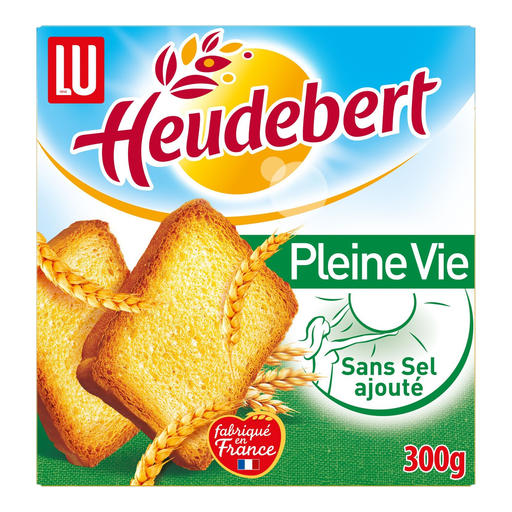 Image unavailable
A Heudebert product to consider as a base for toppings, in a 300 g pack. Don’t rely on the “Unsalted” wording to choose a salt-free recipe: the product information lists salt as an ingredient. Check the pack label, along with the number and size of the pieces.
Check the product name, ingredients list, declared allergens, net quantity and nutritional information. The DGCCRF highlights the importance of this information on food labels. Check the pack you’ve actually bought, especially if a guest needs to avoid an ingredient.
Start with the number of guests and how many topped slices you plan to prepare, then compare the number of pieces and the net weight. Carrefour lists Heudebert boxes containing 32 or 60 slices, while E.Leclerc describes an Epi d’Or product with 108 pieces. These figures alone don’t tell you the size of each rusk.
Follow the product’s storage instructions and check the condition of the pack before preparing your topped slices. Auchan’s listing for Pasquier rusks with six cereals and seeds says to store them in a cool, dry place.