For your family shop, choose the number of rusks to suit how much your household gets through, rather than automatically going for the biggest pack. A family-size pack may be a good choice if several people eat rusks regularly; a smaller pack means less to store when they’re only eaten occasionally. Either way, check the pack size, ingredients and storage instructions for the product you choose.
Who are these pack sizes for?
Families who eat rusks regularly
If rusks are part of breakfast several times a week, work out how many packs your household actually gets through. Auchan and Carrefour product listings include options ranging from 34 to 108 rusks, giving you a useful guide to choosing a suitable amount.
Smaller households keen to avoid waste
If you live alone or as a couple, or only eat rusks occasionally, a smaller pack may be easier to finish. Auchan, for example, lists a Heudebert option with 36 rusks, split into two packs of 18.
Households comparing ingredients
If ingredients or allergens affect your choice, check the ingredients list and nutritional information on the exact pack. The number of rusks alone won’t tell you how much fibre or salt it contains, or which allergens are present.
What should you look for first?
Start with how much your household gets through, then check how the rusks are packed and how they should be stored. Check the ingredients for each product separately, whatever the pack size.
| What matters |
What to check |
Who is it for? |
| How much to stock up on |
Number of rusks, net weight and how quickly your household gets through them. |
When several people eat rusks often, I want to buy enough for the next few breakfasts without building up a pile of packs. Around 42% of consumers put managing household stocks first. |
| Storage |
How the rusks are divided into packs, instructions after opening and whether you have a dry place to store them. |
If we only eat them occasionally, I’d rather be able to finish the pack before the last rusks lose their crunch. For around 33% of consumers, avoiding excess stock and keeping the product in good condition come before other considerations. |
| Ingredients |
Ingredients, allergens and nutritional information per 100 g. |
When the recipe needs to suit my household, I check the ingredients and allergens before choosing a pack size. Ingredients are the top priority for around 25% of consumers. |
Mistakes to avoid
-
Confusing a best-before date with a use-by date
France’s DGCCRF distinguishes between a minimum durability date (DDM), after which some of a product’s qualities may deteriorate, and a use-by date (DLC), which must not be exceeded.
Check the wording on the pack. If the DDM has passed, check that the packaging is intact, inspect the product and consider how it has been stored. Don’t apply this guidance to a product with a use-by date.
-
Choosing based on just one claim on the pack
A claim such as “no added salt” doesn’t tell you about all the ingredients or allergens. The Heudebert and Carrefour products in the listings reviewed contain wheat or gluten; some also warn that traces of other allergens may be present.
Check the ingredients list, allergen information and nutritional details for the product you’re planning to buy.
-
Buying a large pack without planning where to store it
A large number of rusks is only useful if your household can get through them and follow the storage instructions on the pack.
Make room somewhere dry and check how the rusks are divided into packs before choosing a size.
Buying too many may mean more rusks are left open or stored for a long time before they’re eaten.
Brands to consider for different pack sizes and recipes
Heudebert
Auchan lists Heudebert rusks in packs of 36 (2 × 18, 290 g) and 108 (6 × 18, 875 g).
- These two pack sizes make it easier to choose an amount that suits your household’s consumption.
- Check the exact pack format and allergen information for the product you choose. The number of individual packs alone doesn’t tell you how well the rusks are protected after opening.
Carrefour Classic'
Carrefour lists a 300 g pack of 34 plain rusks, as well as an option labelled “No added salt”.
- The product listings let you compare pack sizes and check the ingredients for each option.
- The “No added salt” claim doesn’t mean you can skip checking the ingredients and allergens for that product.
BON&BIO® (ALDI)
ALDI lists BON&BIO® wheatgerm rusks in a 300 g pack.
- This weight gives you another useful point of comparison when looking at pack sizes.
- Check the pack label for ingredients and allergen information.
A rusk option on Joybuy
This 300 g pack is one option to compare when choosing how much to buy for your family. If you’re specifically looking for several smaller individual packs, check the number of rusks and how they’re packed.
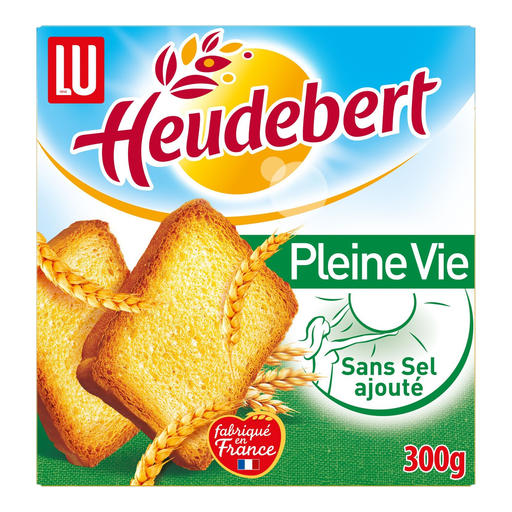 Image unavailable
LU Heudebert Rusks 300 g
This 300 g pack may suit you if you’re comparing a moderate amount with how much your household gets through. Check the pack for the number of rusks and how they’re divided up before assuming they come in several individually protected portions.
The product name suggests these rusks are unsalted, while the associated ingredient information lists salt. If this affects your choice, check the label on the exact product.
View on Joybuy
Frequently asked questions
Should I throw rusks away as soon as their DDM has passed?
No, not automatically. According to France’s DGCCRF, a product with a minimum durability date may have lost some of its qualities after that date. Check that the packaging is intact, inspect the product and consider how it has been stored. A use-by date, on the other hand, must not be exceeded.
How should I choose between 36 and 108 rusks?
Work out how many rusks your household eats before you need to open another pack, then consider whether you have enough space to store them somewhere dry. Auchan lists both sizes for Heudebert rusks: the 108-rusk pack is better suited to regular consumption, while the 36-rusk pack means buying less at once.
Do the products featured contain wheat or gluten?
The Heudebert and Carrefour listings reviewed mention wheat or gluten for the products concerned. Always read the label on the exact pack, including any warnings about possible traces of other allergens.
Does “No added salt” mean “allergen-free”?
No. The Carrefour Classic' product carrying this claim contains wheat or gluten and warns that traces of other allergens may be present. Check the salt claim, ingredients list and allergen information separately.


