Households that eat rusks regularly
If you add toppings to plain rusks every morning, check the net weight and number of slices before choosing a large pack. Make sure the pack size also suits how quickly you’ll use them.


For a budget-friendly sweet breakfast, start with plain rusks in a pack your household can finish without waste, then choose toppings to suit your taste. A brioche-style recipe offers a different flavour; if ingredients are your priority, compare the ingredients and nutritional information for each product rather than assuming that “wholemeal” means “gluten-free”.
If you add toppings to plain rusks every morning, check the net weight and number of slices before choosing a large pack. Make sure the pack size also suits how quickly you’ll use them.
A brioche-style recipe may offer the flavour you’re after with a sweet topping. Check the ingredients, though: the name alone doesn’t tell you how much sugar it contains.
When comparing a wholemeal or cereal-based recipe, or one making a claim about sugar, check the ingredients, allergens and nutritional information for the exact product you’re considering.
First, decide what matters most for your breakfast: how long the pack will last, the flavour of the base, its ingredients or a dietary requirement.
| What matters | What to check | Who is this for? |
|---|---|---|
| Pack size and avoiding waste | Net weight, number of slices and storage instructions after opening. | If rusks are a regular part of my breakfast, I want a pack that suits my household’s needs, without leaving slices to go stale. Around 36% of consumers make managing quantities their top priority. |
| Flavour of the base | The recipe description and ingredients list, particularly for a brioche-style version. | If I don’t add much to my toast, the flavour of the rusk itself plays a bigger part in my choice. This is the top priority for around 29% of consumers. |
| Ingredients | Ingredients, followed by fibre, sugar and salt per 100 g for the products being compared. | I might prefer a wholemeal recipe or check the sugar content of the base carefully before adding a topping. Around 21% of consumers put ingredients ahead of other criteria. |
| Dietary requirement | Highlighted allergens, any “may contain” statement and the characteristics of the exact product. | If I need to avoid a particular ingredient, the label matters more than the product’s appearance or range name. Around 14% of consumers make this their top priority. |
A family-size pack is less practical if your household can’t finish it while it’s still in good condition.
Match the number of slices to how much you usually eat, and follow the storage instructions on the packaging.
A recipe described as having no added sugar may still contain naturally occurring sugars. The 240 g Krisprolls product listed on Joybuy contains 1.1 g of sugar per 100 g.
Check the claim on the pack alongside the ingredients and the “sugars” line in the nutritional information.
Wholemeal rusks may contain wheat. Carrefour’s listing for Heudebert rusks with 96% cereals states that they contain wheat and may contain sesame.
If you need to avoid an ingredient, check the allergens and precautionary statements on the packaging of the product you buy.
The brand features in Carrefour and Auchan ranges, with a choice of recipes including cereal-based and brioche-style options.
Carrefour’s range includes plain, wholemeal, cereal-based and brioche-style rusks, as well as crispbreads.
This Marque Repère range sold by E.Leclerc includes wheat, cereal-based and brioche-style rusks.
Auchan’s range includes wheat rusks, a wholewheat product labelled “no added sugar” and crispbreads.
ALDI France sells 300 g packs of wheatgerm rusks under this brand.
This selection includes wholemeal Krisprolls rusks and crispbread slices to top. To enjoy them as part of a budget-friendly sweet breakfast, start by choosing the type of base you want and a pack size that suits how much you eat.
 Image unavailable
Consider this pack if you regularly use a wholemeal wheat base for your morning toast. Check the packaging for the ingredients, allergens and storage instructions for this pack.
 Image unavailable
This smaller pack is a good option if you prefer to buy fewer wholemeal rusks at a time. The Joybuy listing for this product states that it contains 8.3 g of fibre and 1.1 g of sugar per 100 g, as well as gluten from wheat and barley.
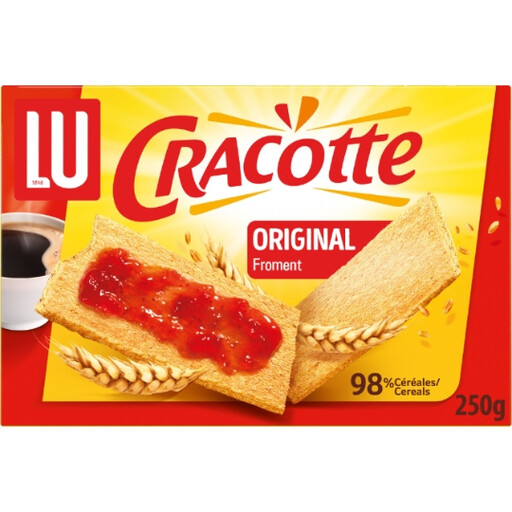 Image unavailable
These crispbread slices offer another base for a slice topped with jam. They’re Cracotte, not rusks, so bear this distinction in mind if you’re looking for a particular texture or product type.
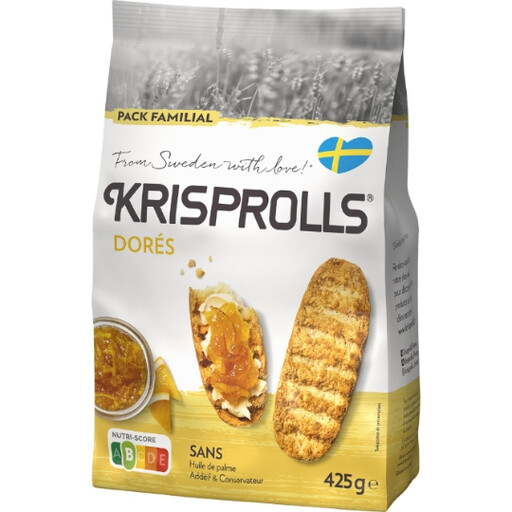 Image unavailable
This 425 g pack can make a crisp base for your favourite toppings. A “no added sugar” claim would conflict with an ingredients list that includes sugar, so check the packaging of the product you buy before relying on this detail.
Choose a pack with a number of slices that suits how much you eat, and store it according to the instructions on the packaging. A large pack is only practical if your household can finish it without waste.
The word “brioche-style” isn’t enough to compare the sugar content of two products. Check the “sugars” per 100 g and the ingredients list for the products you’re interested in.
No. A product with this claim may still contain naturally occurring sugars. Check the “sugars” line in the nutritional information and the ingredients list.
Not necessarily. Carrefour’s listing for Heudebert rusks with 96% cereals states that they contain wheat, while the Joybuy listing for 240 g wholemeal Krisprolls says they contain gluten from wheat and barley. Check the allergens on each pack before choosing a product.
Follow the instructions on the pack you’ve bought. For the 240 g wholemeal Krisprolls, Joybuy recommends sealing the bag tightly after opening and keeping it in a cool, dry place.